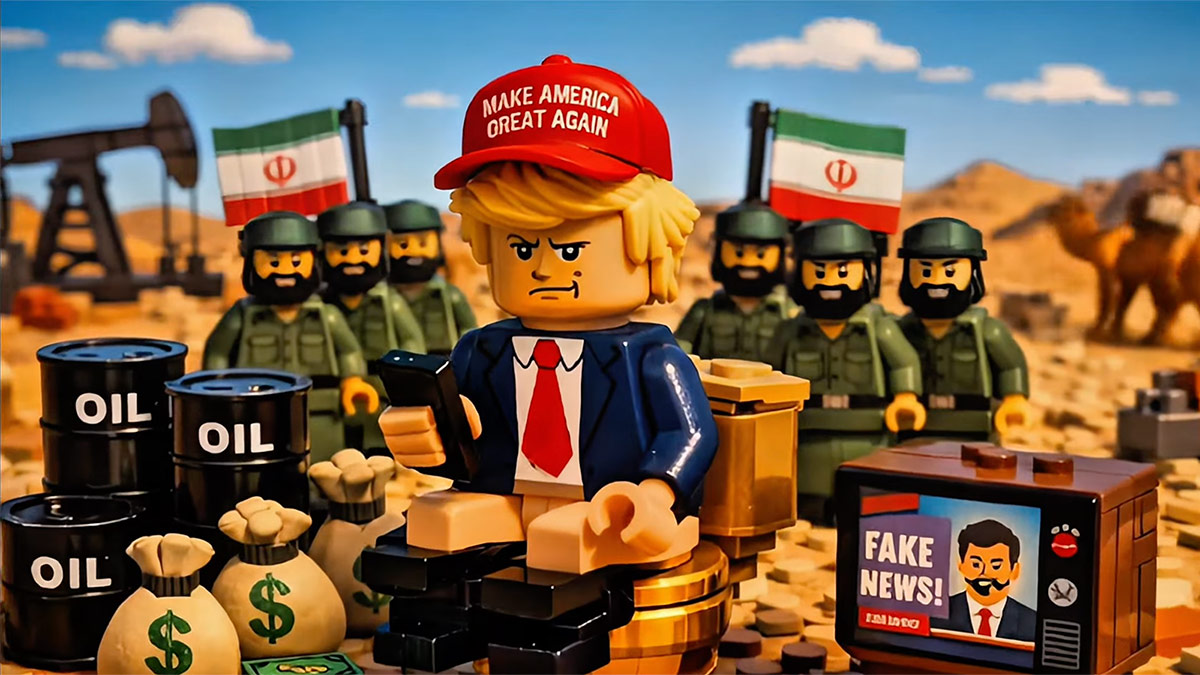
The opening strikes on Iran forced the country’s military to operate without a centralized command structure. Despite this enormous setback, something like a unified approach has emerged, and nowhere is that more evident than on social media.
Iran’s embassies have become meme factories, centers of information warfare churning out images and videos designed to do just one thing: mock the US and Israel and, in particular, Donald Trump. Courtesy of Iran’s overseas missions, we’ve now seen Donald Trump as a minion from Despicable Me; a Lego man fleeing a Lego Jeffrey Epstein; and a Pirate of the Caribbean trying, and failing, to hijack the Strait of Hormuz.
My personal favorite came when Trump called Pope Leo “WEAK” and “terrible” for criticizing the war. To cap this off, Trump posted a meme of himself looking suspiciously like the Son of God, ministering to a sick man, surrounded by adoring onlookers. In response, Iran’s embassy in Tashkent made an AI-video in which the real Jesus appears in Trump’s beatific vision, descending from heaven – and socking him right in the mouth. “YOUR RECKONING HAS COME!” Jesus booms as he delivers his five-finger judgment.
Not all of Iran’s memes have been this good – many have been risible – but even the meme master himself, Donald J Trump, has off days. What’s so striking is how closely Iran’s memes mirror the President’s. Trump’s central message is an America First revolt against globalism. There is a corrupt self-serving establishment that must be destroyed if the American people are to be free at last. Iran’s memes are designed to show that Trump is part of that establishment, that he has betrayed his mission.
Memes have been essential to Trump’s success from the very beginning – everyone knows covfefe, lock her up, and Barney Frank’s very disrespectful nipples. So essential, in fact, that when Trump’s enemies began pursuing those involved in his 2016 underdog victory, they also went after one of his top meme lieutenants, an ordinary dude by the name of Douglass Mackey, a.k.a. “Ricky Vaughn.” He was doxxed, mercilessly hounded by the press and then, days after Biden entered the White House, prosecuted for election interference under a Reconstruction-era anti-Klan law. All for posting memes on Twitter.
We’ve now come full circle. Memes have been integrated into the global information-war playbook. State propaganda now competes in the so-called “attention economy” against podcast clips, sports highlights, AI-generated cat slop, adverts for protein powder, and OnlyFans girls. In the massively online world of today, propaganda has to function as entertainment. It must grab and hold the attention of younger generations raised with smartphones and tablets and whose neural circuitry has been totally frazzled, requiring constant infusions of dopamine just to keep firing.
Attention spans have shrunk dramatically in recent decades. Research at UC Irvine has shown the average time spent watching a screen before twitching has shrunk from two and a half minutes in 2004, to around 45 seconds today. Short content like reels has had the most corrosive effect on concentration, mood and behavioral control. Frequent consumption has been shown to have powerful feedback effects, trapping users in a downward spiral of restlessness and disinhibition.
It’s hard to imagine a teenager sitting through even a 15 minute propaganda reel from World War Two without flipping handstands in their chair or picking up their phone to browse TikTok. But a ten-second video of Donald Trump? If it’s funny and attention-grabbing? Maybe. This is the world in which the would-be infowarrior, whether in Texas or Tajikistan, must now operate.
Iran’s memes haven’t stopped the US from killing the entire Iranian high command at will, wrecking the Iranian navy and air force and blockading the Strait of Hormuz. The memes won’t win the war, or even force it to a resolution. But that doesn’t mean they’re useless. Morale needs to be maintained, and humor, even grim humor, is one way of doing that. In a real sense, each meme represents a blow struck against the US and Israel, however fleeting its effect.
Each meme represents a blow struck against the US and Israel, however fleeting its effect
The war has been pretty confusing. It’s been almost impossible to work out what’s actually going on. Is the Strait of Hormuz open or is it closed? Where is the new Supreme Leader? Where are his legs? Who shot down those F-15s? Did Iran really agree to give up all its nuclear material? At times, the constant exchange of memes has felt like the only reliable gauge that something is really happening. That and the price of gas.
If he were alive today, French philosopher Jean Baudrillard would surely have something to say about all this. I can picture him making some Gallic gesture, a lit cigarette between his fingers, pursing his lips and then proclaiming the whole thing a “hyperreal simulation.” Images and symbols are now completely detached from the things they purport to represent. The Iran war isn’t happening – just like the Gulf War didn’t happen either. Yes, there really is something postmodern going on. The images are reality. Meme warfare is warfare. The Iranians have shown that, whether they win or not.
Part of their success, I’d wager, is the authenticity of their creations. Others have tried to out-meme Trump and failed miserably. Remember “Dark Brandon” and “Kamala is brat”? Of course you don’t. Those memes were abysmal. Charmless, utterly inorganic, astroturfed – and for that reason a dismal failure. Trump’s memes have always worked because they’re undeniably real. So are Iran’s. You don’t have to support or even like the Islamic government to see that. Iran has shown the memes of production can be seized, even from Trump himself.


Comments