
Being one of America’s closest allies – which Britain remains – is like having a very rich friend. You are invited to meetings and parties to which you might not otherwise have access, and people listen to you because of your connections. Sometimes, though, your friend will expect a favour in return which you know might make you unpopular with others. It is the quid pro quo.
That relationship of unbalanced dependency has come under the spotlight since the United States launched Operation Epic Fury, its latest campaign against the Islamic Republic of Iran, at the weekend. America has an enormous military infrastructure in the Middle East with facilities in Qatar, Bahrain, Saudi Arabia, Jordan, Kuwait, the UAE and Iraq. It has also deployed two aircraft carrier strike groups, the USS Abraham Lincoln and the USS Gerald R. Ford, to the region. But President Trump wanted specific assistance.
The United States asked for – and will have expected to receive – the necessary permissions to conduct operations from RAF Fairford in Gloucestershire and from the naval support facility Diego Garcia in the Chagos archipelago. The latter is currently part of the British Indian Ocean Territory but is being gift-wrapped and signed for presentation to the government of Mauritius, 1,300 miles away.
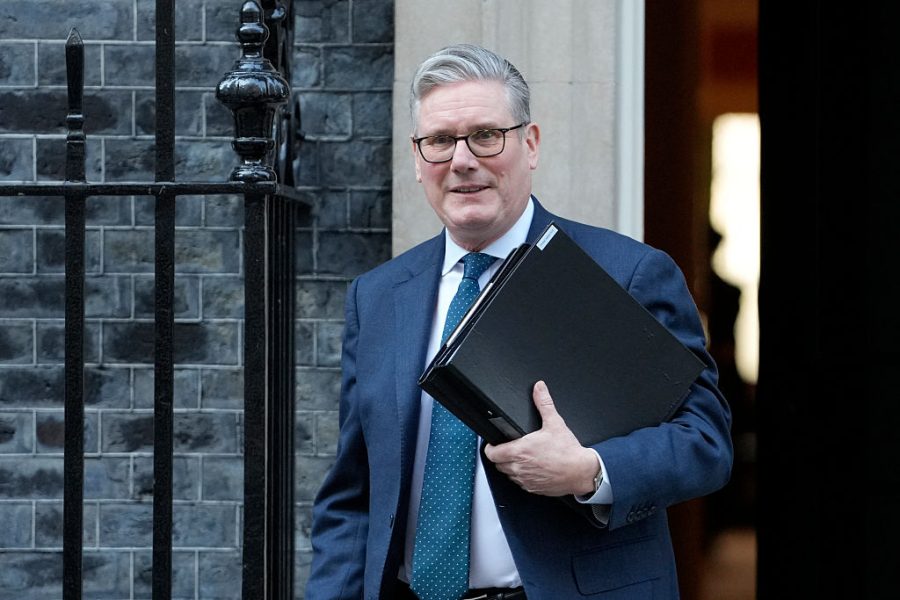
If Sir Keir Starmer has learned anything, it is that sometimes life comes at you fast
Initially, and extraordinarily, the British government said no. The Prime Minister, with legal advice from his friend and Jiminy Cricket of the liberal international order, Attorney General Lord Hermer, was anxious that America’s military action against Iran might not be compatible with international law and that the United Kingdom should not therefore assist or abet it.
If Sir Keir Starmer has learned anything in his 20-month premiership, it is that sometimes life comes at you fast. The Trump administration was predictably outraged and appalled at this failure of friendship, but there was also deep unhappiness among Gulf nations now under attack from Iranian drones and missiles that the UK had squeamishly seemed to be trying to avoid any involvement. Britain, there was a feeling, had brought not a knife but a pen to a gunfight.
Starmer, mixing the worst tendentious pettifogging of international law with the most mendacious flexibility of a politician, issued a statement on Sunday: given that British citizens were in danger, he said, he had accepted a request from the United States for permission to use joint and British bases for the ‘specific and limited defensive purpose’ of operations ‘to destroy [Iran’s] missiles at source – in their storage depots or the launchers which used to fire the missiles’.
Granting this permission, the Prime Minister argued, ‘is in accordance with international law’. He went on to insist:
We are not joining these strikes, but we will continue with our defensive actions in the region… we were not involved in the initial strikes on Iran and we will not join offensive action now.
President Trump has not been wholly placated. He believes Starmer’s permission took ‘far too long’ to be granted and was ‘very disappointed’ by the episode. Starmer must know how thin-skinned the President is, how acute he is to perceived slights and disrespect, and how experienced he is at nurturing long-lived grievances.
The idea has been raised that for Britain to have rowed in entirely behind the United States would have, quite apart from issues of international law, placed it and British citizens at risk of retaliation by Iran. Look, say its supporters, at the way Iran launched drone attacks against RAF Akrotiri in Cyprus after the government had granted even the limited permission it did.
It is an interpretation of staggering naivety, suggesting that Tehran would otherwise view the UK as a neutral observer. It is not borne out by the evidence: the drone used in the Iranian strike against Akrotiri on Sunday was launched before the government’s change of stance. But it is also to assume an attitude the Iranian leadership does not hold, that Britain and America are not to all intents and purposes joined at the hip. We are always regarded as cheerleaders for the ‘Great Satan’; indeed, Iran, like Russia, retains a nagging (if slightly flattering) suspicion that the UK is the Svengali behind the most dastardly episodes of Western foreign policy. This is a relic of our being the driving force behind staging the coup against prime minister Mohammad Mosaddegh in the summer of 1953.
Iran regards Britain as one of its enemies, and we should do Iran the decency of acknowledging it is mutual. Equally, America sees Britain as a friend. The Prime Minister’s agonised legalism has led him to pursue a course which has exasperated our friend and confirmed what our enemy already knew.
In his statement, Starmer said ‘we all remember the mistakes of Iraq. And we have learned those lessons’. It would be interesting to know what he thinks those lessons are. We are not obliged to allow America access to joint or UK bases without qualification, but the presumption in favour of it should be very strong. Now we are in a position from which Starmer seemingly believes he can explain, in the rough-and-tumble of missile strikes and an air war, the nice distinction between ‘offensive’ and ‘defensive’ military operations. Good luck with that.




Comments