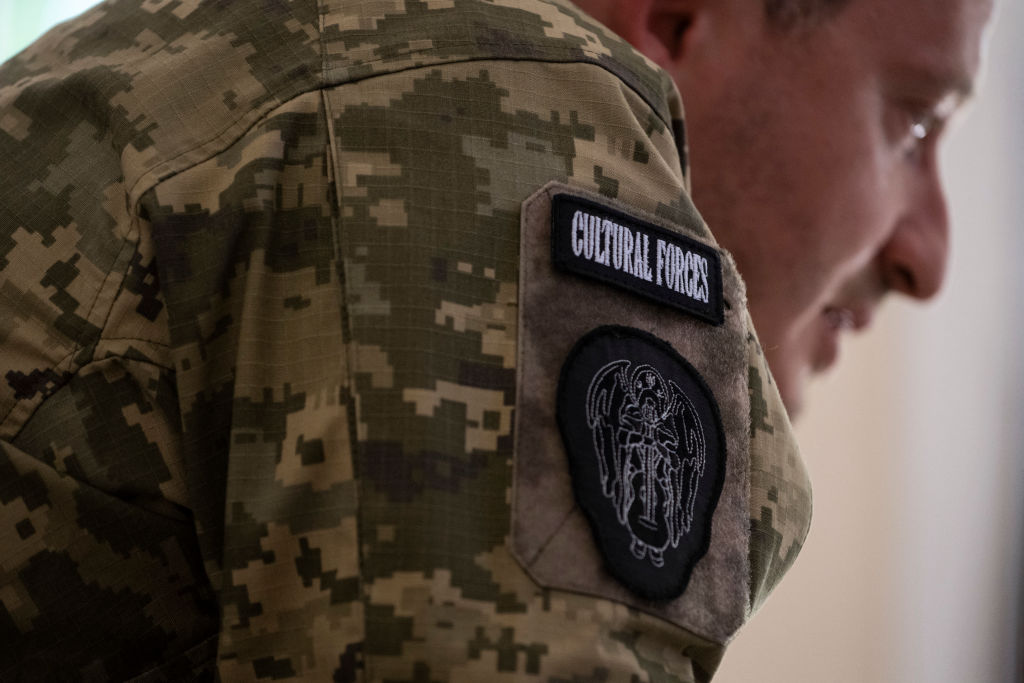
The Ukrainian Cultural Forces’ headquarters is situated above a non-descript shopping center not far outside downtown Kyiv. The walls are covered in artwork and photographs, sculptures are dotted about; the initial impression is of a university arts department, though with more security and military figures.
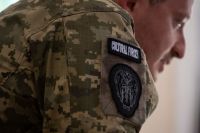
Officially part of the Ukrainian Army, though independently set up and run, the Cultural Forces employs artists, musicians, publishers and data analysts. They are something between an artistic collective, an information operations unit and a wartime parallel to the UK’s British Council. Their remit is broad and continually expanding. Part of the Cultural Forces tour the battlefront and hospitals in small mobile groups, delivering musical concerts to soldiers and civilians, creating beautiful art in war-torn regions, and keeping their finger on the pulse of frontline morale.
As Ukrainian soldiers hold off the Russian military with rifles, artillery and drones, the Cultural Forces fight back by creating art in defiance of the invader
Similar groups operate worldwide in order to raise awareness and gather donations for the Ukrainian war effort. Others are focused more on creating new forms of Ukrainian art in order to counter Russian imperialism. Putin does not see Ukraine as a real country or culture, an attitude that goes back centuries to when the Czarist Empire denigrated Ukrainians as “Little Russians.” Now, as Ukrainian soldiers hold off the Russian military with rifles, artillery and drones, the Cultural Forces fight back by creating art in defiance of the invader.
The art on display is eclectic and innovative. Some are more traditional watercolors, some more abstract, others done in the style of anime or medieval woodcuts. Sculptures are common, often made of materials found on the battlefield. One older artist reflects that he was brought up in a world of Soviet “Socialist Realism,” a style that he imitates in order to warp and turn against those who once enforced it. Another, a musician, has created his own electric variant of the traditional Ukrainian bandura, which he has played live in concerts abroad.
Many of the artists of the Cultural Forces have battlefield experience themselves, which is reflected in their work. Two that I meet create what they describe as “modern military landscape.” In order to do so, they first paint standard landscape paintings of Ukraine – forests, sunflower fields, wide open farmland. Then, these landscapes are marred by the modern detritus of war – burnt-out vehicles, mangled bodies and the spiderwebs of fiberoptic cables from downed drones.
The Cultural Forces are keen to emphasize the European dimension of their work. “We are the cultural shield of Europe,” they repeatedly tell me. It is a variation on a theme that is repeated throughout my conversations in Kyiv.
The Ukrainian capital is full of bold artistic symbolism. Perhaps the most famous example of this is the awe-inspiring Motherland monument. A Soviet-era statue, it was built facing east across the Dnipro, presumably towards the supposed “motherland” of Russia. In a delicious twist of fate, it now raises its shield and sword in defiance of the imperial invader.
Below the Motherland monument and spread across the surrounding park lies Kyiv’s premier military history museum. While officially a museum of World War Two, there are at the moment as many exhibits on the current conflict as on that of the 1940s. Small symbolic examples of Ukraine’s defiance against the invader are everywhere, including the purposeful decapitalization of the word “russia” throughout the exhibits, a linguistic reversal and re-weaponization of the “Little Russia” trope.
Almost half of the exhibits are dedicated specifically to war art. In one, artworks of the modern conflict and of World War Two are deliberately interspersed, to the point where it can be difficult to distinguish the context – scenes of bombed-out villages and traumatic occupation could be the work of Hitler’s Nazis, Soviet oppressors or Putinist Russia. The key theme that runs through the exhibits is not the glorification of war, but the striving for a life free of fear or oppression. The remains of conflict are used deliberately for artistic expression and powerful effect – most heartbreakingly in a collection of children’s prams and teddy bears found amongst the wreckage of destroyed houses, a painful reminder of the human tragedy caused by Putin’s war.
My Ukrainian interlocutors worry that as the war continues, Russia is slowly being let back into the fold of European civilization, assisted by the changing mood in the White House. Narratives of Ukraine not being a real civilization – despite the overwhelming evidence to the contrary – continue to propagate. For Ukrainians, creating art is both an urgent affirmation of their own identity and of resistance against those that would seek to destroy it.


Comments