
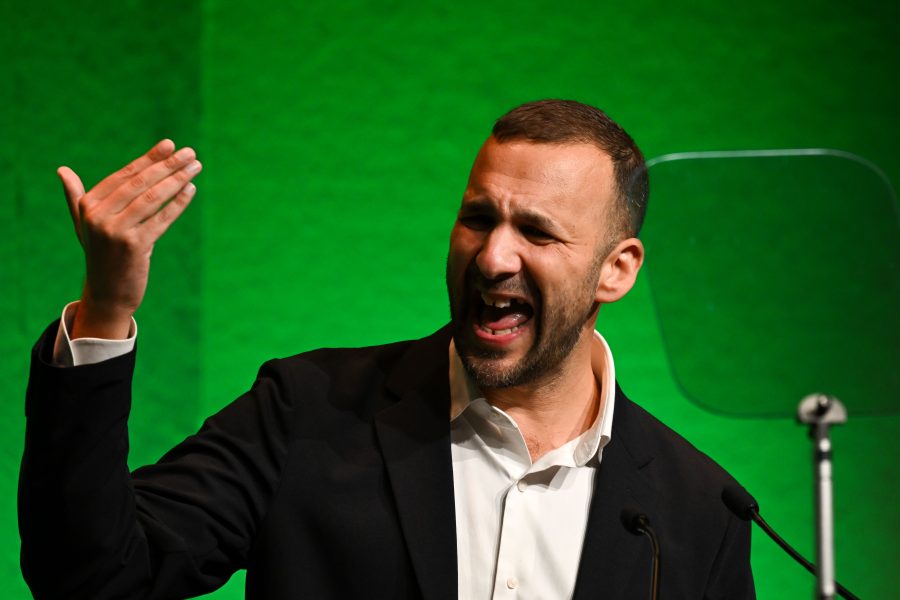
A Green party attempt to bolster its credibility on defence has triggered furious internal backlash. A group of members, academics, veterans and serving military personnel drew up a motion this month proposing an overhaul of Green defence policy. Its authors claim the proposals offer a ‘principled, credible’ approach to the military that ‘robustly protects the UK’ – and could help strengthen Zack Polanski’s national security credentials.
Among the supposedly credibility-boosting measures are proposals to scrap the party’s commitment to end anti-ballistic missile-related activity in Britain and drop the pledge requiring drones to be under human control ‘at all times’, with every launch subject to parliamentary approval. The motion also calls for an expansion of the reserve forces and states that those aged 16 and over ‘may benefit’ from apprenticeships and educational programmes within the armed forces. The raft of policies, which is set to be voted on at the Green party conference this autumn, was leaked to The Times in an effort to demonstrate to the public that Polanski takes the defence of Britain seriously. Only 17 per cent of the public trust the radical left party to protect its people, according to YouGov.
The defence motion has gone down like a cup of cold sick among swathes of the membership
What was conveniently omitted from the leak, however, was that the motion has gone down like a cup of cold sick among swathes of the membership. On an official party forum, seen by The Spectator, members expressed fury and disgust at its contents.
Chief amongst the opponents was former Labour MP Lloyd Russell-Moyle, who defected to the Greens last November. Polanski was so excited by the star defection that he staged an entire press conference to promote it. The happiness has been short-lived: the former MP for Brighton Kemptown and Peacehaven fumed that the latest defence plans are ‘extremely worrying’.

Russell-Moyle hit out that ‘the militarisation of young people is something Greens should be challenging, not accommodating’. He also complained that supporting military apprenticeships ‘risks legitimising the recruitment of children into military institutions,’ before lamenting the weakening of ‘safeguards’ around drone use.
He was not alone. Other members piled in on the party’s official debate forum. One declared: ‘I hope it is comprehensively rejected if it comes to discussion.’ Another said: ‘I find it utterly bizarre that this motion encourages children aged 16 years to be effectively drafted into the military. Are we the German Greens now? I oppose this motion.’ A third complained: ‘The greatest threat to the future of people in this country is clearly climate change… This falls into the trap of going along with the prevailing and ridiculous idea that the UK is under serious threat of being invaded by Russia.’
The backlash makes awkward reading for a party attempting to change public perceptions of its defence policy. While the Greens remain firmly opposed to the maintenance of nuclear weapons, the motion suggests at least some willingness to adopt a more realistic position on other military matters.
It is hardly surprising that the backlash was not shared with The Times. What will be worth watching is how public the dispute becomes if the leadership pushes ahead with the motion – and finds itself battling one of their supposed star defectors.
A spokesperson for the Green Party said: ‘We’re proud to make policy in a democratic way, but these are ideas from our members. Any proposed motion would need to be prioritised by our membership across the country, and debated at conference, which is months away. Only motions that are passed following a vote at conference become Green Party policy.’


Comments