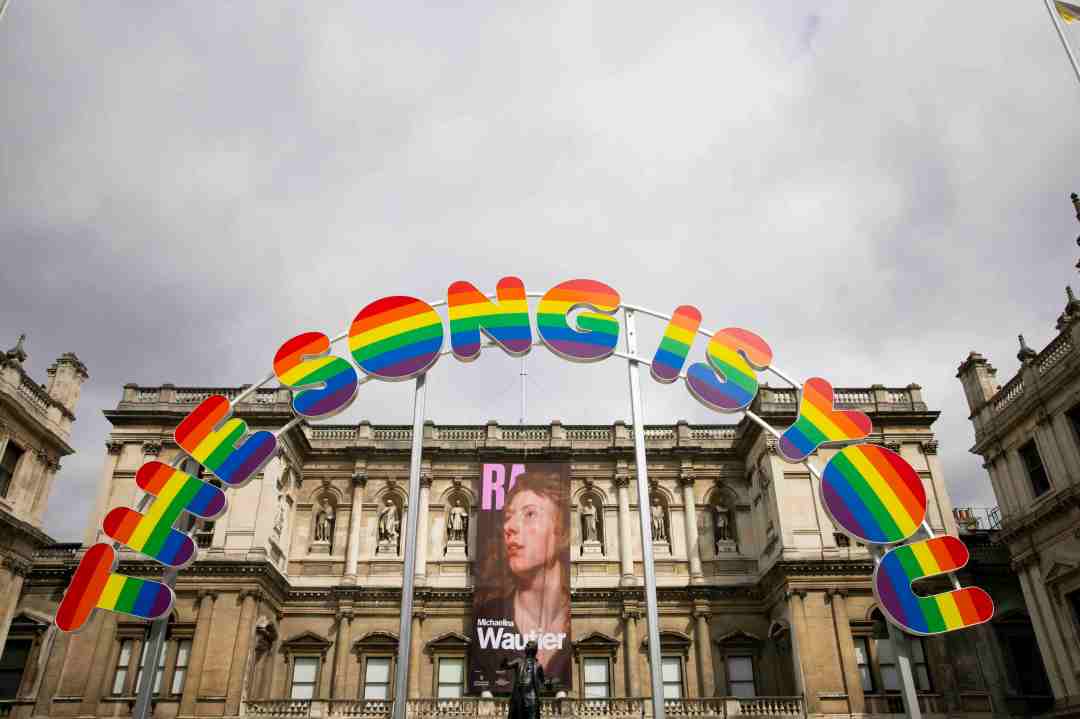
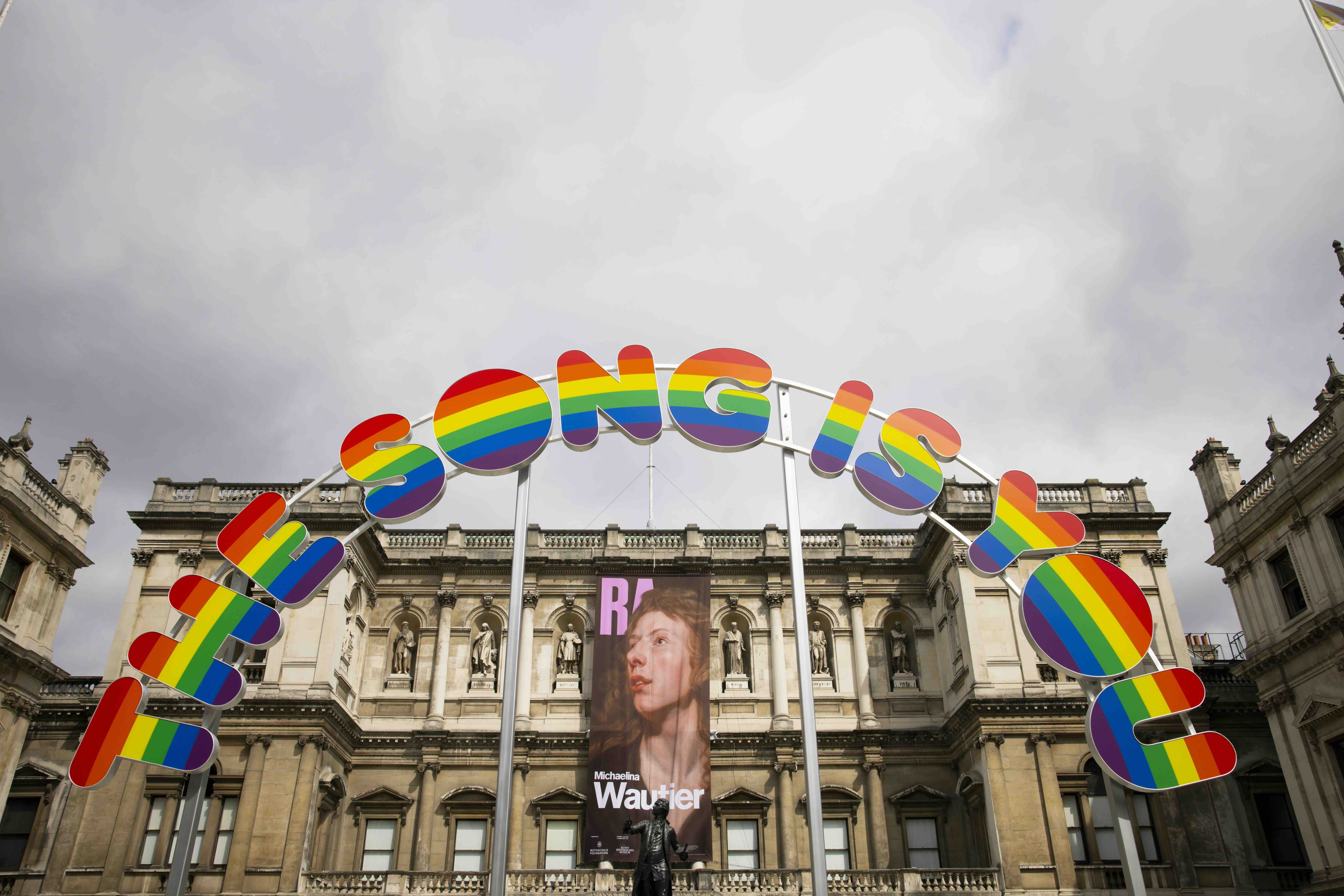
‘Work 1’ of the 258th Summer Exhibition greets you before you have even passed through the portals of the Royal Academy. Rainbow-striped letters arranged in an arc, the words ‘THE SONG IS YOU’ are displayed on four grey metal rods in the courtyard of Burlington House. By exhibitor Ugo Rondinone, the price for the installation is ‘on application’, for which read: not for the likes of you. No matter, I’ll save my pennies, thank you very much. Not being able to work out WHICH SONG I AM, I carried on regardless, conscious that I had 1,850 exhibits still to view.

A highlight of the summer season, the Summer Exhibition is an open submission show, meaning an artist of any standing can become an exhibitor if their work is shortlisted by the committee of Royal Academicians, some of whom also include their own work in the show. Viewers of the exhibition can buy the exhibits and, thrillingly, watch a red dot being placed on the gallery label. Thankfully, one doesn’t have to be Steve Cohen to purchase a piece as the prices begin at £100 but rise steadily to £180,000 for the bigger ticket works such as ‘The Goddess’, an oil by Paulina Olowska.
Much is made of the display of the bewildering array of artworks in the exhibition and ‘Exhibition Co-ordinators’ have tried, in recent years, to tackle what this year’s Co-ordinator, Ryan Gander, calls the ‘hierarchy’ of the viewer’s line of sight. One can only imagine how stressful it must be in an age consecrated to equality to attempt to give every exhibitor the chance to be seen, especially when it is simply impossible.
In his address to journalists, Gander, a conceptual artist, drew our attention to the thick white line he had had painted along the gallery walls, set at two metres from the floor. Familiar to me as the sort of hanging line we use in auction houses and galleries, Gander told us that this was ‘The Line of Passivity’, a line that he said is used in police stations to stop people getting agitated. I didn’t think there was anything nearly exciting enough in the galleries to require crowd control, but it occurred to me that perhaps Gander planned to soothe upset exhibitors whose works had been ‘skied’ (hung exceedingly high up) by asking them to look at ‘The Line of Passivity’ (TLP).
Averting my gaze from TLP, I wandered through the galleries, musing on the theme of the exhibition which, I was informed, is ‘Interconnectedness’. I’m not sure the exhibitors received the memo about the theme, but then again, I am not sure that 1,851 works need to be or even should be connected. ‘Engage cognitively and you will find the connections’ urged Gander, which is what you say to someone when you give them a Magic Eye picture. Try as I might, I simply couldn’t connect the large paint-splattered doner kebab (by Albano Hernandez, £11,500) to anything.
The doner kebab reminded me that I am allergic to conceptual art (Moscow Conceptualists aside) and so I was able to ignore everything in that category and maintain a mood in keeping with TLP. A filter is necessary if you plan to brave the exhibition and come out unscathed; and do try not to rip Peter Liversidge’s ‘Speaking Clock (1400 Minutes)’ (£15,000) off the wall if you can.
While I admired a stylish still-life by Dominic Parczuk; a strange and intriguing watercolour by Jonathan Bennett; a painting of blurred and dappled beauty by Bill Jacklin; a compelling oil which put me in mind of Chaim Soutine by Terence Birch and two conté works by John Maine which were so redolent of Hockney’s Grimm’s Fairy Tales suite that I couldn’t believe they weren’t by the man himself, I decided to focus on the prints, not least because as multiples, their price tags tend to be somewhat less hefty.
I am not sure that 1,851 works need to be, or even should be, connected
Print-making is a vast school and its range is well represented in the exhibition. I liked a luminous copper plate etching by Luke Adam Hawker; a brooding etching of three trees by Edward Richards; two comic woodcuts with Rowlandson-esque figures by Charlie Billingham; a coloured etching and aquatint of a wooden horse by Glynis Porter and a monotype in the style of Rubens by Natasha Michaels, among others. Then I saw two exquisite wood engravings by the artist Howard Phipps, which I fell upon with the joy of seeing an old friend. Surely the heir to Gwen Raverat, his works are beautiful and technically very accomplished; eminently affordable, these are ones to snap up immediately.
I emerged from the exhibition glad that I had seen some pieces and even more glad that I had ignored a great deal. Passing ‘THE SONG IS YOU’ as I walked out of the courtyard of Burlington House, I muttered ‘Emperor’s clothes’ and felt infinitely better.





Comments