
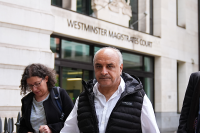
My name is Hamit Coskun and last year I was convicted in a British court of religiously aggravated public order offense. My “crime”? Burning a copy of the Quran outside the Turkish consulate in London. Moments later, I was attacked in full view of the street by a man. I was hospitalized. Then I was arrested and convicted in Westminster Magistrates Court.
I managed to get that conviction overturned, with the help of the Free Speech Union and the National Secular Society, but now the Crown Prosecution Service is appealing my acquittal, with the case being heard tomorrow in the High Court. Now I am in discussions with the White House about claiming asylum in America in case the decision goes against me.
Some may say that book-burning is a poor substitute for reasoned debate. I would counter that it was a symbolic, non-violent form of expression intended to draw attention to the ongoing move from the secularism of my country of birth to a regime that embraces hardline Islam.
As I told Westminster Magistrates’ Court in London, what I did constituted political protest and the law, as I understood it, was on my side. Crown Prosecution Service guidance makes clear that legitimate protest can be offensive and at times must be, if it is to be effective. In that spirit, Article 10 of the European Convention on Human Rights protects not just polite speech but speech that offends, shocks or disturbs. Political expression, above all, is meant to enjoy the strongest protection.
Alas, the judge ruled otherwise. And the reasoning used to convict me raises troubling questions, not only about the scope of public order law but about whether Britain is witnessing the quiet return of blasphemy laws. If that conviction is upheld tomorrow, I hope the Trump Administration will take me in as a victim of political persecution.
Although the man who assaulted me was prosecuted separately, he was spared jail despite shouting “I’m going to kill you” as he attacked me with a knife. The Crown Prosecution Service says his actions helped to prove my guilt. It is arguing that because I was attacked, my behavior cannot have been peaceful. Under this logic, my guilt is proven by how offended or aggressive someone else chose to be in response.
Neither is this the only inversion of logic the prosecution is relying on. It insists that this was not a political protest. Yes, I had told police I was protesting President Erdogan’s government, which has made Turkey a base for radical Islamists while trying to create a sharia regime. Yes, I had written on social media beforehand that I would burn a copy of the Quran outside the Turkish consulate. Yes, I said in police interview that I was criticizing a political ideology, not Muslims as a group. But all of this, the Crown claims, is a “convenient shield,” something I fabricated to conceal my hostility toward Muslims.
The judge in the original case accepted that argument, concluding that my actions were “motivated at least in part by hatred of followers of the religion.”
This lies at the heart of the matter and is key to the danger of the precedent set. If every protest against Islam is presumed to be a protest against Muslims, if criticism of doctrine is redefined as hatred of believers, then space for lawful criticism of that religion – or any religion – collapses. My case turns on that blurring of categories.
Why did the Magistrates Court reject my stated motive of criticising political Islam, rather than all Muslims? Because the judge accepted the prosecution’s argument that I hadn’t shouted “Erdogan” often enough while the first of two assailants launched an attack outside the consulate. At what point, exactly, would the Crown Prosecution Service have preferred me to launch into an explanation of the slow erosion of Kemalist secularism in the republic founded by Ataturk, in the language of my assailants, which I could not speak? While a second man was chasing me? Spitting at me? Or while he was kicking me as I lay on the ground?
So let me do now what I evidently failed to do at the time. Let me set out what brought me to that pavement. Let me explain what I would have said to my attacker, if I’d had more time and a little less adrenaline.
There was a period when Turkey was secular. Imperfectly, yes, but enough to allow people like my parents to live with some dignity. My mother, whose grandmother was killed during the 1915 deportations from the eastern provinces, was Armenian. My father was Kurdish. Neither was religious and I was raised to think freely and to question authority. For a while, that was possible.
It was a symbolic, nonviolent form of expression
In those years, especially during the 1980s, power was still contested. The military cast a long shadow over public life, but civilian governments held office, parties competed in elections and Kemalist secularism, though often used repressively, remained the organizing principle of the state. Islam was present, of course – it always is in Turkey – but it largely remained in the background. For secular families like mine, it was still possible to believe in the republic’s founding ideals.
As a young man, I joined the People’s Labor party (PLP), a legal, left-wing party committed to democratic reform. In 1993, I was arrested for being a member and tortured while in detention. More than a thousand others were swept up in the same wave of repression. My brother, who was also politically active, was murdered in 1997. When I was eventually released from prison in 2002, I took a break from politics and left the PLP, disillusioned by its refusal to confront political Islam. The murder of the atheist writer Turan Dursun and the car-bomb assassination of the secular journalist Ugur Mumcu had already convinced me that the space for dissent in Turkey was shrinking fast.
By the mid-1990s, the Welfare party had risen to power on an overtly Islamist platform, and its leader, Necmettin Erbakan, briefly served as prime minister. His protégé, a young charismatic mayor of Istanbul named Recep Tayyip Erdogan, was already laying the foundations for something far more enduring. The army forced Erbakan from office in 1997, but the movement did not disappear. It regrouped under a new name – younger, slicker, more pragmatic. Even before the electoral triumph of Erdogan’s AKP in 2002, the old secular order was under strain from a rising religious conservatism rooted in the provinces and rural heartlands.
The country I had grown up in was disappearing. Erdogan’s rise to power brought with it a new political theology. Islamist groups were tolerated, even encouraged. The education system was transformed: science and evolution were pushed aside, religious dogma promoted, children funnelled into Quran schools and religious orders. I saw reports of senior figures from Hamas visiting Turkey, welcomed, protected, housed in government buildings. Police officers no longer served the law but the faith. I had resumed by political activity and was detained again, with a plainclothes officer telling me that if I returned to prison I would not come out alive. There was something about the way he put a gun to my head as he spoke that made me believe him.
After that, the decision made itself. In 2022, I claimed asylum in Britain. But had I known that challenging the Islamist propaganda which destroyed the country I grew up in could lead to prosecution, I might have thought twice. If the High Court decides I am guilty after all, Britain will have failed me and I will apply for asylum in the United States. I hope America still stands with those who believe in peaceful protest.
This is no longer just about me. It is about whether the West still believes that no religion is beyond criticism, especially when it shapes public life and political power. That was the principle I was imprisoned for defending in Turkey and it was the principle I was defending outside the Turkish consulate. I have no intention of abandoning that fight.

Comments