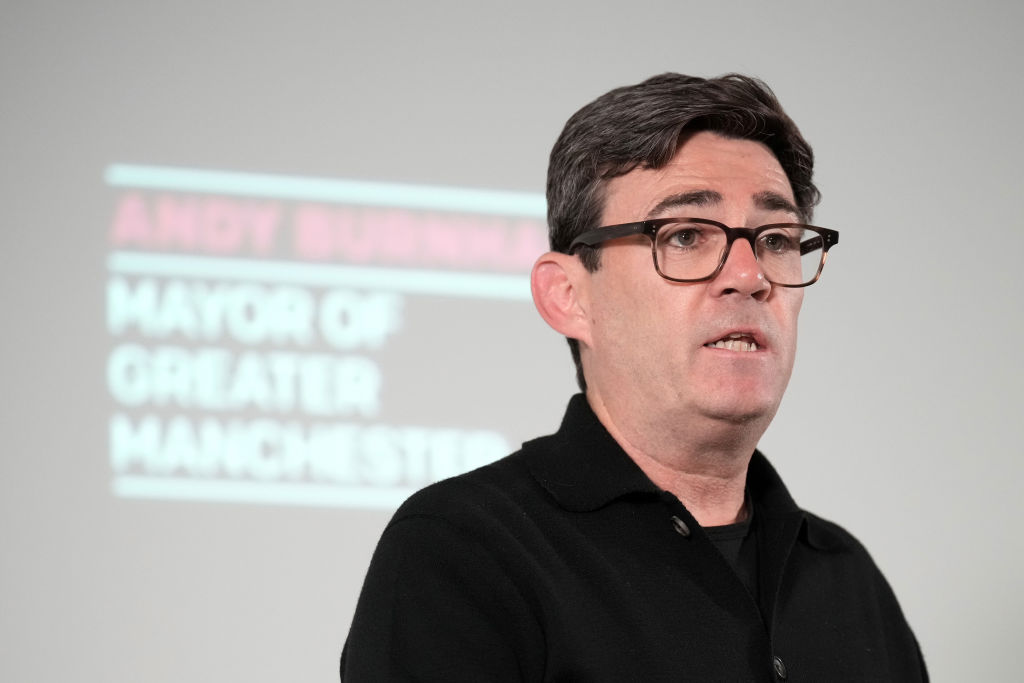
‘Our Andy’ is, of course, Manchester – and Manchester is, of course, him. In recognition of that, no worshipper at the Church of Burnham is more devoted than the city’s local paper, the Manchester Evening News.
On May 9, two days after the local elections, the MEN’s front-page splash headline was ‘Cometh the Hour,’ over a montage of a smiling, hands-in-pockets Burnham, Union flags fluttering behind him, Parliament and a map of the UK in the background.
Under Reach ownership both the MEN and the other great north-west paper, the Liverpool Echo, have become mouthpieces for the region’s political elites
‘Andy Burnham’s name carries a particular kind of affection in Greater Manchester. It’s an attachment that often feels more personal than political,’ fawned the copy, which ran to almost the whole of pages four and five. ‘A figure rooted in place rather than ambition alone… A Labour politician who appears to offer something the national party currently does not – visibility, confidence and a sense of direction…’
‘The answer points not just to Manchester as a model, but to Andy Burnham as its political expression. The answer to Labour’s problems is not around the cabinet table. It is not in Westminster waiting to be found. It is already in Manchester. It is Andy Burnham.’
This was not a comment piece by Burnham’s campaign manager, or his mother. Even the mayor himself has never gone so far as to say that he is the answer to all Labour’s problems. It was a news story, printed under the heading ‘News/ Local Elections 2026,’ written by a senior MEN staff member, and comprising the first three pages of the paper’s coverage of the election, though without a single fact about that election in its 1,650-word hallelujah to the main politician it is supposed to be covering.
Manchester’s revival in the last 30 years has been spectacular. A bit of it may even be St Andy’s doing. But one thing which has never come back, and still separates the city from past greatness, is its media. On Great Ancoats Street you can see the old black-glass Daily Express building, a better, more architecturally-acclaimed lookalike of its Fleet Street sister.
Here and elsewhere in Manchester, using huge staffs, the nationals produced northern editions with the same masthead but often vastly different content from the papers printed in London. It’s a co-working space now.
The removal of the ‘Manchester’ from the Manchester Guardian in 1959, and the whole paper’s subsequent departure to the capital, symbolised not just the North’s decline but the British left’s shift away from the working class and the industrial to the middle-class and the intellectual: a shift, now reaching its electoral apogee, which Burnham won’t be able to do much about.
For years after the move the Guardian was kept afloat by profits from the MEN, then the biggest and one of the best regional papers in Britain. With true Guardianista moral courage, the moment the MEN stopped being a cash cow they offloaded it to Britain’s worst newspaper company, Trinity Mirror, now Reach.
Under Reach ownership both the MEN and the other great north-west paper, the Liverpool Echo, have become mouthpieces for the region’s political elites. Sometimes quite literally: Liam Thorp, the Echo’s political editor, while serving in that job, ghost-wrote a book, described as ‘half-memoir, half-manifesto,’ for Burnham and the mayor of Liverpool city region, Steve Rotheram – the two principal politicians he covers. (And yes, I worked part-time for the then-mayor of London, Boris Johnson, while also working at the Telegraph – but the paper was clear that I could not report on Johnson or City Hall.)
Both the MEN and the Echo have subjected the mayors’ plans for a new high-speed railway between Liverpool and Manchester to barely any scrutiny, though it will cost at least £17 billion, strip money from dozens of better schemes, and take longer than the rail journey does now.
Indeed, both papers’ editors published statements cheerleading for the plans, co-ordinated with Burnham and Rotheram, on the day the two politicians launched their publicity campaign for the new line. As Burnham put it, ‘the MEN and the Echo have never left our side.’
The MEN’s fearless Burnham coverage continued last week when it joined the man it knows simply as ‘Andy’ on an exclusive morning jog. As the paper’s reporter, panting both metaphorically and literally, put it: ‘Some cynical types reckoned [the jogging] was all a carefully orchestrated PR stunt. Andy rubbished that claim very quickly… He points out an elderly lady waiting to give him a wave from her living room and shares brief, warm exchanges with those we pass.’ So heartwarming.
I sympathise with the rotten hand the MEN’s been dealt. Local news all over Britain is in trouble. But another outlet in Manchester, the relatively new website, the Mill, proves you can still do proper, sceptical, ground-breaking journalism – including about Andy Burnham – without much money. It was the Mill which forced Burnham’s night czar, Sacha Lord, to resign after it found he’d made a misleading application for a Covid grant – a story completely ignored by the MEN, apart from one web-only piece, until the actual resignation. And it was the Mill which this week produced a far more nuanced assessment of Burnham, recognising both his weaknesses and strengths, than the MEN’s crude tub-thumping.
Craven, unprobing local papers are one reason why Burnham and the other metro mayors get such a halo effect – but it’s left him, and his policy prospectus, dangerously unprepared for the scrutiny cauldron of No. 10. And for Manchester, though its hot-metal news heyday is gone, growing better local media will be essential for its continued return to greatness.



Comments