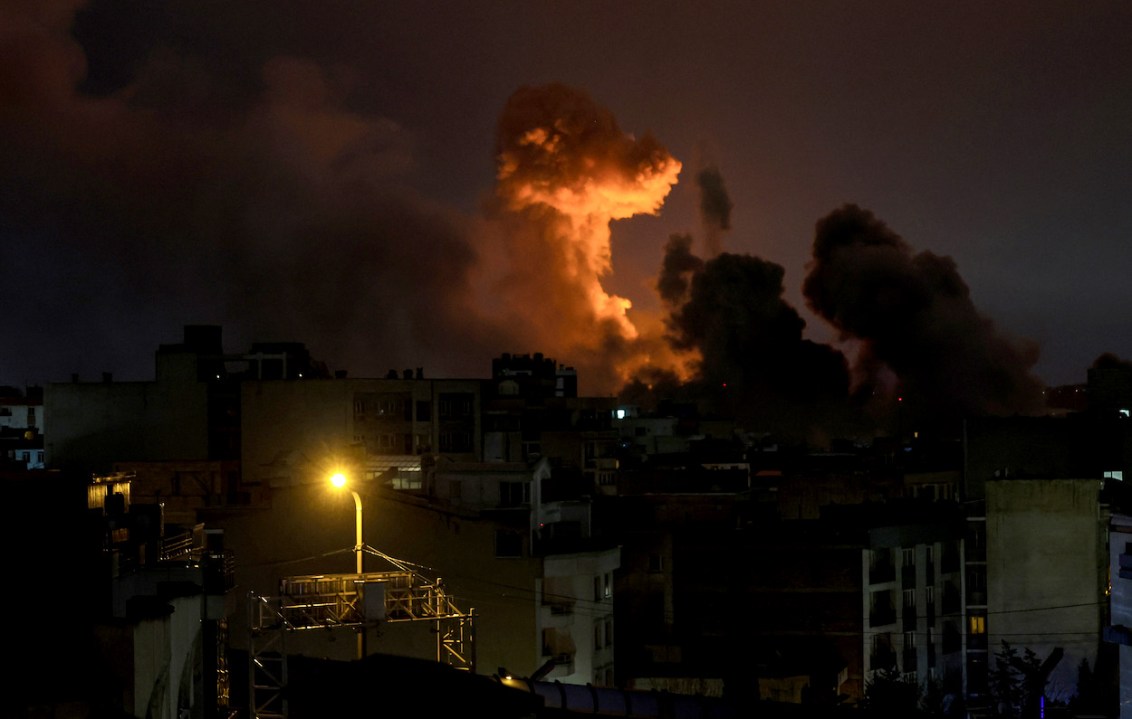
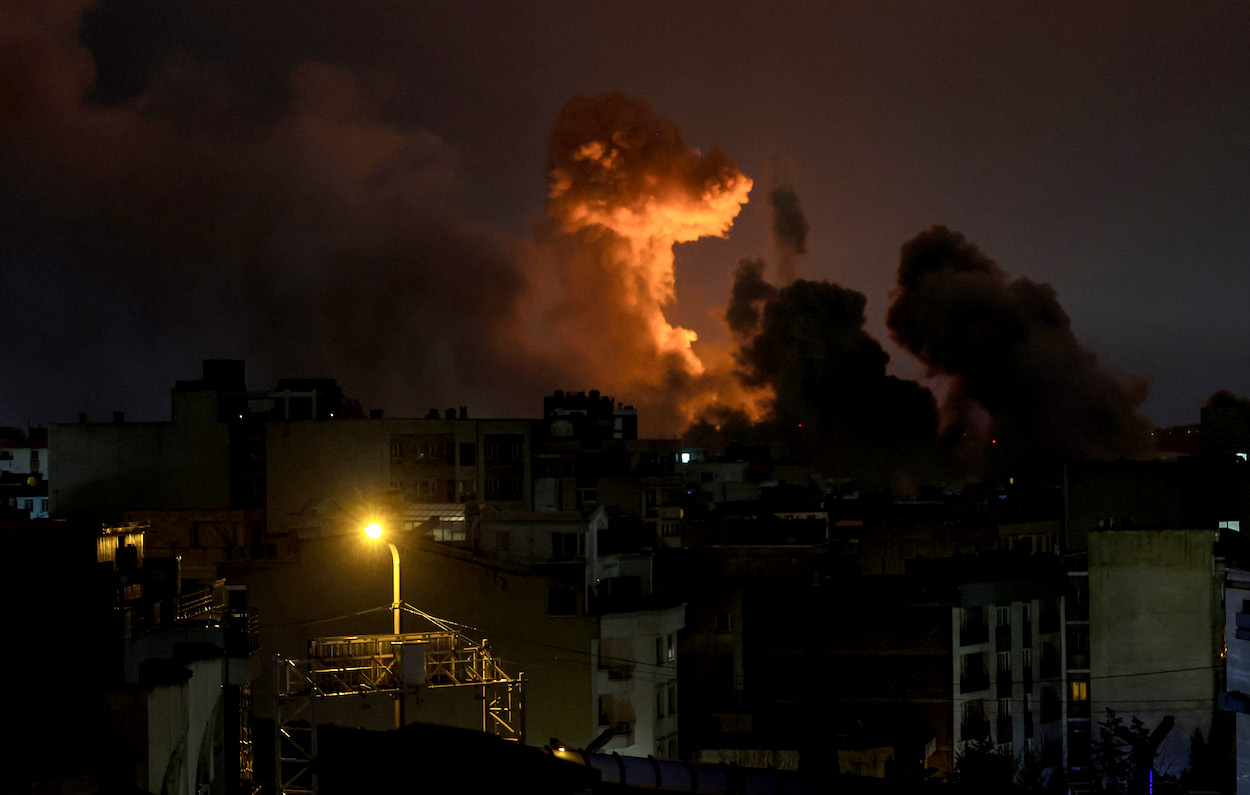
The Secretary of War is the face of America’s campaign against Iran. “War is hell, and always will be,” Pete Hegseth said recently. He is relentlessly focused on lethality, and decimating the Iranian military. His critics correctly point out that this isn’t strategic thinking, this is a strategy of tactics. Hegseth’s metrics of success appear to be counting sorties flown, ordnance dropped and missiles destroyed.

This criticism has been leveled at American strategy makers throughout modern history. During the Vietnam war, the metric of choice was body count. During the global war on terror it was Taliban commanders killed.
The difference this time is that these decisions are being made in a hyperconnected battlefield. Civilian technologies, media platforms, and data infrastructures are now everywhere, deeply entangled with military AI.
This is war in the smartphone age, where the ubiquity of phones and the infrastructure that supports them is reshaping how we come to know about and fight war. Now everyone participates, wherever they are in the world. Sharing footage as drones hit their hotel rooms or geolocating targets to make money on Polymarket, images broadcast across social media feed the same data environment that AI systems analyze to generate targets. In this loop between digital images and machine analysis, the speed of war is reshaping how strategy itself is made.
Take, for example, the US missile strike on an Iranian girls’ school in Minas that resulted in at least 170 deaths. We await the results of the American investigation but Mahsa Alimardani from the human rights organization Witness tells us that the attack followed the appearance of an AI-generated image on Instagram that purported to show military equipment at the school. How the Americans went about selecting it as a target has yet to be revealed. What we do know is that once the story moved to X, Grok compounded the uncertainty and created further online commentary which obscured the reality of the attack.
To control the narrative about the war in Iran, the White House has pressured American satellite companies to restrict the release of Middle East imagery. The goal is to limit how incidents such as the Minab school attack are independently documented.
Why the White House should worry about controlling the digital rights to the war is more of a mystery. After all, at the speed and scale of social media, much of what circulates cannot be verified before AI muddies the waters. This is not censorship as we have previously known it. This is managing attention until the next media spectacle.
It should come as no surprise that President Trump’s definition of victory is whatever he says it is. Victory is no longer predicated on a formal surrender by Iran. Rather it is the moment when the President “determines Iran no longer poses a threat to the US,” Of course with oil prices surging, voters alarmed and threats to the economy mounting, the President is hedging his position. “I think the war is very complete, pretty much,” he says. “We haven’t won enough,” soon after.
The President’s efforts to ride the social media storm contrast with the physical data infrastructures that are materially affecting the conduct of war. At the onset of the campaign it emerged that the location of Iran’s senior leadership had been compromised because their bodyguards were carrying their phones while on duty. This generated location data that could be combined with other intelligence sources to reveal where the Iranian leaders were located at any point in the day.
More recently, Israeli officials told the Wall Street Journal that information provided via Persian-language social media accounts, from ordinary Iranians inside Iran, was being used to identify targets for strikes. Cross-checked and verified with evidence from other sources, the Israelis have used this intelligence to attack Basji militia checkpoints across Tehran.
In each of these cases, the medium became both the story and the vector for military action. The bodyguards’ phones functioned as surveillance devices. Iranian social media sources helped Israel identify suitable targets.
The speed at which all this is happening is matched only by the rate at which American and Israeli forces are generating targets, 5,000 of which were struck in the first ten days of the war. Sustaining this tempo depends on the ability to process vast streams of digital information flowing through a networked battlespace. AI tools are therefore being integrated into campaign planning and targeting, helping analysts identify patterns in scattered datasets faster and at greater scale than human teams alone. In the United States, commanders have reportedly experimented with Anthropic’s Claude to analyze data relevant to military targeting.
Systems that promise faster and more scalable decisions appear well suited to a battlespace defined by complexity and compressed timelines. Social media cycles, real-time information flows and sensor-saturated environments, however, all create expectations that commanders will act quickly. For technology companies, the issue is responsibility and control. Anthropic has insisted that humans must remain in the decision-making loop and that AI cannot replace military judgment. This stance has frustrated the Pentagon, where officials argue that greater freedom to experiment with AI is necessary to preserve their military advantage.
America’s war with Iran is the first time we have witnessed a superpower at war in hyperconnected contexts
The disagreement reflects a deeper tension. Enthusiasm for AI-enabled targeting risks encouraging the belief that improved detection and strike capabilities inherently generate strategic outcomes. In such a context, humans risk being displaced from meaningful decision-making roles – operational systems alone supposedly promise victory. As a result, we are facing a broader struggle over how much authority should be delegated to machines and how much faith should be placed in automated forms of analysis.
This environment of smartphone-driven hyper-connectivity raises deeper questions about strategic decision-making. How can ends, ways and means remain aligned when media cycles continually reshape what objectives appear acceptable and when technological systems encourage the rapid use of military force? How can democratic societies maintain meaningful political control over the use of force at the speed and scale of the social media cycle?
If strategy is the art of creating choice, then technology has always framed the geographical reach and speed at which those choices can be exercised. After all, logistics define the limits of what is militarily possible. America’s war with Iran is nonetheless the first time we have witnessed a superpower at war in hyperconnected contexts. Now military systems and civilian data infrastructures overlap, driving the AIs that both reveal and distort the battlefield.
To my mind, in the context of Iran, this might yield three outcomes: an arbitrary declaration of success by the President; the perpetual use of airpower to keep Iran off balance; or a shift to the next political spectacle, a redirecting of attention to a new season of the Trump show – the collapse of Cuba.



Comments