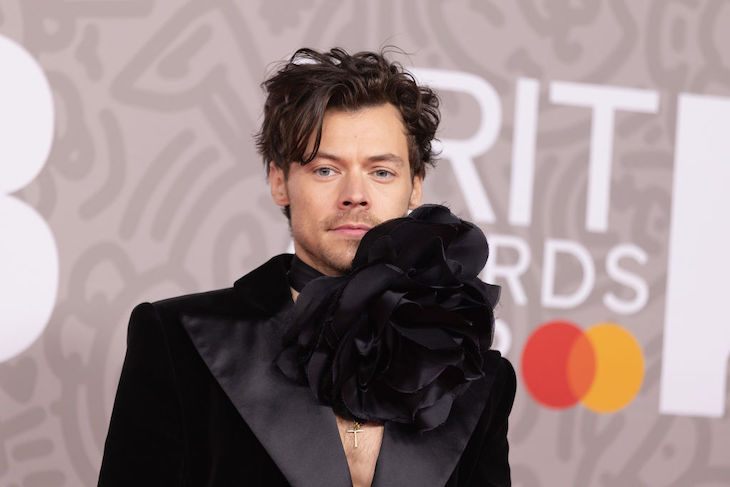
Whisper it, but Harry Styles – once talked of as the biggest British pop star since Robbie Williams – may have come a cropper. His moody new single, ‘Aperture’, lacks the obvious immediacy of earlier hits like ‘As It Was’ and ‘Watermelon Sugar’. His tradition of playing to the gallery (or, the cynical might say, as wide a fanbase as possible) by hinting at bisexual inclinations, all while leading a tabloid-friendly and decidedly heterosexual love life, has begun to founder as his hopeful LGBTQ admirers have wearied of the absence of any demonstration of same-sex proclivities; dressing up in women’s clothing and wearing a bit of lipstick will not do any more. And Styles’S decision not to go on a proper tour but to appear in seven major world cities for extended periods – and expect his fans in their millions to come to him – has been met with a disappointed and indignant response.
This is a far cry from the chaos of the old days of touring, when the Rolling Stones and The Who would travel the world in atmospheres of barely controlled mayhem
Part of this stems from the eye-wateringly high prices that Styles is charging. If you wished to head to Wembley Stadium this summer to see the boy wonder perform at one of the twelve shows he is playing at the venue, you would have to pay a minimum of £44 for a seat in the gods where you are unlikely to be able to see or hear very much, or £144 to stand at the back of the stadium. If you wanted to actually enjoy the experience of the concert, it will cost hundreds of pounds for a decent seat or a ‘VIP package’, of which the most expensive is £725. His other tickets, at venues that include Madison Square Garden in New York – where he is appearing for a staggering 30 concerts – and the Marvel Stadium in Melbourne are all at a similar price. On his last tour in 2022, where he also played Wembley, the top-priced ticket was a far more reasonable £99.
Fans are understandably irritated about the amounts that they will now have to fork out for tickets, but those who are not based in one of the major cities he is gracing with his presence are even more annoyed at the prospect of having to add hotel and travel costs to the already extortionate amounts they’ll be spending. All but the most fervent of Styles aficionados might listen to the underwhelming new single, look at the difficulty of getting to one of the places he’s playing and add up the cost, and simply conclude that it isn’t worth it. Perhaps they are doing themselves a favour.

There are still enough fervent aficionados, however, to ensure that the gigs will sell out without particular difficulty, and then the tickets will become even more sought-after on the secondary market, if similar experiences with Taylor Swift and Oasis are anything to go by. Yet Styles’s decision not to embark on a conventional tour by playing at regional venues is – to allude to his first solo single – a sign of the times. Artists have wearied of an exhausting country and city-hopping schedule that ends up being both disorientating and demoralising, no matter how ecstatic and fervent the welcome they receive when they are on stage. While many pay lip service to ecological issues by claiming they wish to reduce their carbon footprint by travelling less, the reality in many cases is that it is simply easier and more convenient to pitch up in one city, perform a well-paid residency for a set number of nights, pocket the money and then move onto the next destination.
Styles follows such acts as Radiohead – whose 2025 ‘tour’ consisted of only appearing in five European cities – and U2, who performed a 40-date residency at the Sphere in Las Vegas between 2023 and 2024, to hugely lucrative effect. Both bands were therefore able to enjoy performing without having to schlep around on lengthy tours, or debase themselves in the sort of anonymous arenas in places they might prefer not to venture to. The Idaho Central Arena, for instance, may no longer attract the acts that it might once have expected to host.
This is a far cry from the chaos of the old days of touring, when the Rolling Stones and The Who would travel the world in atmospheres of barely controlled mayhem, where drugs and admiring groupies were on hand in abundance. Leonard Cohen – who, of course, was a celebrated poet before he embraced a musical career – hated the idea of touring so much that he adopted a quasi-military persona, ‘Field Commander Cohen’, and ran his 1979 jaunt as it were a gruelling campaign. Ironically enough, he came to enjoy it immensely. But today, in the sanitised and far less interesting music industry, there is no space for Field Commander Cohen and his ilk. Instead, there is just Styles crooning through his hits on night 15 of 30 in Madison Square Garden. Perhaps he wonders, mid-song, whether this music lark is all it’s cracked up to be still.

Comments