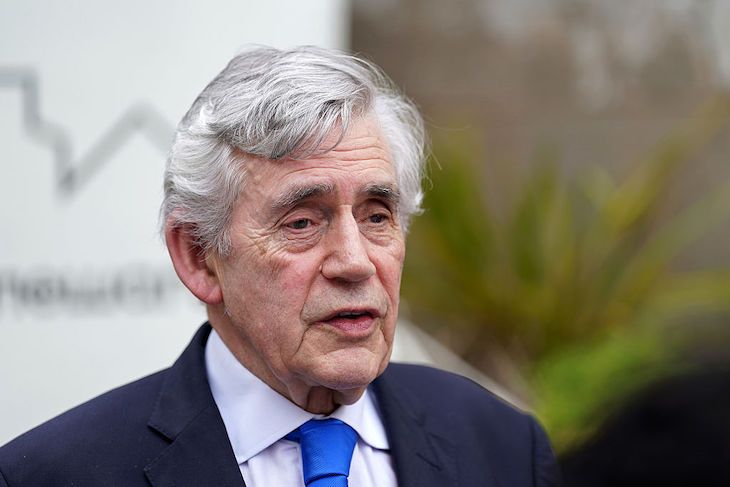
Gordon Brown spent much of his political career arguing passionately that Scotland should remain within the United Kingdom and that his own British birthright should be protected from Scottish nationalism. Yet apparently the same principle does not extend across the Irish Sea. Gordon Brown’s Britishness is permanent. Mine, it seems, comes with an expiry date.
My British identity is no more provisional than Gordon Brown’s Scottish identity
The former prime minister was asked again about Scottish independence in an interview with the Guardian’s Saturday magazine, published on 29 August. Brown was unequivocal. Independence, he said, “would not be the right way forward”, because Scotland is “geographically, economically, socially, culturally linked” to the rest of the United Kingdom.
So far, so unionist. Then came the extraordinary bit.
Asked whether the same geographical logic meant Northern Ireland should be united with the Republic, Brown replied: “Yes. Well, of course, in the long term, Ireland will be united.”
Of course?
Brown appears to have discovered a curious new constitutional principle. Scotland’s links with the rest of the United Kingdom are sufficient reason for it to remain British. Northern Ireland’s links with the United Kingdom apparently are not.
The Union is indispensable in Fife but temporary in Fermanagh.
There is something rather patronising about a former British prime minister pronouncing the eventual disappearance of part of his own country as though he were predicting tomorrow’s weather.
Geography is not political destiny. Northern Ireland sharing a land border with the Republic no more makes Irish unity inevitable than Canada’s border with the United States makes North American unity inevitable.
Brown should know this better than most. He was Chancellor when the Belfast Agreement was signed. Its great constitutional achievement was to replace competing claims of inevitability with the principle of consent. Northern Ireland remains within the United Kingdom for as long as that is the democratic wish of its people.
There is no majority for Irish unity today. Nor is there some immutable law saying there must eventually be one.
Unionists have a multitude of perfectly rational reasons for wanting to remain British. They are political, economic, social and cultural – precisely the ties Brown invokes when defending Scotland’s place in the Union.
One therefore wonders when Gordon Brown last spent any meaningful amount of time in Northern Ireland. We are not some British administrative outpost awaiting eventual absorption by our larger neighbour. We are politically, socially and culturally part of the United Kingdom.
Then there is an issue becoming harder to ignore: security.
The Republic of Ireland’s military neutrality might have seemed relatively unimportant during the comfortable post-Cold War years. It looks rather different in an increasingly dangerous Europe.
The United Kingdom is a Nato member, a nuclear power and a permanent member of the UN Security Council. At a time of Russian aggression and growing threats to Europe’s infrastructure, why should people in Northern Ireland regard exchanging that security umbrella for Irish neutrality as an inevitable improvement?
There are ethical and moral questions too. The increasingly ugly manifestations of antisemitism in the Republic of Ireland should trouble anyone who imagines Irish unity as an uncomplicated journey towards a more liberal and tolerant society. And if you want an example of pure sectarianism look no further that the treatment of presidential candidate Heather Humphries because she was from a Protestant background.
There is no majority for Irish unity today. Nor is there some immutable law saying there must eventually be one
Despite this we should not be hostile towards our neighbours. I want Northern Ireland and the Republic to enjoy a mutual beneficial relationship. Good neighbours cooperate. They do not have to knock down the garden fence and merge the houses.
For me however, what jars most is Brown’s casual assumption about identity.
Gordon Brown is a proud Scot and a proud British citizen. I respect both identities. I would never dream of telling him that one day his Britishness will inevitably disappear because somebody else has decided that history is moving in that direction.
Why, then, is it acceptable to say that about mine?
I was born British. I am British. My British identity is no more provisional than Gordon Brown’s Scottish identity.
If Gordon Brown believes Scotland’s place within the United Kingdom is worth defending, perhaps he might extend the same courtesy to those of us in Northern Ireland.
Not right for Scotland, but apparently perfectly all right for us. I think not.






Comments