
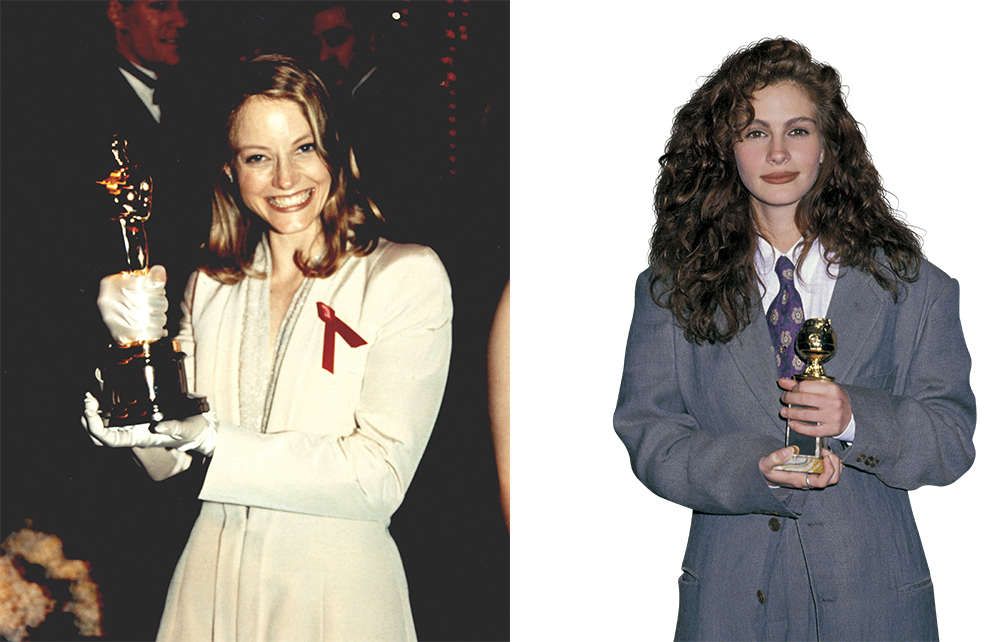
After being put on the “worst dressed” list for the 1989 Oscars at which she won Best Actress for The Accused, Jodie Foster decided that she needed professional fashion help. Giorgio Armani answered the call.
“For the next Oscars, I wore a beautiful and striking cream-colored tuxedo chosen for me by Mr. Armani, and guess what… I was on the ‘best dressed’ list!” recalled the actor. “From then, Armani has been my go-to designer, and he has done many of my costumes on screen as well. In 1991, I finally met him – I had the honor of having Mr. Armani personally fit me for the Oscars. We spoke in French, and it was like being directed by Visconti, or painted by Picasso – in other words, it was a moment with a master… a treasure in time. He did all the alterations himself, hooked me and my breasts up with double-stick tape. It was a very intimate first meeting!”
‘It was a small revolution that responded to a widespread social need, to a need for a change in taste and style’
Jodie Foster has been a regular in Armani on the red carpet along with so many other stars that the label has become something of a Hollywood fixture. No surprise, then, that when the Rodeo Drive Walk of Style was inaugurated in 2003, to celebrate those who have contributed significantly to the spheres of entertainment and fashion, he was the first honoree. That evening, movie star after movie star paid tribute to this Italian from the city of Piacenza, which lies some 40 miles to the southeast of Milan.
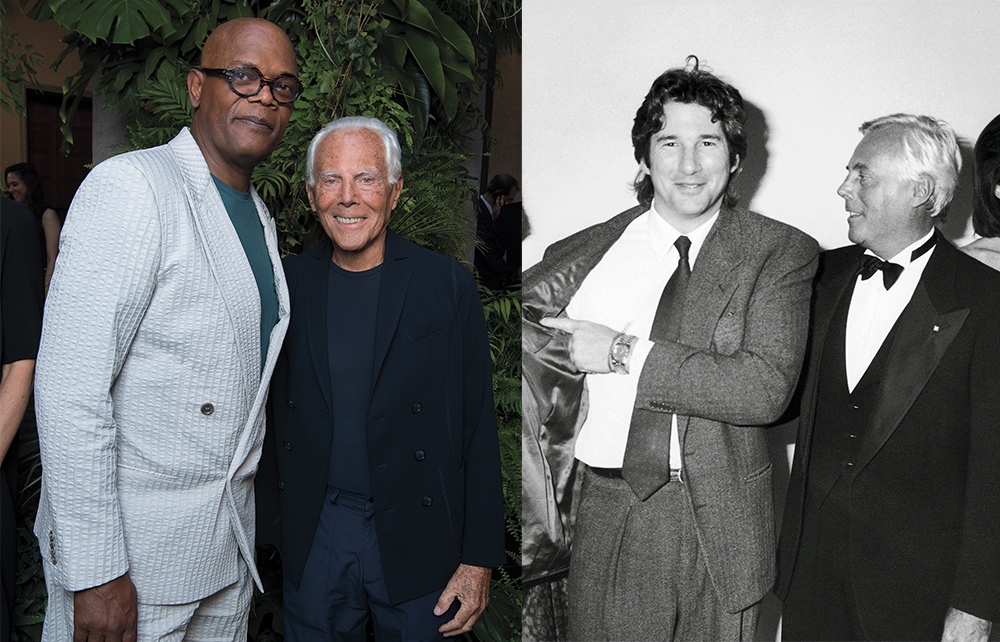
Samuel L. Jackson’s homage was typical of the affection on show: “Giorgio has put me in everything from golf clothes to duster coats to badass brocade. He’s taught me to be fearless about fashion. He gave me attitude in Shaft. He made me look extra good in XXX. He is The Man.” While Harrison Ford quipped: “I want to come back as Armani: cuter, richer, and more successful. He makes menswear look easy, which it isn’t.”
Giorgio Armani’s adventures in the world of film would see him dress more than 250 movies, including The Untouchables, Goodfellas, Casino, The Dark Knight, Ocean’s Thirteen, The Social Network, and Inglourious Basterds. He was so successful in connecting with Hollywood, setting up an office there on Rodeo Drive in 1988 specifically to dress VIPs, that he became the default fashion designer for countless actors, directors, and producers.
The relationship with the American screen had started back in 1980, with the release of Paul Schrader’s film noir, American Gigolo. For this, Armani made 120 outfits for John Travolta, who was originally cast in the lead and had come to Milan for fittings. He was hot property at the time, having starred in Saturday Night Fever in 1977 and Grease the following year. When Travolta withdrew from the project, Richard Gere replaced him and the Italian designer was forced to replace the film’s costumes for the newcomer, who was a different fit. The switch, however, proved a blessing.
“It was 1980, I had only launched my brand for five years, with the idea of creating clothes that combined tailoring with a new softness,” recalled Armani. “Director Paul Schrader called me to dress a then-semi-unknown Richard Gere, who managed to reveal all the sensuality of my style, the natural attitude, the new relationship between dress and body.”
Bodies were something Giorgio Armani was always interested in. In his autobiography, Per Amore, he says, “As a young man I was deeply fascinated by the real body, both its mechanics and its subtle dynamics. That scientific respect for the body has never left me… Examples of this can be seen in the classical and neoclassical sculptures that I have tried to evoke in my advertising campaigns, with photographs that portray men with lithe and elegant muscles, and slender and graceful women.”
It is perhaps not too far-fetched to see this eye for anatomy as a contributing factor to the young Armani’s decision to study medicine, but he soon realized the doctor’s life was not for him. He dropped out of medical school and got a job at Milan’s foremost department store, La Rinascente, which still exists today, hard by the Duomo, assisting the various architecture studios that created installations there, as well as organizing window dressing. He progressed to working as a menswear buyer and then jumped ship to learn the designer’s craft in the studio of Nino Cerruti. It wasn’t until he was 41 years old that he launched his own collection, in 1975, and in 1979 he registered the Giorgio Armani Corporation in the States.
According to Leo Dell’Orco, president of the Armani Group and of the Giorgio Armani Foundation, America was always the goal. Dell’Orco worked with Armani for 50 years, closely collaborating with him on menswear design, and now, since his boss’s passing last year, has taken over the role of creating the menswear for all Armani brands. “For Giorgio, America represented success,” he says. “As a child he had watched American Westerns at the cinema, and then the black-and-white Hollywood movies starring screen legends like Cary Grant and Ingrid Bergman. The beauty and glamor captivated and inspired him to dress the world. And that meant America.”
American Gigolo was thus the perfect vehicle for Armani, and it arrived at just the right time. “In the early ’80s, men had begun to give a certain importance to physical fitness, with a certain amount of vanity,” explained the designer. “In the film, I wanted this new male narcissism to appear in its sexiest form thanks to the role and its interpretation by Richard Gere. I therefore thought of a complete wardrobe, from shirts to dresses [for Lauren Hutton] to coats, which was coherent and which emphasized the personality of the characters – where Richard was concerned, this was a man outside the box, narcissistic and sure of his charm.”
If you’ve seen the film, you will no doubt remember the scene where Gere’s character, stripped to the waist, nonchalantly tosses jackets, shirts, and ties from his wardrobe onto his bed, like a latter-day Gatsby turned fashion stylist. He’s putting an outfit together, and in doing so showcasing the instant appeal of Armani – that it is easy to coordinate on account of its restrained, sophisticated color palette, and the fact that everything has been designed to correspond to a rigorous vision of modern sartorial dressing.
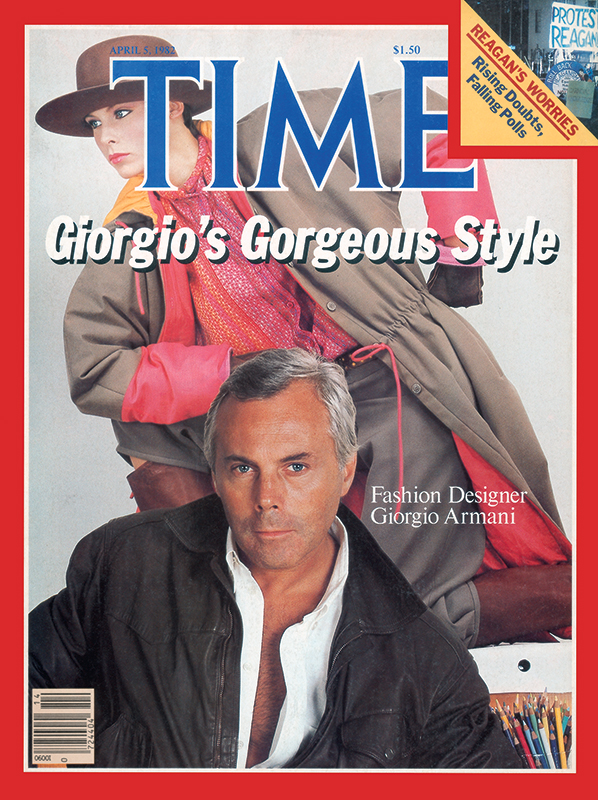
America went crazy for the look and by 1982, only three years after he’d registered his company in the US, Armani made the cover of Time magazine (right). He was the first fashion designer to do so since Christian Dior in the 1940s.
The story’s coverline read, “Giorgio’s Gorgeous Style,” and it opened with: “Suiting up for Easy Street. Giorgio Armani defines the new shape of style.” The piece described how the designer was creating “A new sort of freedom in clothes. An ease, the Armani ease.”
What the designer understood was that tailoring needed to be updated. His secret wasn’t only in his deft handling of an easily coordinated neutral color palette – something that would come to be known as Armani “greige” – but also his commitment to giving his customers comfortable tailored clothing. In Per Amore, he describes how his mentor, Nino Cerruti, charged him with exploring how to make traditional suiting softer.
“My job was to create a new image for men,” Armani explains. “Despite the fact that he could exploit both advanced technology and the many Italian-American experts who worked for his company, Cerruti asked me to find some new solutions to make a man’s suit less rigid and more comfortable, less industrial and more sartorial. By ‘deconstructing’ the jacket I made it come alive on the body, using fabrics that weren’t at all traditional.”
‘I like America and the American people. Whenever I return, they show their admiration and affection’
The quest followed Armani to his own design venture, and what started as a reimagining of the structure, fit, and, consequently, look of the man’s jacket would lead him to create womenswear that was equally relaxed but tailored. He spoke of how his sister and her friends would wear the men’s jackets he had created and that this made him realize that women would adopt the look. “Giorgio Armani created a women’s wardrobe in the ’80s that empowered women,” says his niece, Roberta Armani, who has worked with her uncle for many years as head of entertainment and VIP relations. “For the first time they had clothes that could compete with those that their male colleagues wore at work – they looked strong and confident.”
Armani was aware of the stylistic shift he was engineering. Even during his first foray into cinema wardrobe: “In my opinion, American Gigolo marked an important watershed between a style characterized by a traditionalism made up of a certain rigidity of dressing, and a more casual style. Giving men a softer and more loose wardrobe, which is what I have done and continue to do, has meant freeing them from a rigid and stereotypical representation of their roles. It was a small revolution that responded to a widespread social need, to a need for a change in taste and style that affected both men and women.”
This “small revolution” took many forms. On the red carpet it saw the designer dress Diane Keaton in a long double-breasted jacket and skirt for the 1978 Academy Awards when she won Best Actress for her performance in Annie Hall, and then, later, Julia Roberts in an oversized man’s-style suit for the Golden Globes for her supporting role in Steel Magnolias. “It’s astonishing now to think that Diane Keaton was the first movie star to wear Armani to the Oscars – and that in just a few years afterwards he was dressing so many people on the red carpet,” says Roberta Armani. “My uncle saw there was a new mood in Hollywood that wanted something less glitzy, more contemporary.”
However, the change in mood was perhaps nowhere more apparent than on Wall Street, where men and women adopted Armani to make them look smart, but modern. Not trussed up in the tailored armor of their parents and grandparents, but striding into the future in comfortable, lightweight pieces that imbued them with the confidence that they were on the money in more ways than one.
Vanessa Friedman, fashion director and chief fashion critic of The New York Times: “Armani gave executives that didn’t subscribe to the English tailoring tradition of Wall Street a different way to look powerful and have authority, and that resonated, particularly on the West Coast. Power dressing is a big part of American identity: the notion of the self-made man, dress for success, dress for the job you want.” In short, he understood a key aspect of the fabled American Dream. “The idea that you can come out of nowhere and you can dress the part and look the part and become the part. Intrinsic to creating your own story is costuming yourself. Armani gave men and women a way to do that that tapped into modern mythmaking,” explains Friedman.
In 2013, Giorgio Armani would revisit that era when he dressed The Wolf of Wall Street for his friend, director Martin Scorsese. “The era of power dressing on Wall Street projected tremendous amounts of resolute strength. I remember the period well, when my deconstructed suiting emerged as an emblem of success,” he said of his collaboration on the film.
Scorsese had long been a friend of Armani’s, and had not only worked with him on film projects but had also made the intimate 1990 documentary Made in Milan about the designer’s life, style philosophy and creative process.
At the time of The Wolf of Wall Street’s release, the director said: “Giorgio Armani revolutionized male fashion design – he gave us a new idea of elegance that was, and still is, a perfect fit with the times.”
It’s that statement, that Armani’s elegance remains “a perfect fit for the times” – and the fact that Scorsese made it more than 10 years ago – that speaks volumes. For what is remarkable about Armani is that it is still here, half a century after its foundation, a world-famous fashion brand, currently being valued at around $5 to $8 billion in anticipation of a sale after its founder’s death. Incidentally, the designer was the sole shareholder of his business, which, in today’s conglomerate-dominated fashion world, made him a notable rarity.
Fashion companies rely on a perceived relevance for their success. And it is a paradox that in an industry dominated by newness and trends, Armani resolutely stuck to his singular vision of easy-to-wear, sophisticated, tailoring-based clothing, citing a desire to achieve style rather than fashion. He would talk of not wanting to follow passing trends (though admitted in his autobiography to some lapses: “Of course, I was also a victim of those trends. I, too, wore clothing like a mauve velvet or floral-print jacket – and later regretted it.”) And while this meant, inevitably, that there were moments when the new kids on the block hogged the headlines, his consistency has been the secret of his work’s longevity.
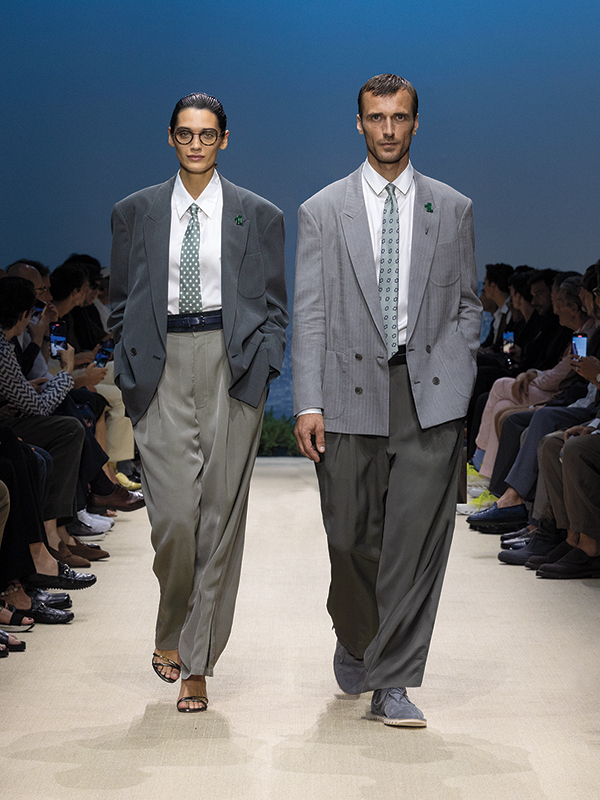
Now he is gone, we are perhaps in a better place to assess his achievement. Vanessa Friedman, fashion director and chief fashion critic for The New York Times, says simply that, “He’s in the fashion firmament the world over. He’s one of the great designers who essentially changed the way people dress.”
Nick Sullivan, creative director of Esquire says: “The Armani look is all-pervasive – that soft, luxurious, low-key aesthetic that frankly informs so many other brands. It has evolved, but like an Italian risotto, it tastes the same even if you play with the ingredients.” Sullivan acknowledges that this is a position that requires confidence: “Ironically, it’s almost anti-fashion – true to itself and ignoring the changing times. This doesn’t mean that it’s out of touch, but that it’s beyond that circus. It’s a look that is somehow above being trendy.”
This approach will mean, however, that because in fashion what goes around comes around, there are moments when the Armani label is “hot” again. And now is just such a time.
“Among younger men there’s a major Armani renaissance going on,” says The New York Times’ Friedman. “Maybe it’s a post-pandemic, dress-up-but-we-don’t-want-to-be-restricted idea? Maybe it has something to do with the Winter Olympics now, where Emporio Armani is dressing the Italian team? Maybe it’s awards season, where Armani is dominating the red carpet? Whatever the reason, a lot of Gen Z guys are rediscovering Armani.”
“Of course, since his passing there’s been a lot of people discovering his work,” notes Esquire’s Sullivan. “But it’s been looking good for a few years now, since we ditched the tightly tailored look and returned to exploring volume.” His litmus test? “The vintage market is always a good indicator of the cachet of a brand, and vintage dealers in New York and LA who were being asked for French pieces from the ’90s, for example, have for a while now been asked for Armani. An Armani jacket off the runway in 1998 would look great right now.”
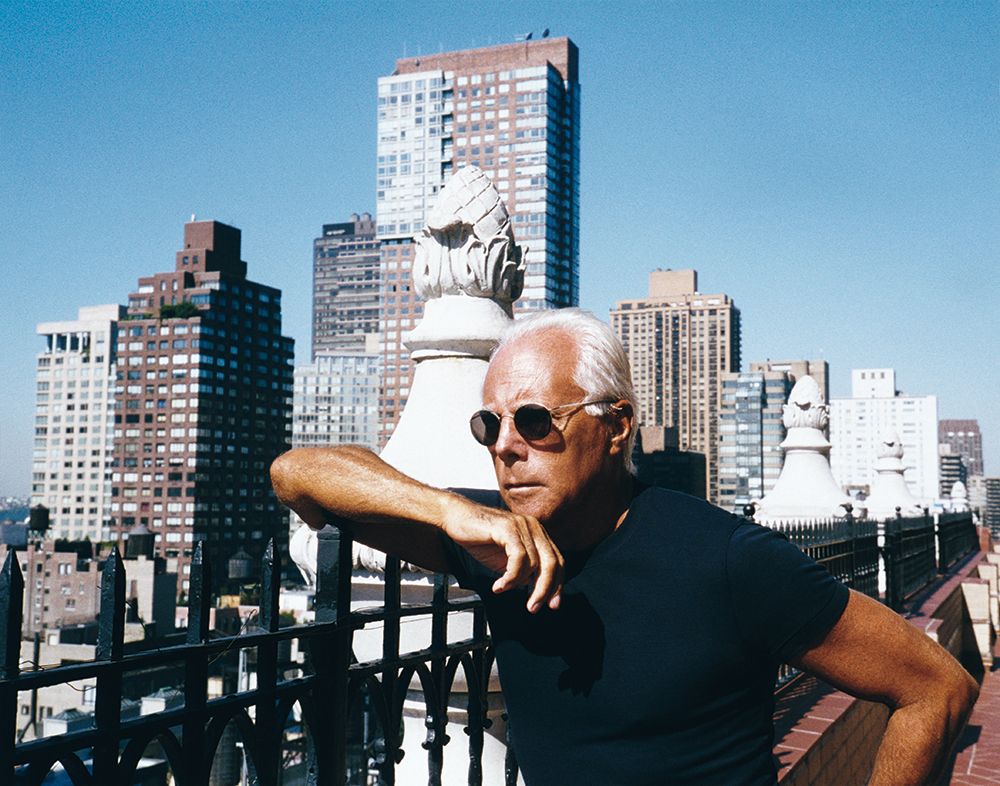
Or one from a decade ago, when 700 guests were invited to Armani’s 2013 One Night Only bash at SuperPier in Manhattan’s Meatpacking District. Showcasing a medley of nearly a decade’s worth of couture collections, Armani said of New York, “Since the opening of my first store in New York in 1985, I’ve always had a loyal following in the city.” He also explained his continuing affection for the States as a whole. “I like America and the American people. Whenever I return, they show their admiration and affection toward me with incredible enthusiasm. This comforts and reassures me. There’s spontaneity in my American audience, and they have such a sincere way of expressing admiration that, as a designer and entrepreneur, it encourages me to continue working with fantasy and commitment.”
He would return 12 years later, in 2025, to open his refurbished Madison Avenue store, which, emblematic of how the Armani universe has expanded in the past quarter century from offering just clothing and accessories, now boasts a café, restaurant, interiors boutique, and residential apartments. There is, to date, no Armani hotel in New York, but the ones in Dubai and Milan suggest that this could change at any time.
“I am delighted to return to New York to celebrate this very important project,” said the designer on that occasion. “My time in this city has always been significant and has marked key moments in my career. The opening of Madison Avenue is an important personal milestone because it crystalizes my vision of style in the city that was perhaps the first to truly embrace it.” Sadly, that trip would prove to be his last.
But it seems he’s still with us. Esquire’s Nick Sullivan again: “He’s not really gone. The brand is so famous that it feels like it’s just carrying on. When a fashion house loses its connection with a designer it can choose to embark on a new direction or respect the legacy. It remains to be seen what will happen at Armani, but to go away from his aesthetic altogether would not only be a move away from Armani, but also from Italian style itself. In the States, I suspect we’ll just carry on wearing Armani as we have done for the past 50 years.”



Comments