On the night of 1 March 1943, RAF Bomber Command launched its heaviest raid of the war so far. More than 300 planes dropped 660 tons of bombs on Berlin. Precise targeting was impossible and the aircraft hit the south-west of the city, including the botanical gardens and museum. Incinerated that night were three-and-a-half million dried plant specimens: ‘a catastrophe of major proportions to world botany,’ lamented Science magazine.
The devastating fire at the Berlin-Dahlem Botanical Museum provides the arresting opening to Ben Dark’s Green Kingdom. Dark’s first book, The Grove, was a charming wander through ‘19½ front gardens’ on a single street in Camberwell. In Green Kingdom, the former head gardener expands the canvas greatly to encompass the vast history of plant evolution.

On the night of the Berlin bombing, the museum’s botanists were engaged in a decades-long survey of the world’s plant families, an early attempt to determine the evolutionary connections between plants. Dark tells a related story through the narratives of just 16 plant families – one chapter per plant family – arranged according to their evolutionary order. The chapters build to an epic tale that traces the emergence of plants from the water to their domination of the land.
The book starts with mosses and ferns, progresses through cycads and pines to waterlilies, buttercups, bellflowers, grasses and orchids. It is an account that ranges over millennia and takes in asteroid strikes, ice ages and continental drift. The grand scientific narrative is counterpointed with historical vignettes and biographical sketches of botanists, artists and philosophers. Dark has a sharp eye for the telling anecdote and evidently relishes the surprising swerve.
Take the chapter on pines. It opens in 1937 with a thrilling description of the rediscovery of one of China’s oldest surviving timber buildings by the first Chinese woman architect, Lin Huiyin, and her husband, the architectural historian Liang Sicheng. Constructed from Prince Rupprecht larch, the isolated East Hall of Foguang Temple in Shanxi province had, extraordinarily, survived intact for 1,080 years. Picking up on the name of the larch variety, Dark takes a detour into the politics of plant nomenclature (the tree’s botanic name honours Rupprecht, Crown Prince of Bavaria), before outlining the process by which trees lay down wood. A personal memory of the pine forests of Bogotá then shifts into an account of the seismic events that shaped the globe, before turning to the repeated cycles of glaciation and thaw that sent pine forests marching and retreating across Europe.
Such shifts in focus and timescale risk disorienting the reader, but for the most part, Dark’s writing is sufficiently beguiling that you go with the flow. The structuring device of plant families – which contain anything from one species (ginkgo) to 28,000 (orchids) – gives him licence to roam across continents, islands, mountains and bogs. While Dark conveys scientific ideas with clarity, it is as a cultural historian that he really shines. The book is crammed with intriguing nuggets gathered from art, literature and history.
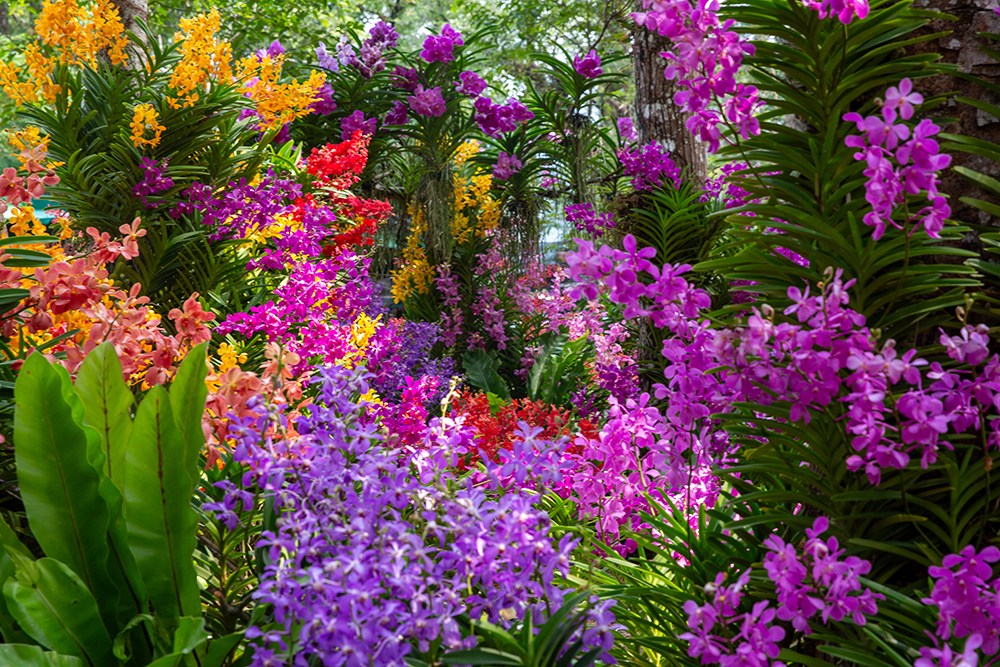
Plant families can contain anything from one species (ginkgo) to 28,000 (orchids)
We learn, for instance, that Claude Monet was so obsessed with the play of light on the waterlilies in his Giverny garden that he had the stretch of road outside his house asphalted to prevent the dust from settling on them – and spare his gardeners their former morning task of dunking the lily pads underwater to restore their glossy sheen.
In 1934, Sir Arthur Hill, the director of Kew Gardens, led a party of botanists to Mount Athos in Greece. Free from the depredations of goats (which, along with all female living beings, are excluded from the monastic region), Mount Athos has a unique flora. Out botanising, the Kew party encountered an aged herbalist monk with a large sack on his back. To identify plants, the monk drew from his bag four manuscript volumes which, amazingly, turned out to be the herbal treatise written by the ancient Greek physician Dioscorides: an unbroken tradition of plant knowledge stretching back to the first century.
You’ll find many such gems in Green Kingdom. If you like your science mixed with culture, and want a readable introduction to plant evolution, then this is the book for you. Dark writes with flair, wit and occasional lyricism. He takes time to reflect on the endless task faced by botanists as they painstakingly describe each species. He is particularly struck that the bombed-out staff of the Berlin Museum continued with their work of classification amid the ruins. ‘To do so as the Red Army advanced could be seen as form of poetic madness,’ he writes, but then again, what greater work could there be than to persist in ‘humanity’s unending struggle to understand our world and its inhabitants’?





Comments