
If you hear ‘allahu akbar!’ shouted in the street, you’ll probably run for cover. If a stranger bellows the Jewish equivalent, ‘Baruch hashem!’ in public, you might guess they’re expressing gratitude for their good health when asked how they are. If the words ringing out from the midst of a crowd are ‘Jesus Christ!’ You’ll probably think someone has stubbed their toe, or seen something ridiculous.
Islam is a proselytising religion, unlike, say, Judaism, which actively discourages conversion
Instinctive reactions matter because they expose deeper dispositions, often aligning with the very intention behind the action that provoked them. There is no true equivalence between the three phrases, even if they appear to cover similar ground across the Abrahamic traditions. Comparing our reactions to these religions, and to others, rarely proceeds on a straightforward like-for-like basis.
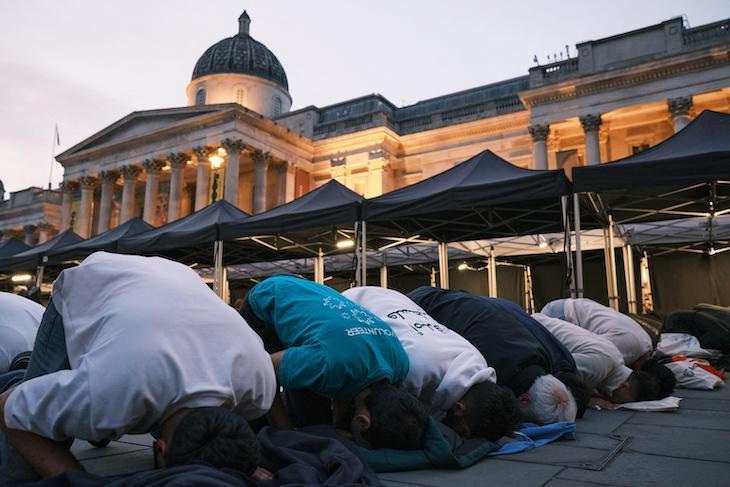
When Nick Timothy posted a critical comment on X about the recent public Muslim prayer in Trafalgar Square, which included the participation of London’s mayor Sadiq Khan, opinion split quickly. Many thanked him for articulating what they felt others were unwilling to say, while others responded with sharp criticism.
“Mass ritual prayer in public places is an act of domination,” the Conservative MP wrote. “The adhan – which declares there is no god but allah and Muhammad is his messenger – is, when called in a public place, a declaration of domination.” He went on to call the Trafalgar Square gathering “an act of domination and therefore division” noting the “domination of public places is straight from the Islamist playbook.”
Behind this debate lies the idea that Islam is a religion of dominance, which seeks to confer the rest of us into adherents. It’s a proselytising religion, unlike, say, Judaism, which actively discourages conversion and makes it difficult to achieve. The Islamic concept of Dawah, coupled with the regular manifestations of violent Jihad the UK and the West have had to become accustomed to over recent decades, is one reason why many people feel a genuine and legitimate sense of unease when they hear the same words terrorists shout as they slaughter us, echoing across our nation’s primary public square. It is unsettling.
Many felt equally uncomfortable seeing videos circulate of Islamic prayer echoing through Windsor Castle, and more recently through Westminster Hall in the Houses of Parliament. The very room thousands had shuffled through to pay their respect to her late Majesty Queen Elizabeth II and Winston Churchill, in the heart of our Parliamentary buildings, now appeared to some to have been ‘conquered’. Both venues carry the weight of being iconic, historical settings which represent different branches of power in our nation, as does Trafalgar Square. They represent power through royalty, parliament, and military victory.
Labour MP Naseem Shah – the Labour MP who was once suspended from the Labour Party for antisemitism for sharing posts online before she became an MP which suggested that Israel should be ‘relocated’ to the US (‘problem solved’) and warning that ‘the Jews are rallying’ to skew an online poll – responded by saying Timothy’s comments were ‘beyond awful’ because other faith groups regularly celebrate their religious festivals and holidays in Trafalgar Square, but Muslims were being ‘exceptionalised’.
It’s true, I have stood several times under the shadow of Admiral Nelson next to a massive Chanukiah, eating doughnuts and spreading Jewish good cheer. But it is intellectually dishonest, and socially tone-deaf, to equate these events with crowds of Muslim men prostrating on the pavement to the sound of “Allahu akbar” during a full public prayer service. They register differently with Londoners who witness them, shaped by distinct cultural backgrounds and motivations. That, in essence, was the point Nick Timothy was making.
I have often seen small groups of Muslim men praying in Israel’s Ben Gurion airport, unfolding their rugs and quietly engaging in their religious practice. Nobody bats an eyelid. Similarly in airports across the world, many observant Jewish men wrap tefillin in groups of ten when it is time for their morning prayers. These episodes tend be uncontroversial because they are clearly quiet, personal moments of religious reflection, respectfully carried out in an unusual place out of necessity, because of travelling schedules, time zones, or a lack of synagogues or mosques nearby to pray in. Mass street worship is different.
Suppressing discussion of the fears surrounding this sensitive subject will only deepen, for some, the sense of being overridden or subordinated.
The debate is not confined to London. New York City is home to nearly one million Muslims, and in late February, soon after Zohran Mamdani became the city’s first Muslim mayor, crowds gathered in Times Square to broadcast the Islamic call to prayer during Ramadan.
In France, since around 2010, when mosque overflow first pushed thousands to pray in the streets in areas such as Goutte d’Or and Argenteuil, the issue has remained a point of contention. Marine Le Pen, then leading the National Front, described those scenes as an “occupation.”
If it’s not an essential requirement, why would you want to pray on the dirty ground of London’s streets, especially if you know the anxiety it causes about your religion?
It is intellectually dishonest, and socially tone-deaf to equate these events with crowds of Muslim men prostrating on the pavement
Islamic history links public congregational prayer and the adhan, the call to prayer, to shifts in political and civilisational dominance. In Mecca, during Islam’s minority phase, early Muslims prayed privately or within homes such as the protected, semi-secret Dar al-Arqam. Public visibility was limited, constrained by vulnerability.
With the move to Medina and the consolidation of power, this changed. Public prayer emerged as an open expression of authority and presence. The adhan became a proclamation, audible and deliberate. The pattern appears again during the conquests of the seventh and eighth centuries: military victory, followed by public adhan and congregational prayer, then mosque construction, and the gradual transformation of space into Islamic territory.
Some interpret modern instances of street prayer in Europe and North America as a continuation of this sequence in attenuated form, a soft replication in which visibility and presence are asserted without military force. They point to core Islamic sources emphasising supremacy, public ritual, and total societal submission. For example, Mohammed is quoted as saying, in Sunan al-Tirmidhi 317, “All of the earth is a place of prayer except graveyards and bathrooms.” Quran 9:33 and 61:9 state that Allah sent Islam “to manifest it over all religion.” Surah Al-Fatihah, recited 17 plus times daily in prayers, includes “Guide us to the straight path…not those You are displeased with,” which is interpreted by some to mean Jews and Christians. All this frames public prayer as affirming dominance over us infidels.
The political part of Islam presents itself as more than personal faith, extending into a comprehensive ideological project. Within that framework, mosques are at times described as outposts in non-Islamic environments, a view reflected in internal Muslim Brotherhood material. A 1991 memorandum, revealed in U.S. court proceedings, outlines a strategy of “civilisational jihad” through settlement, institution-building, and gradual influence. Public prayer, in this reading, functions as a visible marker of presence. You can understand why some people are afraid.
Mass street worship is different
Because contemporary rhetoric from imams and activists in the West often spreads ideas of conquering Europe with prayers and babies, expressing Islamist political action through prayer risks granting it immunity, and even the authority to disrupt.
In Britain, we fiercely protect freedom of religion, and any criticism of someone else’s faith can easily be smeared as discrimination or inequality. It’s not in our nature to do so. But Nick Timothy did not do that. He represented a widely held concern that many ordinary citizens have, and went some way to explaining why they have it. He started a debate, in a calm and respectful way, on a topic of potentially explosive sensitivity. If that isn’t the job of a Member of Parliament, what is?

Comments