

How to report Iran? It is a huge story. Perhaps as many as 30,000 people were recently murdered there by the tottering regime, but it won’t let western media in. The BBC’s solution is a deal: their correspondent can enter and report, but the report cannot appear on their Persian service. This agreement is rightly explained on air, unlike the BBC’s iniquitous deal with Hamas over Gaza. Do the terms of the deal benefit journalism, however? We are always told that BBC foreign language services are the lifeblood of truth for citizens of dictatorships. Why are Farsi speakers to be deprived of this? Also, what do we learn from Lyse Doucet walking the Tehran streets in a headscarf? (Is it compulsory or voluntary? Either way, she should explain.) Obviously, the people she meets will not dare criticise the regime. She does not just veil her head: she veils the truth.
Of all politicians who mattered in the Thatcher/Major era, none is more self-effacing than Richard Ryder, partly by temperament and partly because he was Major’s chief whip for five years. He has never broken that omertà. So it is typical that his new book has the tremendously uninformative title Ten Essays, with no explanatory blurb, is privately printed, unavailable in shops and already sold out. Of the ten men remembered (the one all-important woman has no essay to herself but bustles in and out of all of them), only three – Geoffrey Howe, Keith Joseph and Cecil Parkinson – were household names. One other, Alan Clark, became a household name later. Richard is particularly good on the behind-the-scenes characters who matter in public affairs – Airey Neave and Ian Gow (both murdered by Irish republican terrorists) and Alistair McAlpine, the flamboyant party treasurer. Ryder’s phrasing is always just. Here he is on Thatcher and Howe, and on Gow’s role as a friend of both: ‘MT was driven by passion and certainty, crisply stated, whereas Howe preferred to ease the tempo with reason, measured yet copiously expressed, sometimes until after the cows had drifted into the barn. Ian attempted to unite the pair yet found conflict-resolution a non-starter, forcing him to arbitrate temporary ceasefires.’ I do hope he will reprint fast: this is the ideal collection of Thatcher circle pen-portraits.

Between 2013 and last month, Guy Elliott could not talk to his friends – of whom I am one – about the main problem besetting him. Accusations about his business conduct, originally in Britain, Australia and the US, mutated into charges in Australia and America, the last taking by far the longest. His company Rio Tinto, its chief executive and he, the chief financial officer, were all accused of having been too slow to write off the value of a failed project in Mozambique, ‘indirectly causing false statements’ in accounts, and of fraud. Elliott could not talk even privately until the charges laid by the SEC were dropped. In his Spectator column [7 February], Martin Vander Weyer rightly emphasised the horrendous slowness of the American process, about a third of Elliott’s entire working life. Two other points should be added. The first is the triple jeopardy in raising capital in three jurisdictions. The second is that Elliott ended up fighting alone because Rio Tinto and the chief executive settled early on a neither-confirm-nor-deny basis. Elliott held out, insisting he had committed no fraud or any other financial sin. It took a particular courage to persist. It is galling for such people that accusations, when made, attract big media coverage, whereas exoneration is hardly reported. Hence this Note. Guy Elliott is, in the famous phrase, ‘a pretty straight kind of Guy’. The world should know this.
Following my mention of Constable’s ‘Leaping Horse’ last week, a reader writes, defining the difference between Constable and Turner as one of ‘religion’. Constable ‘is concerned with empirical experience of the natural world, and finds delight and beauty in each “scoop and ragged burst” of a storm cloud… The deity… is distributed and fragmented through these natural experiences which are microscopically aesthetic.’ Turner, however, ‘is an idealist, and his paintings are objectifications of a monotheistic metaphysic. They are visions of supernatural power and concentrated macroscopic authority.’ You can admire both ‘but sincerely love only one’. That is very well put. My correspondent’s name is John Constable. He shares his ancestor’s fascination with the weather, being director of the Future of Energy Institute at the University of Austin and a leading climate sceptic.
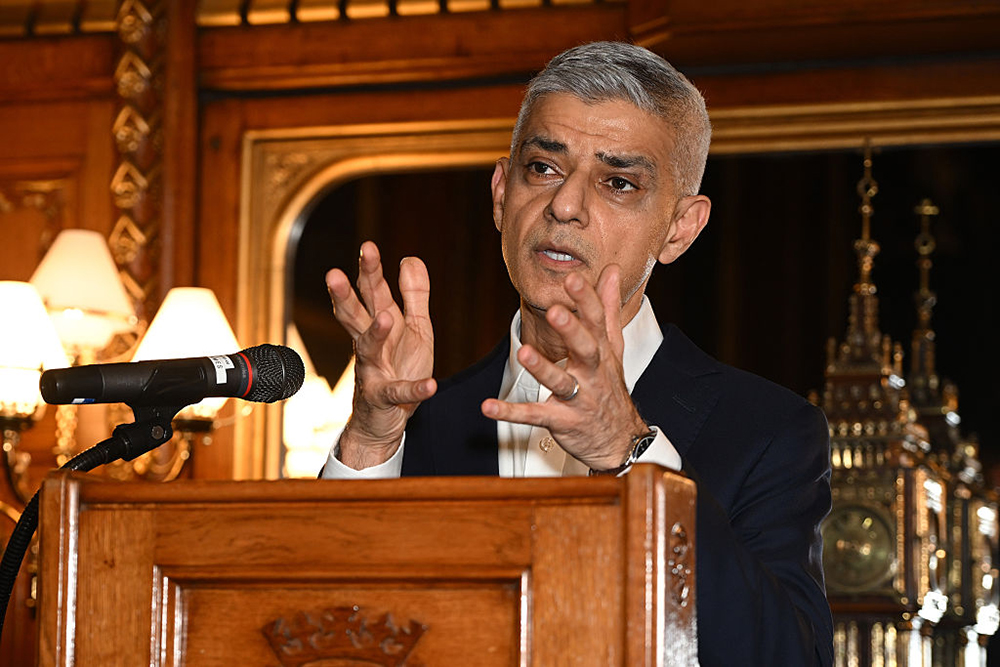
Following Jim Ratcliffe’s controversial words about Britain being ‘colonised’ by immigrants, my Telegraph colleague, Michael Deacon, pointed out that, to mark the 70th anniversary of the Empire Windrush, Transport for London, backed by Sadiq Khan, had poems displayed on the Tube. One, by a Jamaican woman, reads: ‘What a joyful news, miss Mattie,/ I feel like me heart gwine burs/ Jamaica people colonizin/ Englan in reverse.’ Michael has shown me the last stanza, which TfL omitted although (or because?) it is more explicit. It reads ‘Wat a devilment a Englan!/ Dem face war an brave de worse,/ But me wonderin how dem gwine stan/ Colonizin in reverse.’ So Sir Jim and Sir Sadiq would appear to agree that colonisation is taking place. Oddly, it is Sir Sadiq who thinks colonising is a good thing.
Radio 3 Unwind is the broadcast equivalent of assisted dying, music as a drug to end life’s pain. Music can indeed be balm to the troubled soul, but a whole channel devoted to this degrades culture into therapy. Turning on Radio 3 proper in the car this week, I heard Georgia Mann excitedly announcing the first ever weekly classical chart, whose hit parade the station will avidly report. So Radio 3’s classical music offering is now a choice between a 33rpm version of Top of the Pops, and the sleep of death.


Comments