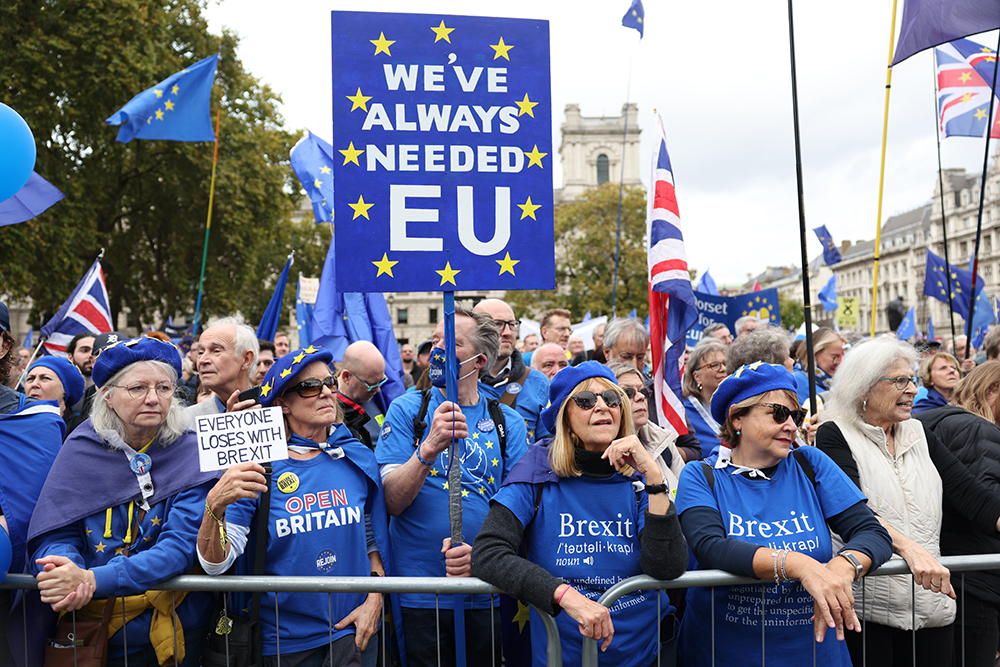
In the build-up to the tenth anniversary of the EU referendum, we’ve heard lots of claims about Bregret. There are some Remain nostalgists who are convinced that, after a decade of listening to their wise counsel about how much better we’d be if we’d stayed in the glorious EU, those misled numpties who voted the wrong way must surely have changed their minds and be ready to slink back to Brussels. Recently, the Observer commissioned polling to prove the point. It’s true that rejoining attracted the largest single share, at 33 per cent. But the options for staying out of the EU, taken together, commanded a clear majority: 55 per cent. Mysteriously, the paper decided not to publish. Darn it, why does the public keep giving the wrong answer? Intrepid researchers from a new initiative, Britain Unbound (I am on its advisory board), wondered if this was a one-off and went back through Opinium’s published data. They found a poll from 20 May posing a simpler question: was the idea of rejoining the EU acceptable or unacceptable? A majority of 54 per cent called it unacceptable. That poll, too, was commissioned by the Observer and, again, the findings were filed in a drawer labelled ‘inconvenient truths’.
As The Spectator’s debate, ‘This house believes that Brexit was a mistake’, approached, I noticed that it was to be held on the same night as England’s first World Cup game. I became rather worried that the flag-waving types, who might be amenable to my arguments about national sovereignty, could be down the pub and their absence would distort the outcome against me and fellow team debater Michael Gove. I resolved – unlike Keir Starmer, Andy Burnham and other second-referendum advocates-of-old – not to demand a re-run of the vote.
On flags and football, several councils have issued warnings to residents not to fly England flags, banners and bunting on lampposts, railings or road signs without permission, citing concerns over safety and community cohesion. They have even issued detailed instructions about the correct way for residents to fly the flag on flagpoles at their own homes or else risk hefty fines. One of the main reasons why people voted to leave the EU was to escape such hyper-regulatory fuss-bucketry. Too many municipal jobsworths didn’t get the memo.
Meanwhile, a report has emerged from the Independent Monitoring Board watchdog that immigration officers should not wear England badges during the World Cup because they might damage ‘professional standards’ and could show workplace bias that detained migrants might find intimidating. This concern was linked to recent anti-immigration protests ‘in which flag displays were prominent’. The demonisation of people’s entirely reasonable desire to demonstrate national pride is the same tactic that was used against those who voted to take back control, partly to stop free movement, as ignorant, racist xenophobes. Many of my own left-leaning liberal peer-group in the media and academia were so shocked when they realised that I supported Brexit they accused me of betraying respectable discourse and accommodating 1930s-style fascist bigotry. Such was the #BeKind Remainer rhetoric weaponised during the Brexit years.
Once we left the EU, that rhetoric never really went away. Indeed, the tendency to brand as ‘unacceptable’ any displays of populist fury at a political class that refuses to act on the wishes of the electorate has become turbo-charged in recent times. Many of those who today harangue the public to mind their language and who justify censoring social media were once the very perpetrators of vile name-calling aimed at Leavers. Of course, they will never acknowledge that they are reaping a bitter harvest of a polarised society, declining trust in institutions and even civil unrest.
I recently spoke at the Police Foundation conference at Cumberland Lodge about the dangers of police activism. It was nerve-racking to lecture senior officers about why they should stop enthusiastically criminalising people for their views under the auspices of tackling hate speech. I joked that I hoped my strident remarks wouldn’t get me arrested. It was disconcerting that while some laughed, others were stony-faced.






Comments