
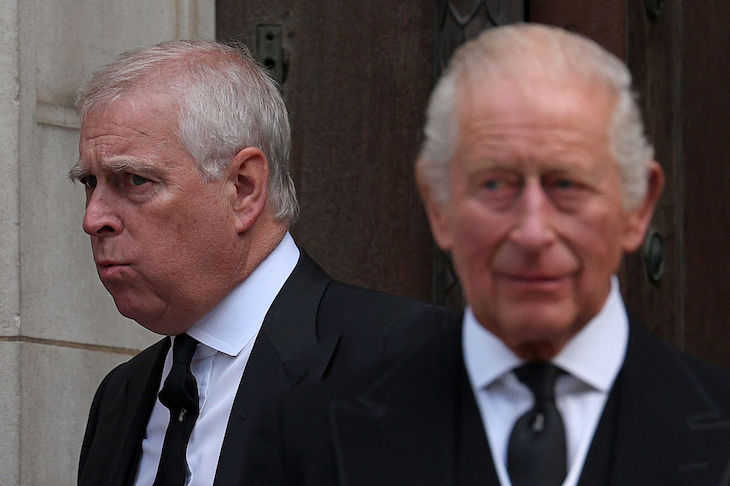
So: is the game up? Looking at the former Prince Andrew’s slumped posture, corpse-grey face and thousand-yard stare in the snatched photographs of him leaving police custody, you might be tempted to think so. He looked like Ebenezer Scrooge confronted by the Ghost of Christmas Future. The future certainly doesn’t hold anything very uplifting for this wretched, silly specimen – but will he take the monarchy with him?
The Firm gets away with being secretive in all sorts of ways – not least around money. That must change
There are two separate cases here, I think. One is: does the former Prince’s disgrace present a rational case for the abolition of the monarchy? The other is: does it create such a foul smell that the institution won’t be able to survive? That’s the difference between “should” and “will”. One case is to do with principle; the other to do with PR.
The latter is, unfortunately, the one that monarchists need to worry about. That in itself is a funny thing. After all, traditionally the whole point of a monarchy is that the people don’t get a say. When we break the law, we do our bird at His Majesty’s pleasure. Yet now, there seems to be a consensus that His Majesty holds his position, to some extent, at *our* pleasure. That has been the case a bit since the Abdication crisis, and it has been the case a lot since the death of Diana, Princess of Wales.
The principled case can be marked, I think, “not found”. As far as the family goes (because the royal family is an institution and also a family), the King and the wider royal family so far don’t seem to be on the hook. His Majesty is not his brother’s keeper. He issued a statement after Andrew’s arrest – I imagine at the cost of some personal anguish – of exemplary probity and principle. Until such time as something comes out that makes clear that red flags were raised and ignored, or worse, that any potential evidence of malfeasance was actively concealed, His Maj and his heir look to have a clean bill of health.
And nobody can seriously imagine, I think, that the case for a monarchy in principle – the case for the institution – depends on never having a member of the monarch’s family do anything disreputable. You don’t need to be a professional historian to know that over the centuries we have had any number of thieves, rapists, murderers and players of pocket billiards on, or within baying distance of, the throne.
There are, though, aspects of the story that do damage to the institution: not qua institution on principle, but as it stands. Andrew’s biographer Andrew Lownie, whose outstanding reporting on the former Prince’s doings has done much to put him under the spotlight, makes the very good point that the system itself tends to make the exposure of these things very difficult. The Firm gets away with being secretive in all sorts of ways – not least around money. That surely needs to change.
It’s a clear nonsense, for instance, that even though he was acting as a public servant in his role as trade envoy, all the records relating to Andrew’s doings in that role are sealed by default until 2065 simply by virtue of his being a member of the royal family. All that makes a case for modernisation and transparency in the monarchy. It doesn’t, it seems to me, make a prima facie case for its abolition.
The PR case, though. That’s bad. I talked about a foul smell contaminating the institution, and that’s exactly what we have. Even the coverage of the former Prince’s arrest was damagingly murky. We had senior members of government taking to the airwaves to say how their thoughts were now with Jeffrey Epstein’s victims, and Virginia Giuffre’s brother was wheeled in front of the cameras again to say how proud he was of the stand she took. All of which will tend to give the vague impression that Andrew had been arrested for complicity in Epstein’s sexual crimes.
As yet, he has not. I don’t mean, by that, that he doesn’t have questions to answer. His refusal to give evidence in the case, his Keystone Cops-style dodging of legal papers, the pack of ludicrous lies he told when asked about it, the substantial financial settlement with a woman he claimed never to have met, the grotesque photographs of him cavorting with young girls in royal properties, the emails: all of these things invite one of Paddington’s very hardest stares.
Republicanism is the rational position
But he’s been arrested on suspicion of misconduct in public office over claims he passed classified government documents to Epstein (he has not yet been charged and has repeatedly denied any wrongdoing). He hasn’t been done for anything sex-related at all, and “Being A Wrong ‘Un” is not, yet, a charge that the Crown Prosecution Service recognises. Not that you’d know it from the tone of the coverage – which is, as I say, the PR problem.
Having been tangled up with Epstein, PR-wise, is not like being shot with a sniper-rifle. As the other big names who have appeared in the Epstein Files can testify, it’s more like being sprayed with buckshot smeared with dog poo; and there are plenty of stray pellets hitting everyone standing anywhere near you. The King, to switch metaphors, has done what he can to steady the ship. The next year or two will make clear what’s going on below the waterline.
For what it’s worth, which I know is not much, I’m a bit on the fence about the institution. It seems silly to me that we should be subjects rather than citizens. The flummery is ridiculous and the cost considerable – whatever may be said about those tourists supporting the economy by buying hot-dogs from botulism carts while they mill about in front of Buckingham Palace. You wouldn’t design it this way from scratch. Republicanism is the rational position.
On the other hand, the apparatus of monarchy does have some soft-power wallop. And it’s not something anyway whose value can be costed in pounds and pence. Most of the important things in life are not strictly rational. The Royal Family is our greatest national soap opera, giving joy and amusement to millions the world over. Its longevity and, yes, ridiculous flummery are part of the oddness and distinctiveness of our national identity. And Chesterton’s Fence applies, too. We don’t want to find out that the monarchy was a good thing by the experiment of getting rid of it. Or as Hilaire Belloc expressed this honourable conservative principle: “Always keep ahold of nurse/ For fear of finding something worse.”





Comments