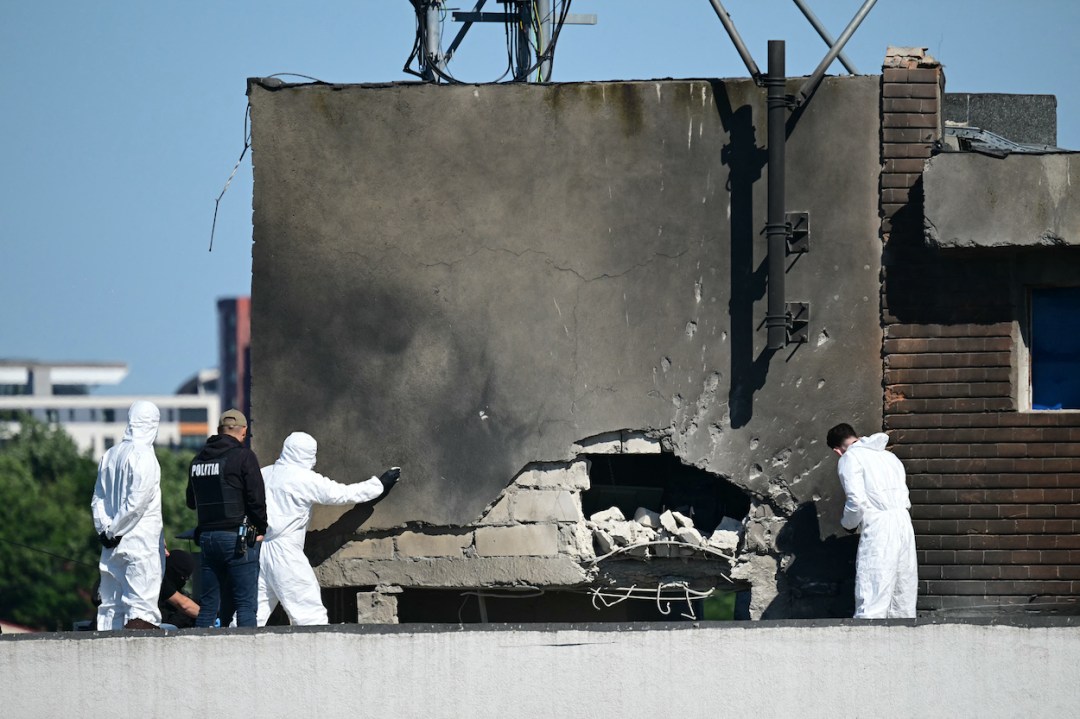
NATO’s mission is to defend every inch of its members’ territory, the alliance’s mantra goes. Then, on 29 May, a Russian drone hit a Romanian block of flats, injuring two people. Now Nato faces a dilemma: if it doesn’t react, it signals that adversaries can hit Nato with impunity as long the harm is, in the scheme of things, insignificant. If it does hit back, it risks full-scale war. This dilemma is precisely why Russia is so cavalier about minor incursions.

In the early hours of 29 May, a Russian drone whizzed through Ukrainian airspace and entered Romanian territory, where it hit a block of flats in the port city of Galati. A mother and child were injured in their home. It remains unclear whether Romania was the intended target or whether the drone strayed across the border after encountering Ukrainian drone defences.
Either way, two people are injured, and President Nicusor Dan didn’t mince his words when assigning responsibility: ‘I declare, with the utmost firmness, that full responsibility for this incident lies with the Russian Federation,’ he wrote on X. He added: ‘There is no ambiguity regarding the perpetrator or the cause of this aggression.’ Other Nato presidents, prime ministers and foreign ministers immediately took to social media to express their support for Romania. (Donald Trump and Marco Rubio did not. The United States’s Nato ambassador did, but refrained from mentioning Russia.)
Mark Rutte was also unequivocal. ‘Russia’s reckless behaviour is a danger to us all. They continue to target civilians and civilian infrastructure across Ukraine. And last night showed yet again that the implications of their illegal war of aggression don’t stop at the border. Russia’s war needs to end, as does Russia’s disregard for civilian safety,’ the NATO Secretary General posted on X. He promised that NATO would strengthen its deterrence.
The Galati incident was only the latest one involving incursions by Russian drones and even aircraft into Nato airspace. ‘We’ve seen a whole string of drone incursions since the beginning of Russia’s full-scale invasion of Ukraine,’ said Oana Lungescu, the Romanian-born former Nato spokesperson, who is now a distinguished fellow with Rusi. ‘There have also been aircraft incursions into Estonian airspace, and drone debris has fallen on Romania’s border with Ukraine before. This all shows that even though Nato countries are not party to the Ukraine war, they can be directly affected.’
Within 24 hours in September last year, no fewer than 19 Russian drones entered Polish airspace. Some, or all, may have been intended for Ukraine, but that was cold comfort for the Poles, just as it was for the Romanians last Friday. Russia seems unconcerned about the risk of its drones straying into Nato territory, where they are unwelcome and may cause injuries or worse.
What’s more, ever since the invasion, the Kremlin has been expanding its use of non-military needle pricks against Nato. It attacks our digital systems around the clock. It regularly hires ordinary citizens in our countries to commit attacks including the setting of arsons and the delivery of parcel bombs. (In March 2024, five young Britons set fire to a London warehouse that contained supplies for Ukraine.) It has tried to destabilise the borders of Norway and Finland by depositing migrants there. It continues to deploy the shadow fleet. The fact that all this leaves victims with significant monetary losses and poses risks to human life seems not to bother the Kremlin. But such attacks are not a matter for Nato, whose task is to defend its member states’ territory against military assault.
The Kremlin has been expanding its use of non-military needle pricks against Nato
Does a lone drone, or even 19 drones, constitute a military attack? Such decisions are a delicate matter. ‘Romanian pilots had the authority to shoot down the drone, but it was too risky to bring it down over a residential area,’ Lungescu told me, referring to the 29 May incident. ‘These are the kind of split-second decisions pilots have to take.’ The alliance is working to tackle the new threats. Polish and other Nato aircraft have shot down drones in Polish airspace. The alliance has set up an initiative called Eastern Sentry to enhance ‘Nato’s vigilance along the entire eastern flank’, and one called Baltic Sentry which patrols the Baltic Sea’s undersea installations. Poland and Romania have purchased anti-drone systems. Just a few days ago, Estonia launched the first part of a similar system.
The mother and child who were injured in Galaii were indisputably on Nato territory. But these days, defending every inch is rather less straightforward than when the alliance was founded nearly eight decades ago.






Comments