



Arabella Byrne has narrated this article for you to listen to.
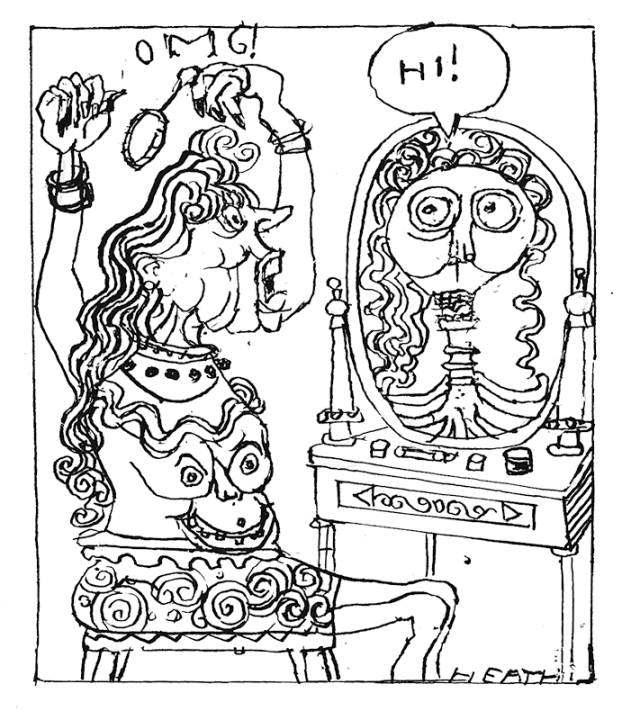
Recently, I have started to worry about my face. Early in the morning, before the children wake up, I’m sure I can see ghosts in the downstairs loo mirror. My 20-year-old self’s face flashes before me but soon vanishes reproachfully into the crow’s feet around my eyes; I didn’t like her anyway. My long-deceased father lingers over my cheekbones and draws the smoking lines around my mouth in ash. I frown back. My grandmother, anxious, appears in the split second between posing and relaxing. I squint as she used to when playing bridge. If the past is an inscrutable face, I am reduced to reading, not between the lines but between the wrinkles.
I never thought I would get old – I’m 43 – but it’s happening. Admittedly, my lizard-like love of the sun and devotion to fags hasn’t helped. I once spent an entire month in Provence lying on a riverbank with no SPF on and smoking Gitanes sans filtre. That’s some skincare regime. Mercifully, a new buzzword in beauty has appeared – and it suits me down to the last frown line. “Old Money Face” is an active rejection of Kardashian beauty optimization and the reviled 2D “Instagram Face” retrofitted by plastic surgeons after we were taught to edit ourselves through filters on a phone.
Like most things to do with being posh, you simply can’t buy it
Forget fillers, forget Botox, forget the hush of the clinic and the scolding word of the surgeon as he taps the needle. The grandest thing you can do in this beauty revolution is to wear a sensible hat and smear some sun cream from the bottom of a drawer over your mug. Picasso, speaking to Gertrude Stein, once pointed to a face and said: “It is as old as the world.” Could he have known, 100 years later, that this would be the greatest compliment of all?
But Old Money Face is more than skin-deep. Like most things to do with being posh, you simply can’t buy it. Old Money Face betokens a way of the world that has, rather hilariously, nothing to do with the altar of wealth upon which the beauty industry (worth £28 billion in the UK) relies. Or, as Alan Clark would have it, face work is the surgical equivalent of having to buy your own furniture. Old Money Face speaks to a life spent outside in the country – walking the dogs, riding, gardening – and a stout, immovable skepticism about sun skin damage (“I think climate change is absolutely bloody marvelous, the sun shines more,” one jolly aristocrat tells me during “over the yardarm” drinks in the walled garden). It is the weatherbeaten sign of a life well lived and a suspicious approach to “beauty” – a Mitford-esque belief that one looked in the glass only out of concern rather than vanity.
I can spot Old Money Face a mile off: sunspots from lashings of skiing and sailing; bags under the eyes from too many boozy afternoons at the Chelsea Arts Club; craterous frown lines across the forehead after paying the school fees for four children; and, importantly, smoking lines down either side of the mouth which gives it a slightly doggy, chic look. Its most famous possessor, of course, is the Queen – no stranger to the Gloucestershire wind or the yardarm drink and cig. Other poster girls include the late Mollie, Marchioness of Salisbury, who helped the King design the gardens at Highgrove, and the late, great “Debo,” Duchess of Devonshire, who wouldn’t have gone near a needle in a fit. Regarding needles, Old Money Face is categorically opposed to Ozempic. “You don’t look so wrinkled if you’re a bit fatter,” a wise OMF confided.

Why now? Are we postface as we were once postmodern? Perhaps we have lived too long in the age of digital visibility: on Instagram, on Zoom – where the face has become suspended from the body – and even within the realm of emojis where affect is short-circuited in a range of variations on the cartoon countenance. And only cartoons could explain “Mar-a-Lago Face,” a look worn and engineered by the women of the Trump administration such as Kimberly Guilfoyle, the ambassador to Greece. Mar-a-Lago face constitutes a crude artificiality; perhaps, like its political crucible, it is a dismissal of reality altogether. And similar to its brother philosophy of looksmaxxing, it rests on the credo that everything – from the eye area to the shape of the skull – can be improved. But we have become faced out. For if the female face has become the site of the struggle between time and vanity-induced terror, it was inevitable that it would come undone. Face capital could last only so long; expect the same to happen with semaglutides.
Another early morning dawns and I resolve to seek a professional opinion (for journalistic purposes) on the ghosts in the mirror. Is it Old Money Face, as I hope, or simply the beginnings of Old Hag Face? The plastic surgeon greets me in his immaculate Belgravia clinic with loafered calm and kind assurances. I have, he tells me, “pronounced sun damage” across my forehead and, rather mysteriously, my chin. I lie back and he begins to outline a range of treatments: light exfoliation, laser treatment, bespoke pigmentation creams. I pretend to listen, but I am elsewhere, lost in a gallery of faces that I don’t recognize. I leave the clinic with my dark glasses on, light a fag and sit in the sun.





Comments