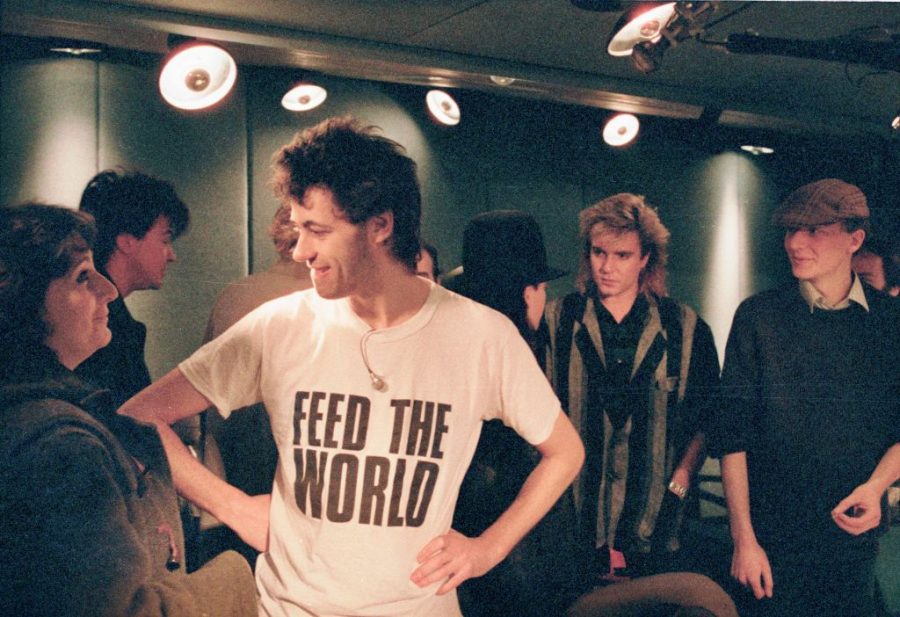
Is this the year that ‘Do They Know It’s Christmas’ – the charity song written by Bob Geldof and Midge Ure in 1984 to provide relief for the victims of famine in Ethiopia – finally died? The song has been condemned for its broad-brushstrokes lyrics about Africa, and it feels increasingly like the work of a naïve and distant past. But the truth is that it has always been better music than critics would like us to think. The question that matters most though is the hard one: did Band Aid improve the world?
Urging the public to ‘feed the world’, Band Aid created the modern association between fame and philanthropy and sparked a global movement culminating in the Live Aid concert the following summer. In combination, the song and the concert raised over £100 million in today’s money for the famine, and placed Africa on the Western agenda. Geldof’s lyrics call for thought for the ‘world outside your window’, but they were inspired by the world as it appeared on the TV. Geldof watched BBC coverage of the famine on a Friday night in November, as his fame in the Boomtown Rats dwindled.
The stars who recorded ‘Do They Know It’s Christmas’ did it in part to feel good about themselves
The story that follows is a familiar one, and boils down to several weeks of bollocking people on the phone; but there was a surprising level of brinkmanship involved in finishing the song in time for Christmas. Geldof wrote the majority of the lyrics in half an hour in the back of a taxi. Ure, the Ultravox singer who served as producer, had four days to finish the music and record the instruments at home. ‘Feed the world’ was already the strapline by the time the singers stepped into the studio, but not a lyric. The ‘Let them know’ finale was written in the studio on the afternoon of the recording.
The song is catchy and musically daring for a sentimental Christmas hit, an experiment with no hook or chorus and cheap but charming new wave instrumentation. The door-opening sound at the start was sampled from the synth group Tears for Fears – later among the numerous bands which Geldof announced for Live Aid before asking if they actually wanted to come. The song was mercifully spared a U2-style arrangement by a kidney infection, which struck down its intended guitarist The Edge the night before the recording. The signers who showed up rescued the song, often rewriting the vocal melodies entirely. George Michael added his sirenic descent on ‘But say a prayer’; Boy George hyped up the cry of ‘throw your arms around the world’ which sets off the first verse, and punctuated the track with ‘oos’ throughout. Bono hated his line, ‘thank god it’s them instead of you’, but no one forced him to scream it an octave higher than it appeared in the notation.
Ure locked himself in the studio all night to mix the record and sent Geldof to the BBC with a tape cassette the following morning. The song was an instant number one –the fastest-selling British single until ‘Candle in the Wind’, Elton John’s farewell to Lady Diana – and raised £8 million in the following year, against hopes of £70,000. Geldof visited Ethiopia to see the deployment of the funds, where he requested not to be photographed with children, but was. The seeds of the Live Aid concert as a follow-up lay partly in the need for more funds to break a trucking cartel hampering the distribution of the food – but also partly in the enthusiasm of Boy George, who suggested a live version after enjoying the recording, and whom Geldof originally supported as the organiser.
Why should the money have been raised for that famine, and not for another cause? Whether or not the objections to Band Aid are ‘bollocks’, as Geldof has always described them, there is often fantasy thinking involved. A Christmas song released in the middle of the 1980s was unlikely to foster steady regime change in a war-torn nation or indeed promote free trade or international socialism. The lyrics have probably not cost Africa ‘trillions’ through damaging stereotypes, as has been alleged. The participants may have benefited from their involvement, but that did not reduce the donations.
It has been argued that the aid prolonged war in Ethiopia by relieving areas starved by Mengistu’s regime; there is no consensus that that was the wrong decision. In all truth, Ethiopia forms a minor part of the legacy. The Band Aid phenomenon may have been the most significant public-facing factor in the formation of modern international development, permanently changing fundraising methods and broadcasting images of famine to 1.5 billion people through the concert.
If the point of that spectacle was to raise awareness, then the impact on public donations may have been underwhelming. In the US, where numbers are sound, the public donated around 1.6 per cent of GDP in 1980 to charity. That figure stands at 2 per cent in 2025, and the increase mainly took place mostly in the 1990s. The international figures are murky, but suggest that donations outside of the US may have been stable. But for better or worse, private charity is not the whole picture – especially in the UK. The timing of the follow-up Live 8 concert in 2005 – and the involvement of Geldof and Bono in New Labour summits – lines up with a large increase in government aid spending, which rose from 0.3 per cent of UK GDP in 1980 to 0.7 per cent in 2020. David Cameron invoked Live Aid when he committed the Conservatives to 0.7 per cent under both of his electoral manifestos. Times have changed since, and the target has been cut to 0.3 per cent to fund more spending on defence, not without cause.
If the song retains some of its charms, that is because it sounds like what it was: a group of hungover pop stars realising that the rest of the world existed, and resolving to save it the following day. That is not an agenda, but it was a real feeling, even if it now seems preposterous. Something about the song still captures the strangeness of the modern world, in which the whole of our species is visible on a TV screen, at enormous distance. We don’t do much about it, and that may often be for the best, but we cannot completely forget its existence. If there is something about the Band Aid era which is particularly tempting to mourn, it is the spirit which led two relatively young men – Geldof was 33, and Ure was 31 – to attempt something enormous which everyone told them could not work.
Geldof has described the ‘white saviour’ phrase that has followed him since as the ‘greatest load of bollocks ever’. It is an irritating label, to be sure, but he isn’t completely right. The stars who recorded ‘Do They Know It’s Christmas’ did it in part to feel good about themselves – and to be seen to be doing good. No doubt, those same motivations drove a portion of the public’s donations. But what this says about the world is in itself complicated, rather than disastrous. Everyone wants to feel good about themselves, and everyone wants attention; but given the choice, we’d prefer to look like heroes rather than villains.





Comments