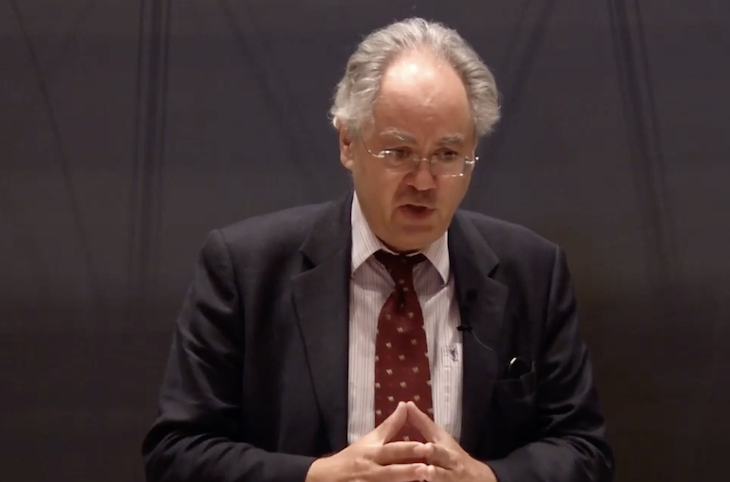
Death arrives on a day just like any other, often rudely unheralded. We all know that, but it never ceases to shock. So it was with news that David Abulafia had died on Saturday night.
Notwithstanding his lifelong fascination with the Mediterranean, David was a Brexiteer in 2016
Readers of The Spectator will know him as one of the shockingly small number of professional historians who care enough about the historical truth – and the public’s perception of it – to risk woke ire in exposing ideologically fabricated history for the corrupting trash it is. So, last June here he was, in these pages, debunking yet another attempt to make the past a boring, narcissistic mirror of ourselves, by claiming that the “diverse” Vikings were sometimes black and Muslim.
“Decolonizing the Vikings is, admittedly, a difficult task,” he wrote. “They were very good at colonizing other people’s lands, including large swathes of the British Isles, Normandy and the kingdom they founded in Kyiv, even if the Faroes, Iceland and Greenland were largely empty of people when the Vikings turned up.”
Observe the fluent mastery of the historical territory. Note, too, the wry humor. And then the rigorous, blunt, uncompromising judgment: “One of the first requirements of a competent historian is the attempt to be accurate. When arrant nonsense is taught in the name of ‘decolonization’ political ideology has taken over from history, and ignorance has triumphed over truth.” All three features were characteristic of him.
Many readers will have enjoyed his article without being aware just how much academic heft lay behind it. David was one of Britain’s most distinguished historians, having developed pioneering expertise in the history of the Mediterranean. He became a fellow of Gonville and Caius College, Cambridge at the age of 25. And he was made a university professor in 2000, fellow of the British Academy in 2010, winner of one of three inaugural British Academy Medals in 2013, winner of the Wolfson History Prize for The Boundless Sea: A Human History of the Oceans in 2020 and, “for services to scholarship,” Commander in the Order of the British Empire in 2023.

While David was rooted in Cambridge, his work and reputation traversed seas and oceans. In 2003, he was appointed Commendatore dell’Ordine della Stella della Solidarietà Italiana by the president of the Republic of Italy. And in late 2022, his book, The Great Sea: A Human History of the Mediterranean –published in 2011 and now translated into 12 languages – was spotted on the bookshelf behind Chinese president Xi Jinping, when he delivered his New Year’s address. David was very chuffed by that: I heard him chuckle over it several times.
But I came to know him primarily, not as an academic historian, but as a bold British patriot and defender of free speech.
Notwithstanding his lifelong fascination with the Mediterranean, David was a Brexiteer in 2016. In the run-up to the referendum on EU membership, he chaired Historians for Britain, arguing that the European project was a deterministic myth used to silence other visions of European community, and that British legal and parliamentary traditions are incompatible with the EU’s regulatory framework. In 2015, when History Today sought to open a debate about Britain’s place in Europe with an article by David, he (and Historians for Britain) became the target of a mass online pile-on. A stampede of almost 300 historians nationwide signed an open letter, dismissing his views by smearing them with the thought-numbing label, “British exceptionalism.” If it upset David, it never twisted him. I never heard him speak bitterly; he only sighed. He wasn’t unnerved at being isolated in a maligned minority, nor was he particularly surprised by it. After all, he was a Jew.
In recent years, I had the privilege of working alongside him in the exciting new venture that is the Pharos Foundation, of which he was the president and I, the chairman of the board. Pharos’s mission in life is to generate a renaissance in the arts and humanities in the English-speaking world’s culturally strategic universities, by promoting thinking and scholarship that cares about the truth of things, is disciplined by traditional norms of intellectual rigor, is free from fashionable obsessions such as “decolonization,” and believes that Western civilization has a lot to be said in favor of it. Far from remaining a decorative figurehead, David quickly made it clear he wanted to make an active contribution, helping to select bright young fellows, fostering intellectual community among them, and taking a close interest in their progress.
The Abulafias are Sephardic Jews, expelled from Spain in 1492 and initially scattered around the Mediterranean. Evidently, they pitched up in Thessaloniki (Salonica), for, when visiting the Jewish Museum there two years ago and standing before the wall down which cascaded the names of deportees to Auschwitz, my eye lighted again and again upon “Abulafia.” The name, originally Arabic, means “father of wellbeing.” That David lived up to it has blessed us all. That he’s no longer able to give more, we lament. But what he has given was true and brave, and it remains. For that we give thanks, and from it we take heart.


Comments