‘I have not found anybody yet who has a good word to say for the new coin,’ Sir Douglas Glover complained to the House of Commons in November 1969. ‘The great mass of the people are very hostile to the shape, size and look.’ So hostile, in fact, that retired colonel Essex Moorcroft formed the Anti-Heptagonists, calling the coin an insult to the sovereign. Crucially, nobody had called it a ‘jolly good coin’.
Luckily, by 1973 heptagon-hate had waned. It was during this lull that the first commemorative 50p was issued, marking Britain’s entry into the European Economic Community. Designed by the sculptor David Wynne, it showed nine hands clasped together in a circle, each representing one of the nine member states at the time. You could cash it in for two pints of bitter and a copy of The Spectator and still have some change jangling in your pocket.

I’ve never held such grievances as Glover – or indeed his aghast Ormskirk constituents. Plenty of 50p coins have passed through my hands easily enough. On balance, I probably would call it a ‘jolly good coin’.
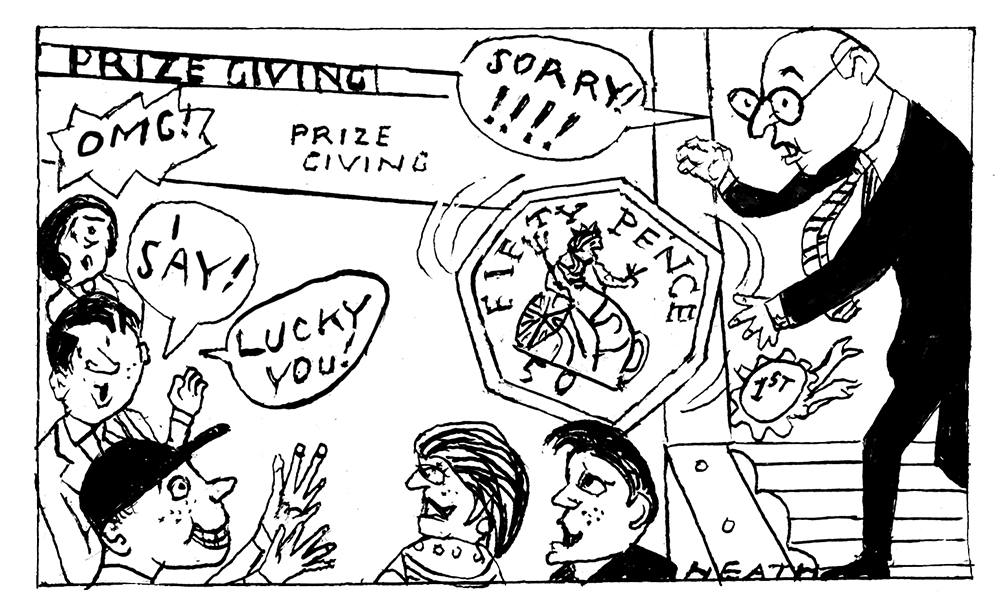
Every year at school – for one of those unexplainable traditional reasons – we were presented with a newly minted 50p by the Lord Mayor of London. Though it was meant to be carefully kept, most frittered theirs away in the school tuckshop. Not me, of course – I didn’t dare let it go. I figured it was a coin that wasn’t really money at all.
My first foray into numismatics came in 2012 when the Lord Mayor let us choose a special Olympic coin. I clutched mine close – a gymnast twirling a ribbon around the Olympic rings. A scroll on eBay tells me I should have gone where the value is – wrestling, judo, or the one explaining the offside rule. But hindsight is the collector’s curse. And one should never look back too often.
If buying coins online, be wary of two things: the chancers and the fact you’re ruining all the fun. No matter how ‘rare’ you claim your 2010 Girl Guides coin is, it can’t match the thrill of finding one by chance. The joy of Jemima Puddle-Duck turning up unexpectedly in your change trumps it arriving through the letterbox any day.
Those in the know crave the Kew Gardens 50p. With an incredibly low mintage of just 210,000, the clamour is legitimate. Though a gold proof of the coin fetched £6,800 at auction last year, it has since been knocked off its perch by the 2023 Atlantic Salmon coin, with 10,000 fewer in circulation.
In 2021 the ‘Brexit coin’ provoked fury on all fronts – from all the usual suspects. Sir Philip Pullman declared that because its inscription – ‘Peace, prosperity and friendship with all nations’ – lacked an Oxford comma, it should be boycotted by ‘all literate people’. The ever-calm Alastair Campbell soon joined in the histrionics too. He rejected the coin for its pure Brexity-ness, telling his followers on X that he’d be requesting two 20p pieces and a 10p from the shopkeeper should the dreaded coin appear in his change.
‘Boycotting’ a 50p coin in a contactless world carries, dare I say, less political currency than its proponents might have hoped. But clearly what the pair didn’t know is that turning down a Brexit 50p means passing up on a potential windfall: a few rare pieces printed with the wrong date are said to be worth tens of thousands. So, more’s the pity, Alastair and Sir Philip, Sir Douglas and your disgruntled woolybacks. Should I come across it, I’ll be snatching it right out of the shopkeeper’s hand.



Comments