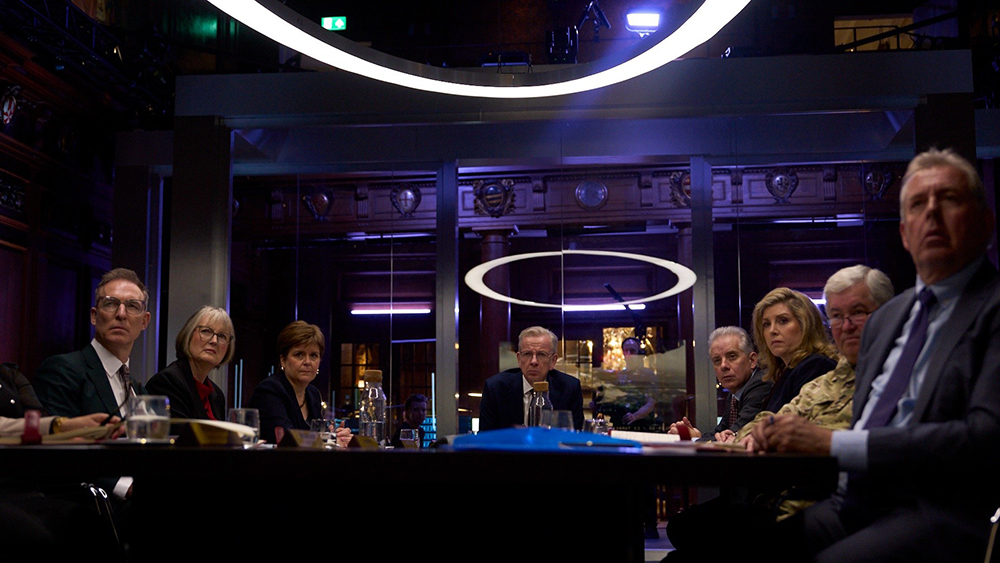


I t won’t be much of a consolation to Keir Starmer but I too was overwhelmed by the responsibilities of being prime minister. Fortunately for the country, I was only playing the role in a fictional coalition cabinet assembled by Sky TV to wargame the consequences of a Russian attack on the UK. My turn as make-believe premier began with unwarranted overconfidence, moved to fumbling crisis after crisis and ended with me almost alone in a bunker wondering how disaster had come so quickly. So very different from the real world.
My cabinet colleagues – Nicola Sturgeon, Penny Mordaunt, Harriet Harman, Jim Murphy and Sayeeda Warsi – all gave a good account of themselves. But the stand-out star was General Sir Richard Barrons, author of the real government’s strategic defence review. His calm explanation of how weak our air defences currently are was chilling. If we need to shoot down missiles launched at the UK we will need to rely for protection on our Type 45 destroyers. We were originally supposed to have 12. We got six. They can’t operate in hot water and are more underpowered than an Ed Miliband-approved tumble dryer. Three of them are currently immobilised, undergoing major refits. One, HMS Dragon, is limping to the Gulf, stopping at Greek islands along the way as though it were a Swan Hellenic cruise ship. The other two are our sole effective shields against any rocket lobbed at us. One would have to cover our nuclear base at Faslane from attack. And the other would be our only remaining bulwark against annihilation. Israel has an Iron Dome, we have a rustbucket adrift.
There was, sadly, no Reform member of our fictional government of National Unity. One colleague suggested that Sky couldn’t afford the £5 million fee required. I thought that a bit much. I am very fond of Nigel Farage. I enjoy his company and admire his bravery. But we’ve had our differences. I was opposed to an EU referendum, but when one was called I did everything to help Vote Leave win. Nigel fought hard for the referendum, but then when it was granted seemed to be doing a fair bit actually to stop Vote Leave winning. The full story of just how much he and the other self-styled Bad Boys of Brexit did to frustrate Vote Leave’s victory in that referendum is detailed in compelling fashion in a new book, Ten Years On, by the Vote Leave CEO, Matthew Elliott. It is, alongside Tim Shipman’s volumes, the definitive guide to that time.
It’s a cliché but, like most clichés, true to say that Nigel is a Marmite character. And the secret to Marmite, or Gentleman’s Relish for that matter, is that you mustn’t lay it on too thickly. In his first foray into long-form journalism, on Substack last week, Nigel made an effective case against the deleterious effect of DEI on the public realm. It was well researched and, for the most part, well written. But it was marred by his references to ‘anti-whiteness’ being institutionalised and ‘white’ Brits becoming a minority by the end of the century. I want a society where we de-emphasise difference and instead opt to be colour-blind. Using the tactics of ethnic-particularism against the DEI advocates may seem like rhetorical judo, deploying your opponents’ moves against them, but it’s not my kind of conservatism. In the 1980s Margaret Thatcher ran ads which proclaimed: ‘Labour say he’s black, we say he’s British.’ In that regard I wish Nigel was truer to his Thatcherite roots.
Thatcherism is, I fear, in for another rhetorical battering with Andy Burnham’s ascent to the premiership. The 40 years of neoliberalism he holds responsible for Britain’s malaise started, of course, with the Lady’s reign. Our economics editor Michael Simmons has pointed out in his article that this is dodgy history and doesn’t add up. State spending has risen not fallen over the period. But then suspicion of the value of maths and history was a feature of Andy’s time when he was shadowing me as education secretary.
He was personable, fair and generally pragmatic. But he did let the unions dictate too much. When I suggested schools record how many pupils scored GCSE passes in English, maths, the sciences, a foreign language and either geography or history (a measure known as the EBacc), the teaching unions objected. How dare I enquire into what was being learned in this way? The unions encouraged their supporters to sport a badge proclaiming: ‘I didn’t pass the EBacc.’ Andy obliged. I pointed out that it struck me as odd for members of a teaching organisation deliberately to advertise their ignorance and campaign against knowledge. But that sort of attitude only ended up with me getting sacked, while Andy is to be the real prime minister. When will I ever learn?



Comments