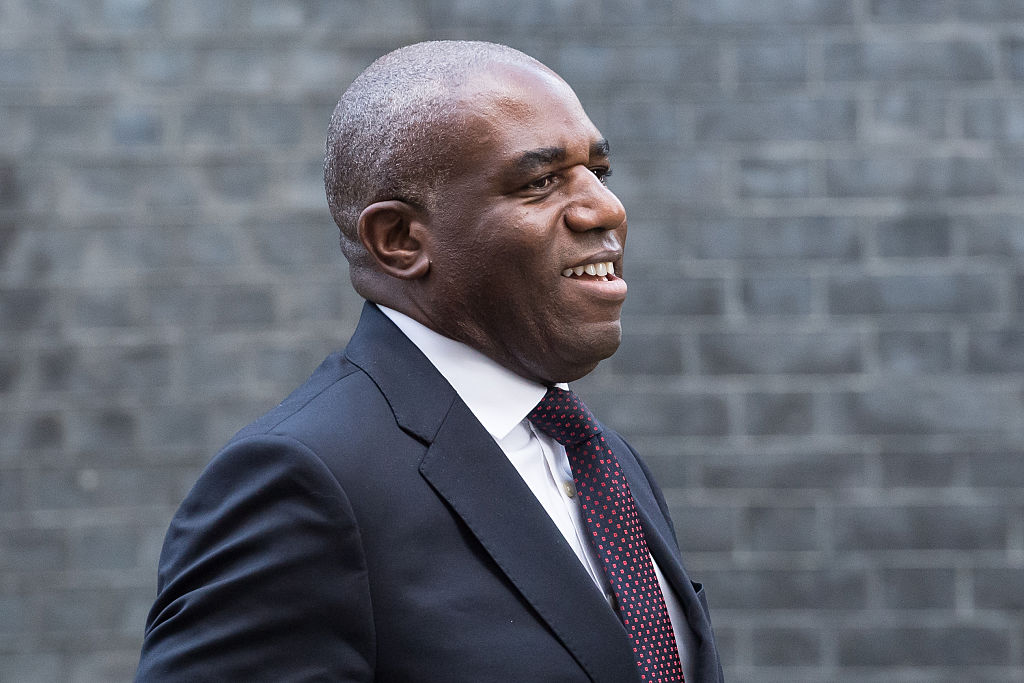
David Lammy, the deputy prime minister, has had a bruising five months. Last September, he took charge of the Ministry of Justice (MoJ), which oversees the courts, prisons and probation, as part of a reshuffle sparked by the forced resignation of Angela Rayner. Within weeks, the former foreign secretary had to deal with the accidental release from prison of Hadush Kebatu, an Ethiopian asylum seeker convicted of sexual assault who’d been living at the Bell Hotel in Epping. The error, by prison staff, was deeply embarrassing for everyone at the department, but it was compounded by Lammy’s ham-fisted handling of it. After he’d publicly pledged to grip the problem it emerged other offenders had been mistakenly freed, spawning the unfortunate nickname, ‘Calamity Lammy’.
Worse was to follow in the weeks before Christmas. A leaked memo revealed that the beleaguered Justice Secretary was planning to drastically curb jury trials to halt the ballooning backlog of cases in Crown Courts in England and Wales. It currently stands at a record 80,000 and is set to rise to 100,000 next year. The proposal unleashed a torrent of criticism which Lammy’s advisers appeared wholly unprepared for, and in the absence of an effective response, two damaging narratives took hold.
The first was that the government’s proposals were an attack on people’s ‘right’ to trial by jury. The second was that limiting jury trial was the only, or main, way the government intended to stem the backlog. Both claims are false.
Defendants have the right to a ‘fair’ trial, but not to a jury trial. The vast majority of criminal cases are in fact dealt with by magistrates; juries try only 3 per cent. And the government’s plans to cut the number of outstanding Crown Court cases has always rested on a three-pronged approach: substantial new investment in the courts, combined with more efficient and technology-focused working practices – alongside reform to jury trials.

This week, ministers finally set about correcting the course. In a speech at an AI conference in east London, Lammy said that while jury trials would remain the ‘cornerstone’ of the justice system the threshold for such hearings needed adjusting. He confirmed that in future, magistrates or judges sitting alone in the Crown Court will hear cases where the likely sentence on conviction is up to three years’ imprisonment.
The advantages of such a change are speed and transparency. The MoJ reckons cases presided over by a judge will be at least 20 per cent faster than those heard by a jury. When it comes to transparency, the reasons for the verdict will be given by the judge in open court. Juries simply declare the accused ‘guilty’ or ‘not guilty’.
The government also wants to rectify a bizarre legal anomaly under which one category of defendants is allowed to choose where their case should be heard. At present, people charged with ‘either-way’ offences, which may include theft, burglary and drug dealing, can opt for a trial in the Crown Court rather than by magistrates. Some defendants undoubtedly game the system, hoping that the delay resulting from their case being transferred between courts will lead to witnesses pulling out and the prosecution collapsing. Under Lammy’s plans, courts will determine where people will be tried: more cases will stay with magistrates.
If no action is taken, MoJ modelling suggests the backlog will hit an extraordinary 200,000 cases by 2035. But if the government proposals are implemented in their entirety – investment, efficiencies and jury reform – the backlog is forecast to stabilise by the end of the Parliament, in 2029, at around 80,000, before declining to about 50,000 within a decade. That would still mean long delays for justice for many victims, witnesses and defendants, but at least the caseload would be more manageable.
Lammy’s plans broadly follow recommendations made by Sir Brian Leveson, the distinguished retired senior judge who carried out two exhaustive reviews on the criminal courts. But after Leveson’s first report was published, last July, ministers failed to seize on his recommendations and make the argument for structural change.
Instead, airwaves and newspaper columns have been dominated by the legal profession, particularly barristers. Theirs are eloquent and powerful voices. The barristers’ representative body, the Bar Council, says Lammy’s jury reforms would ‘erode a deeply entrenched constitutional principle for negligible gain and with substantial risks’. The views of lawyers must be taken seriously – but there is a danger that they are having a disproportionate influence on the debate compared to others in the criminal justice system, especially victims of crime. The position of the Victims’ Commissioner, Claire Waxman, for example, is that a ‘wholesale package’ is needed, including structural change. ‘We can no longer ‘cherry pick’ our way out of this emergency.’ she says.
More than 20 years ago, the Bar Council was at the forefront of another campaign against legal reform, as it conducted what was said at the time to be its largest-ever lobbying effort against parts of the controversial 2003 Criminal Justice Bill. Among the ‘objectionable’ elements that it opposed were changes to the ‘double jeopardy’ law, so that people acquitted of an offence could be tried again if compelling fresh evidence emerged. The then chairman of the Bar Council, Matthias Kelly QC, said it would result in ‘sloppy investigations, and the police being given a second bite of the cherry’. Kelly also condemned plans to introduce ‘bad character’ rules, so that juries could be told about a defendant’s previous convictions, if relevant. He said it would lead to a ‘round up the usual suspects’ police culture.
Two decades on, these legal changes have been successfully embedded in the criminal justice system. Gary Dobson, one of the men who murdered Stephen Lawrence, is among a number of killers who would never have been convicted had it not been for the double jeopardy reforms, while the bad character provisions, carefully applied by judges, have allowed juries to have a more rounded picture of the person in the dock in front of them. Common-sense changes prevailed and the fears of the Bar Council, which opposed both, proved to be unfounded.
That is not to say that their criticism of the government’s measures should be brushed aside. But, as Lammy and his deputy, justice minister Sarah Sackman, have pointed out, lawyers tend to be conservative in their outlook. ‘I understand the profession’s wariness about change,’ said Sackman, who herself worked as a barrister, in public and environmental law, before entering politics. ‘They’re a traditional lot.’
With the proposals about to be set out in a parliamentary bill, the challenge now facing Lammy and Sackman is less about convincing lawyers and more about persuading backbench Labour MPs and peers that structural reform to the cherished system of jury trial is necessary. Ministers have lost ground in making their case – but it is not too late.




Comments