
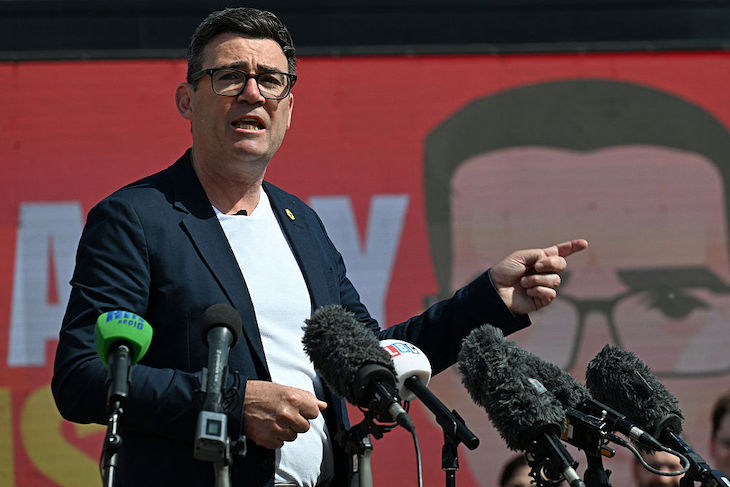
Now that he’s officially the Prime Minister in waiting, Andy Burnham is trying to work out how to stop Labour MPs from turning against him in the same way they turned against Keir Starmer. He’s got a letter from nearly 80 backbenchers calling on him to ‘refresh’ the party’s immigration policy, and he has already apologised for the party’s stance on Gaza. Burnham said yesterday:
‘I know many people feel that at the start of Israel’s military action in Gaza my party didn’t get it right and I am sorry about that. The response has too often not been good enough. We need to do better.’
Starmer’s basic pitch when he was leader of the opposition could also have been summed up as ‘we need to do better than the last lot’ – often without articulating precisely how he would be better. Burnham has a slightly different problem, in that he often does set out how he would do things differently – but then changes his mind.
Starmer fell into the trap that so many prime ministers find themselves in
Either way, he still inherits a Labour party that is fractious and frustrated – and with the next election drawing closer, he also has backbenchers who are going to act irrationally as the prospect of losing their jobs looms.
To that end, he is also proposing a change in the way the whips office operates, doing better than Starmer’s back-me-or-lose-the-whip blunt approach that lost him more respect than it gained. Threatening someone who is merely expressing concern about poorly-thought-through government policies with the loss of the whip was an extreme approach, especially given the policies did often later change anyway.
And the fundamental flaw that Starmer had in this approach was that he never offered the carrot of listening to those worried MPs first: he was all stick. Starmer fell into the trap that so many prime ministers find themselves in, of treating the vast majority of his MPs as though they were stupid and not worth listening to. Some of them do match that description, but most are intelligent, hardworking and loyal to their party to the extent that they don’t want it to mess up. But even if you’ve ended up with a party stuffed full of twits, the trick is to never let them realise that you think that. With Starmer, his disdain was quite obvious: even those around him found it staggering how reluctant he was to ever meet backbenchers.

Burnham is better than that, for sure, but his own suggestion that the whips office ‘should be our HR department, not something to be feared or where discipline is used to stifle debate’ isn’t well-thought-through, either. The functions of the whips and an HR department are so different that they should be based at opposite ends of the parliamentary estate, not held in the same role.
Indeed, one of the reasons life in the Commons is so unhealthy and dysfunctional is that the whips are currently also notionally in charge of pastoral care for MPs.
Even with a whips office that politely asks MPs how they feel like voting each day, and high-fives them as they leave the lobbies, there will always be a conflict of interest so long as pastoral care is included in the role.
You simply cannot have people charged with persuading colleagues to walk with them through the lobbies in difficult issues where there is no clear right answer (which is the bulk of governing) who are also listening to those colleagues talk about the breakdown of their marriage, their drinking problem or their mental illness. For one thing, MPs are unlikely to open up on any of those things to a whip, which is why many of these problems grow far bigger than they should because backbenchers don’t feel they have anyone they can turn to, and for another, there is always the temptation to at least suggest that ‘we helped you with your gambling problem, now it’s your turn to help us on this difficult vote to cut benefits’.
Either way, Burnham needs to have a much more strategic approach to how he whips and how he responds to party concerns. If he tries to curry favour merely by accepting every backbench letter complaining about this policy area or that, he will make his reputation for flip-flopping look unfair merely by virtue of him getting much worse once in office. But even with more vim and vigour than Starmer ever possessed, he knows that party management will end up being the most difficult problem of his time in office.





Comments