
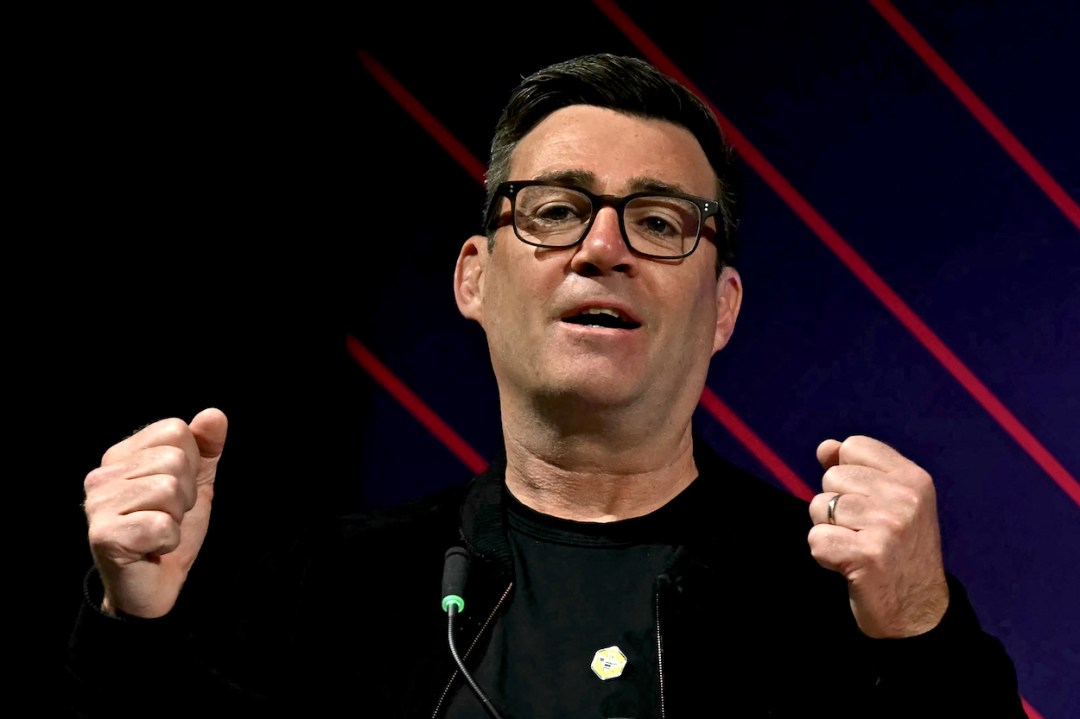
‘Politics needs to change,’ Andy Burnham, our presumptive next prime minister, told the ‘Great North Summit’ in Leeds this afternoon. Burnham used the event to declare that what is set to be ‘no ordinary by-election’ should set the stage for a ‘bigger debate about how politics needs to change if it is to work properly for the north of England’.
The Manchester mayor argued that Britain had been on the ‘wrong path’ for the last 40 years and that change was needed. He pointed to the ‘devastating deindustrialisation’ of the 1980s that has been ‘compounded’ by ‘deregulation, privatisation and austerity’.
His remedy, then, is presumably to attempt to reverse all that. How that would be done – against the economic tide – was not clear, but he pointed to what he sees as a necessary realignment of the relationship between central and local government: more devolution.
But Burnham was forced to go on the defensive in his speech too, thanks to Wes Streeting’s helpfully – and definitely not cynically – timed comments at the weekend that called for Britain to rejoin the EU. That’s obviously trouble for Burnham, given that Makerfield is a constituency in which 65 per cent voted Leave in the Brexit referendum.
Hoping to put a stop to what will surely be the main thrust of Reform’s campaign in the seat, Burnham said: ‘My view is that Brexit has been damaging, but I also believe the last thing we should do right now is re-run those arguments. I am not proposing that the UK considers rejoining the EU.’ A slightly eyebrow-raising U-turn, given Burnham was arguing for that very policy just seven months ago.
Back down south, the current Prime Minister continued to defy voters, MPs and his own cabinet ministers by insisting that he isn’t going anywhere. Starmer said to GB News’s Christopher Hope: ‘No, we’ve got a lot of work to do,’ when asked if his premiership is effectively dead. Going further, the PM insisted he would fight the next election and refused even to countenance any talk of setting out a timetable for his departure.
Given how much the ailing state of Britain’s economy has contributed to Starmer’s disastrously unpopular premiership, it must be incredibly frustrating for the squatter in No. 10 that, just as his time in office appears to be over, the economy starts ticking up.
Last week we had the news that Britain had outgrown the rest of the G7 in the first quarter of the year, and today Washington’s normally gloomy International Monetary Fund (IMF) upgraded its growth forecast for Britain’s economy this year from 0.8 per cent to 1 per cent. To IMF economists’ surprise, we’ve entered the latest global crisis with ‘more momentum than expected’. There was praise for the Chancellor too in the report, with the IMF ‘welcoming’ Reeves’s ‘balance between deficit reduction and growth-friendly spending’.
This unexpected run of good news could continue this week, with inflation figures due out from the ONS this Wednesday. Given everything going on in the Strait of Hormuz and energy markets, you would expect inflation to tick upwards – sharply – until long after the crisis is resolved.
But not so, say bank analysts. In a note to clients last week, researchers at Deutsche Bank predicted that April’s inflation figures will actually show a drop in the rate of price increases. That’s because last month’s price hikes in utility and other bills and regulated prices were not as bad as the ‘awful April’ we lived through last year and so, comparatively, this April’s inflation doesn’t look quite as dramatic.
As to where prices go from there, the IMF expects the Iran-induced inflationary shock to be temporary and peak just below 4 per cent at the end of this year. Now, we’ve of course lived through this before, when our own Bank of England said not to worry about Covid-era inflation and called it ‘transitory’ before it went on to prove sticky and peak at double what they had said it would.
Burnham – or any leader – has very little room for manoeuvre
There’s reason for a bit more hope that the IMF and indeed the Bank are correct this time, given that unlike in the run-up to the inflationary spike of four years ago, growth in money supply is much more subdued. That should limit the capacity for supply-side price spikes to evolve into long-term inflation.
Here, the IMF offers more good news for the government, suggesting that whilst there’s no room to cut interest rates, there may not be a need to hike them for the rest of the year either. If that is the case, then it’s quite possible that the government ends up with a not-totally-terrible story to tell on the cost of living after all.
Now, if all of the above proves true and inflation does not soar totally out of control, and recession is avoided too, that does not mean that Burnham will be able to waltz down to London and remake Britain in Manchester’s image. Instead, he will slam into reality.
As he already found out last week, when the gilt market surged in fear of his prospective policies, Burnham – or any leader – has very little room for manoeuvre. Any future energy support, for example – as Reeves is set to announce on Thursday – should be limited, the IMF says. And if Burnham thinks he can tax his way to a more equal Britain, the Washington economists say no on that front, too: ‘The long-term scope for further revenue increases is becoming limited.’
Instead, the brutal truth Burnham needs to prepare himself for is that ‘expenditure restraint’ (spending cuts) will be needed’. That means scrapping the triple lock, reining in the welfare bill and potentially even charging for certain parts of the NHS. That’s a reality Burnham will not be able to avoid for ever.





Comments