
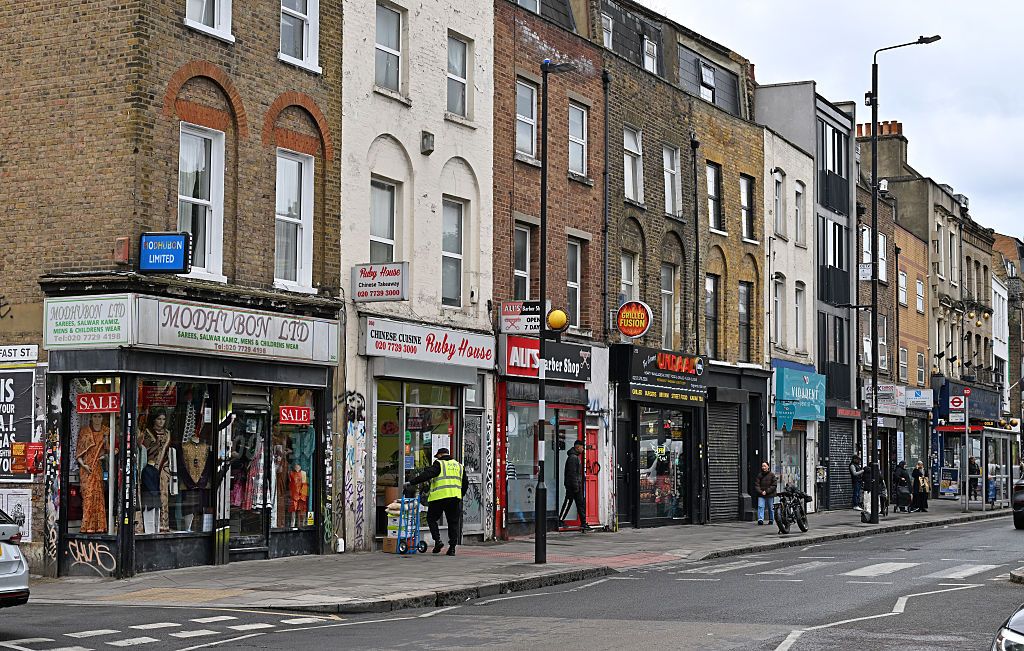
I went back to my hometown recently, a small suburb in north-west London. I strolled the streets, stopped by the crumbling library where we did our homework, visited the convent where I was educated (it’s a block of flats now – isn’t everything?). And I’m going to tell you something I’ve been keeping to myself since that day: while I was there I didn’t hear a word of English.
It really hit me later in the evening, on the Tube home, when I heard a young English fella yapping on his phone. ‘This teenage blather is the first thing I’ve understood today’, I thought to myself. And you know what? I was grateful for it. I’m at that age where I find mobile chatter on trains irksome. Not this time. The boy’s voice hit me like thunder, a sudden, blinding bolt of home.
I know what I’m supposed to think: that it’s enriching to find oneself wrapped in such a glorious tapestry of diversity. But all I felt was crushing alienation
Walking my old haunts – the record store now a 24-hour greengrocer, the second-hand bookshop an Afro barbers – I heard Urdu, Russian, Romanian and other tongues I couldn’t decipher. I know what I’m supposed to think: that it’s enriching to find oneself wrapped in such a glorious tapestry of diversity. But all I felt was crushing alienation. The foreign voices closed in like a fog, rendering me a stranger in my own hometown.
Am I allowed to mourn my old neighbourhood? Am I allowed to say I miss the cockney hollering of the long-gone market stall holders? And the hum of Anglo-chatter in the disappeared greasy spoons? And the old English geezers standing at their gates who’d say, ‘Raising a football team, love?’ to my young Irish mum as she walked by with her huge brood in tow?

Am I allowed to think there’s a reason God punished the Babylonians who tried to reach His kingdom by scrambling their language so that they could no longer understand each other? Beating my old streets, hemmed in on all sides by mysterious tongues, I finally understood what a savage curse that was. You nailed it, God.
I’m not the first person to go home only to find home no longer exists, I know. But we might be the first society where it’s a cancellable offence to lament home’s withering. Where even craving connection is considered gauche. To some in polite society, my longing to understand what people are saying, to feel linguistically at one with the people with whom I share an island, will be an intolerable request with the whiff of ‘white fragility’. God punished people with unfathomable tongues; we’re punished for wanting a universal one.
What is a Briton? It’s a question many of us are asking, normally in hushed tones over cold pints. The morally sanctioned view is that the new residents of my hometown are as British as the old ones were. Some of them, perhaps a majority, will have acquired British citizenship, so case closed: they’re Brits just like those wideboy butchers and bakers that saps like me are nostalgic for.
But is it true? Listen, I wish no ill will whatsoever against the people who have replaced the English and Irish of my old hometown. Good luck to them. But all of us, in the deep, quiet sediment of our psyche, know it’s a strange Brit who rejects the English tongue, or who covers her face in the fashion of Islamic obscurantism, or who lives here but doesn’t really live here. We know there’s a difference between being technically British and really, spiritually British. And we should be free to say so, right?
I see Reform UK’s new proposals on social housing as an effort to say this unsayable thing, to acknowledge in law the thing we have been prohibited from acknowledging in social discourse: that a Briton for life and a newly decorated ‘British citizen’ are different things.
Reform says that under its future rule, foreign-born folk, even those who have become British citizens, will be made to wait longer for social housing than native Brits. ‘Racist!’, the chattering left wails with soul-eating predictability. Oh stop it. Through the housing issue, Reform is trying to right one of the grave moral errors of our time – the industrial-scale emasculation of British citizenship.
We can all sense it: the slow, humiliating stripping of weight, teeth and pride from Britishness. The bloke who’s been here for five years and yet has not one word of English – he’s as British as John Cleese, they say, and you’re ‘fash’ if you say otherwise. Citizenship is handed out like candy, and at the same time we’re instructed to feel shame over British history, and to quit our ‘supremacist’ belief that Britishness is special, and to tut tut when some oik hoists the British flag up a lamppost.
Did the credentialled classes really think they could so ruthlessly eviscerate Britishness and that there would be no consequences? The fools. The consequences have come. And one of them is a very serious discussion about how we might distinguish between people who’ve been Brits forever and people who’ve been Brits for five minutes. The people calling this discussion racist are the people who made it necessary.





Comments