The historian Niall Ferguson, sometimes of this parish, said: “The law of unintended consequences is the only real law of history.” The new British Prime Minister Andy Burnham’s government is getting a lesson in that with its new sanctions on goods from Israeli settlements. The sanctions are meant to help the cause of a Palestinian state but may have the opposite effect. As an added bonus, they could hit British exports to the US.
Ben-Gvir demanded international sanctions against Britain as long as we remain in possession of territory ‘violently stolen from the Argentine people’
The “comprehensive reset” of British policy towards Israel comes in the middle of a rancorous Israeli general election campaign. Almost everyone with a chance of forming the next government opposes a Palestinian state. But the far-right parties are open in their desire to expel the Palestinians – “voluntary resettlement” – starting with Gaza. They have been looking for a foreign government to pick a fight with. Britain has obliged them.
The response from Itamar Ben-Gvir, Israel’s national security minister, was to call on the government of which he is a part to recognize the Falkland Islands as “Argentine territory under occupation”. Ben-Gvir is a seasoned provocateur, and he posted that message on X in Spanish, tagging the Argentine President Javier Milei (who promptly reposted it). Ben-Gvir demanded international sanctions against Britain as long as we remain in possession of territory “violently stolen from the Argentine people”.
The other leading right-winger in Israel’s government, Bezalel Smotrich, called on Israel to expel Britain’s ambassador – “tonight!” He said: “We will not be a doormat trampled by an anti-Semitic government, in a country conquered by radical Islam, trying to save itself from economic and social decline by attacking Jews and the State of Israel.”
As well as being finance minister, Smotrich is, in effect, governor of the West Bank, the territory west of the river Jordan captured by Israel in the 1967 war. He has encouraged the so-called hilltop youth to seize as much Palestinian land as possible. By some estimates, as many as 200 new settlements and outposts have been created during his tenure in office.

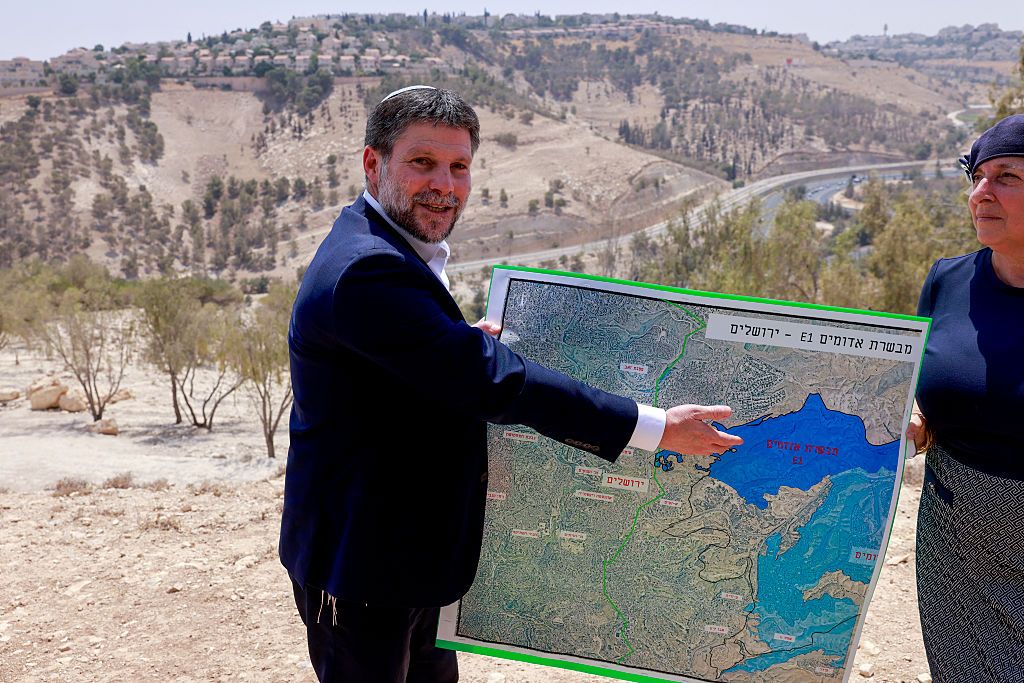
But the biggest prize is the E1 development, which Smotrich has said will “bury the idea of a Palestinian state” once and for all. More than 3,000 new homes are planned there, and last month the Israeli government put the contract to build 1,200 of them out to tender. This was the trigger for the British sanctions.
Smotrich is a settler himself and believes he is on land gifted to the Jews by God. E1 is less than five square miles but it is perhaps the most crucial parcel of land in the entire occupied territories, or Judea and Samaria if you prefer. Building there will cut off East Jerusalem, which the Palestinians claim as their capital. It also cuts the West Bank nearly in half. E1 ensures that there can be no Palestinian state, Smotrich said, “because there is nothing to recognize and no one to recognize.”
Successive Israeli governments have advanced and paused plans to start building E1 since the 1990s. Every time the bulldozers seemed about to go in, there was an international outcry and, most importantly, pressure from Washington. Now Donald Trump, who calls himself “the best friend Israel ever had,” is silent on E1.
No surprise, then, that the US ambassador to Israel, Mike Huckabee, waded in to criticize the sanctions. He was already embroiled in an extraordinary row with the Foreign Secretary, Ed Miliband, after Miliband questioned whether medicines were being allowed into Gaza. “The Brits have lost it,” Huckabee said. “The Jew hate of their government knows no boundaries and knows no facts.”
He stuck to that line during an appearance on British television yesterday, despite being reminded that Miliband is Jewish. (He is the son of refugees from the Nazis.) “You go by what people do,” Huckabee said, adding that the ban on settlement goods was “discrimination against the Israeli government and against the Jewish people.” He warned that if Britain went ahead there could be “sanctions, repercussions, or retaliations from the US.”
Huckabee pointed to states such as Florida, which have passed laws against doing business with companies or countries that boycott Israel. Florida congressman Randy Fine said that the British government “should understand that their vanity project in support of Muslim terror could cost them billions of dollars.”
On the face of it, this seems like a foolish threat to make. A million British tourists visit Florida every year and are vital to the state’s economy. The UK is Florida’s biggest source of foreign investment. But America is a religious country, and millions of voters are Christian Zionists who believe that God has ordained a Jewish state in the land of biblical Israel. Huckabee, a Baptist pastor before he entered politics, once said that “those who bless Israel will be blessed; those who curse Israel will be cursed.”
For all the fuss, British sanctions are largely symbolic. They will affect only a tiny part of the Israeli economy – the sanctions do not apply to goods and services originating in Israel proper. The most likely outcome is that goods made in the settlements will simply be relabeled as made in Israel. And Britain continues to support Israel in other ways – supplying arms, for instance.
Still, it suits the Israeli right to be rude about Britain, and that includes the Prime Minister, Benjamin Netanyahu. He has called the UK “the Islamic republic of Britain,” last month repeating J.D. Vance’s joke that the country would be the “first Islamic republic to get a nuclear weapon.”
It suits the Israeli right to be rude about Britain
Netanyahu is (slightly) behind in the polls, but there is a reason he has been Prime Minister of Israel for all but 18 months since 2009. He is a political Houdini who has been written off many times before. The polls may be understating support for the center-right and far-right parties (as polls tend to do).
Even if he loses, Israeli strategy will be conducted inside the lines he has drawn in nearly three years of war on three fronts. His main challenger, Gadi Eisenkot, a former chief of staff, is just as intent on disarming Hamas. He said last month that anyone still thinking of two states after October 7 is “just delusional.”
Eisenkot is the author of the Dahiya Doctrine, named after the suburb of Beirut controlled by Hezbollah. The doctrine calls for overwhelming force to be used against groups such as Hezbollah or Hamas. Towns or villages used to launch attacks against Israel are treated as military bases, not civilian areas. The Dahiya Doctrine has seen much of Gaza turned to rubble.
But Eisenkot also calls E1 a mistake, and says Smotrich and Ben-Gvir are “causing Israel to lose international legitimacy.” The British sanctions are a gift to the right but they are also an argument the Israeli center will use in the election campaign.
Netanyahu has charisma, and Eisenkot is a bit of a plodder. In a vicious campaign, Netanyahu has put out ads making fun of Eisenkot’s poor English. Eisenkot, whose parents came from Morocco, called it racist and asked where Netanyahu’s excellent English had been on October 7.
Netanyahu became famous as deputy foreign minister, appearing on CNN during the first Gulf War, fluently explaining Israel’s actions. No doubt he will brush aside sanctions by Britain and others.
But each victory comes with a cost in goodwill towards Israel. As Prime Minister, Netanyahu has been responsible for a collapse in Israel’s standing abroad. He may be able to shrug off Britain but not the United States. Backing for Israel there rests on a base that is religious, Republican and aging. After Trump, the next US president – Democrat or Republican – may question American support for the Jewish state. The law of unintended consequences cuts both ways.


Comments