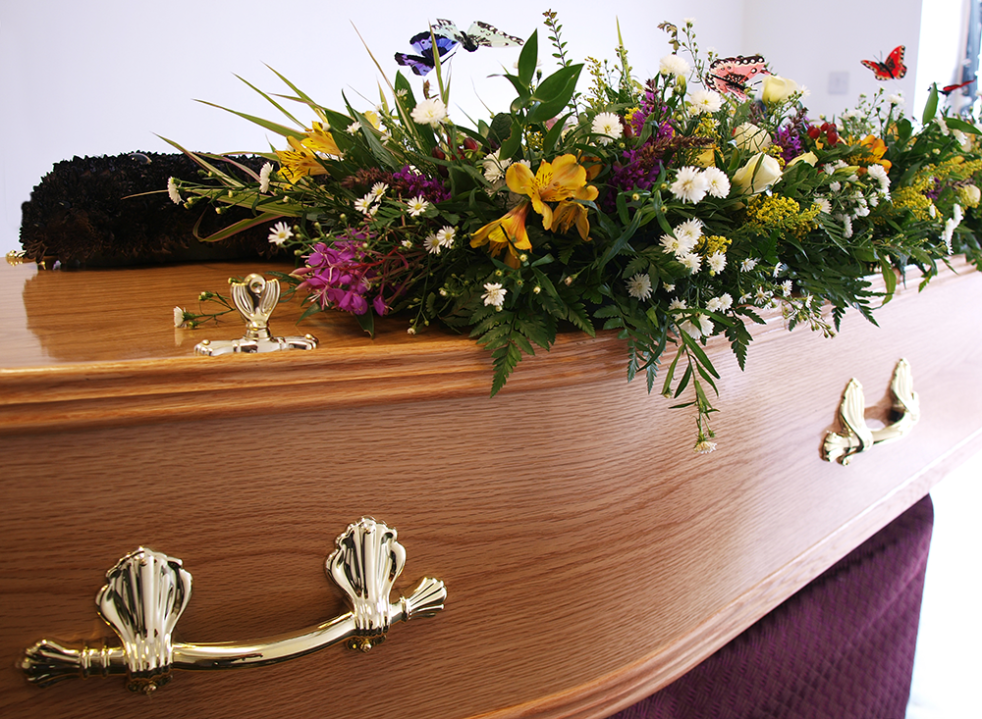


‘All aboard!’ reads the Facebook caption from Steve Soult Ltd, the Nottinghamshire coffin maker, above a flotilla of hashtags – #FinalVoyage, #FullSteamAhead, #CoffinBoffins. The photograph shows the firm’s latest commission: a coffin built as the Queen Mary, with three funnels, rope handles and the liner’s livery picked out along the hull.
There is a precedent for going to the grave in a ship. After the Battle of the Nile, one of Nelson’s captains presented him with a coffin made from the mainmast of L’Orient, the French flagship that blew up during the battle. For a time he kept it in his cabin, behind the chair in which he ate his dinner. He was buried in it at St Paul’s seven years later.
In the Coffin Clubs across Britain, members can pay £250 for a ‘fabulous Dutch flat-packed’ coffin
Steve Soult’s customers may be less renowned, and the coffins more ‘tacky’, as one social media commenter put it, but it is an example of the growing divide in Britain’s funeral market between those who want ever more elaborate and personal farewells and those who want the cheapest funeral and coffin available, a growing number of which now arrive flat-packed from China.
A coalition of European coffin-makers are preparing an anti-dumping complaint to the European Commission, arguing that cheap imports have closed roughly a quarter of the continent’s manufacturers in five years. A coffin can be made in China for around a third of what it costs in Italy, even from the same wood, thanks to cheaper labour and timber. Manufacturers also suspect what the trade has taken to calling the ‘Ikea loophole’: coffins arriving flat-packed and declared to customs as wooden components, to be screwed together into something recognisably funereal once they’re inside the single market. Oliver Peyton, the founder of Exit Here, a modern funeral director in London, reckons a similar trend is happening here, with Chinese coffins coming into Britain ‘by the containerful’, most of them destined for ‘large corporates’.
Imports have been hurting British businesses which once made some of the finest coffin furniture in the world. Newman Brothers of Birmingham, whose cast brass gothic handles went on the coffins of George V, George VI, Churchill and Queen Mary herself, closed at the end of the 1990s, reportedly undone by foreign competition. Henry Smith of Battersea, which made Elizabeth II’s lead-lined English oak coffin, has also since shut up shop. ‘Your bog-standard coffin today is essentially really cheap,’ says Kate Tym, co-founder of Coffin Club UK, a branch of the international group created to discuss funerals and even make your own coffin. ‘MDF with some veneer on it and handles that aren’t actually strong enough to bear weight, which is why we have to shoulder them.’

At the cheaper end of funerals, a growing number now opt for direct cremation, in which the body is collected, cremated without ceremony and the ashes returned by courier. In 2018 it accounted for 2 per cent of British funerals; by 2021 the figure was 18 per cent. Anyone who has watched daytime television, with its adverts urging viewers to spare their children the fuss, will have an idea of why. Tym suspects the big firms are ‘stockpiling’ the cheapest coffins they can find for the purpose. ‘It feeds into the thought process: do I just get a cheapo coffin because it’s a direct cremation? No one’s going to see it,’ she adds. ‘At the end of the day, this is a thing that is going to be burnt or buried, so what is the point of paying X amount when it could go on a memorial reception instead?’
Poppy Mardall, who runs Poppy’s, the independent funeral director in south London, is relaxed about direct cremation, which makes up around 20 per cent of her funerals. She takes a twice-yearly delivery of flat-packed cardboard coffins from Poland and reserves her impatience for the trade itself. ‘I think we’ve been lazy in this country about justifying why a funeral might be worth having,’ she says. Traditional firms assumed people would keep buying whatever was put in front of them, and now find themselves squeezed between independents like her and the companies telling the public that rather than spending £5,000 or £6,000, they might have their mother inexpensively turned to ash. The state of the economy, she adds, is ‘100 per cent having an impact’, with people ‘struggling with day-to-day things’. A funeral is ‘so often not budgeted for’.
One of Mardall’s bestsellers is a coffin woven from willow, part of a budding eco-coffin market, costing around £800. Exit Here offers its own specially designed ‘modern, curved’ coffin, as its founder says he ‘couldn’t work out why there was only one coffin design’, alongside seagrass and wicker coffins from £750. A company called Loop Biotech has invented the Living Cocoon, grown from mushrooms and hemp, which promises to return its occupant to the earth within 45 days but costs more than £2,000.
Tym believes we should be thinking about coffins long before the point of need. In the Coffin Clubs across Britain, members can pay £250 for a ‘fabulous Dutch flat-packed’ coffin with primer and rollers, and spend weeks painting it while talking about death. Her own mother chose a coffin that ‘surprised’ her, made from recycled pallets. The Bournemouth and Poole Coffin Club reports having fielded lots of questions about a ‘Viking funeral’, burnt on a pyre at sea. That, it turns out, you can’t do, though you can apply for a licence to be buried at sea in three places: off the Needles in the Isle of Wight, off Tynemouth, and between Hastings and Newhaven.
At Poppy’s, personalisation takes many forms: families have added the deceased’s tomato plants to the coffin, written messages on the underside of the lid and asked for the dog’s ashes to go in too. But it is not confined to the boutique end. The Co-op, the country’s largest funeral director, has published a list of the stranger things it has been asked to put in a coffin, among them a false leg, an Argos catalogue, a pair of clown shoes, a pork pie and a Chinese takeaway. So somewhere in Britain, a family has watched a Chinese takeaway go into the ground, quite possibly in a coffin that arrived flat-packed from China.




Comments