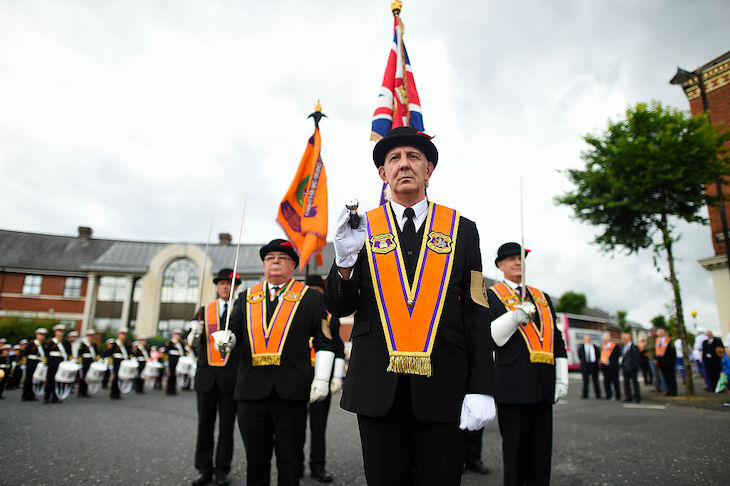
The annual Twelfth of July celebrations are about to take place in Northern Ireland, over a long and hopefully sunny Bank Holiday weekend. In some loyalist areas on Sunday night, there will be raucous street parties that culminate in the lighting of bonfires, some of them towering over 200 feet tall and constructed intricately from up to 300 rows of wooden pallets. Then, on Monday, members of the Orange Order will march through towns and villages across the province, to remember King William III’s victory in 1690 over James II, at the Battle of the Boyne.
In the decades since the trouble at Drumcree, the Orange Order has worked hard to improve its image
These traditions are frequently cited by critics as evidence that unionists in Ulster are ‘stuck in the past’ or used to imply that Northern Ireland’s sense of Britishness is alien to people in the rest of the UK. The parades, with their thundering Lambeg drums, military-style band uniforms and sash-clad Orangemen, can admittedly seem strange and aggressive to anyone who is not from the province or parts of the west of Scotland.
Some Irish nationalists have portrayed them, particularly in the past, as ‘coat-trailing’ exercises in intimidation. Infamously, in the 1990s, a stand-off over a Sunday morning parade to Drumcree church in Portadown sparked days of rioting and was linked to several deaths. The arguments over the march, which persist to this day, encapsulated many of the themes of other parading disputes that flared at that time.
The residents’ ‘coalition’ that purported to speak for local people claimed the marches were triumphalist displays, intended to threaten its community. Orangemen insisted that their walk, which took them from the town centre along a short, predominantly nationalist section of the Garvaghy Road, was an innocent expression of culture, dating back two centuries, that was turned into a flashpoint by republicans.

For almost thirty years, the parade has been prevented from proceeding down this route. Indeed, a new tradition developed instead. On the first Sunday of July, a small group of Orangemen marched to a police road-block, where they handed over a letter of protest. This year, the Order dropped this act of defiance and instead launched a legal challenge against the decision by the Parades Commission, which regulates and restricts parades in Northern Ireland, to block its march.
In the decades since the trouble at Drumcree, the Orange Order has worked hard to improve its image and depict its events as family-friendly celebrations of culture. The flagship parade in Belfast happens alongside an ‘Orangefest’ that includes a food village, funfair and circus performers. Supporters are urged to focus on the ‘battle, not the bottle’ to limit street drinking. And in areas where marches remained controversial, the Order tried patiently to engage with the ‘residents groups’ that opposed its activities.
The ‘marching season’ was previously a time of heightened tensions and possible violence in Northern Ireland. There are still stories about emblems or political posters being burnt on bonfires, which are not organised by the OO, and occasional examples of drunken behaviour. This week, the police arrested a man after a model of a mosque was placed on the pyre in Moygashel, alongside an anti-immigration message. This crude display was viewed as ‘hate speech’ by many politicians but defended by the bonfire builders as a ‘political protest’.
Overwhelmingly, though, the most striking thing about recent Twelfths is how uncontentious they have become. In fact, you could argue that, rather than Northern Ireland unionists ‘moving on’ from celebrating events in the seventeenth century, the rest of the UK should do more to make sure that this history is remembered.
The Battle of the Boyne became a focus for the Orange Order because of William’s direct involvement in the fighting and the fact that it put James’s army firmly on the defensive. Historians argue that the Battle of Aughrim, a year later, was more decisive in determining the outcome of the Williamite War.
The Twelfth in Ulster, though, does not just celebrate the victory of a Protestant king over a Catholic monarch, even if that is clearly important to the Orange Order, which puts faith at the centre of its activities. The political emphasis is on the entrenchment of the Glorious Revolution and the Bill of Rights, which effectively established the world’s first parliamentary democracy at Westminster.
Those events are not just critical parts of our national story and the basis of our constitution, determining the relationship between parliament and the Crown; they also played a huge role in the development of the West. Indeed, the Order recently hosted a lecture in Belfast by Spectator contributor Lord Hannan, exploring the historical relationship between the American Revolution and the Glorious Revolution, as well as the legacy of those events.
The roar of drums, the bowler hats and the Orange arches, decorated with historical and religious images, are all distinctively Northern Irish; and the alleged triumph of protestant liberties over Catholic despotism is unlikely to bring modern Britons together. At a time, though, when our history is too often maligned and our patriotism vilified, perhaps we should all do more to celebrate Britain’s key role in establishing the rights and freedoms that are now taken for granted in most western democracies.




Comments