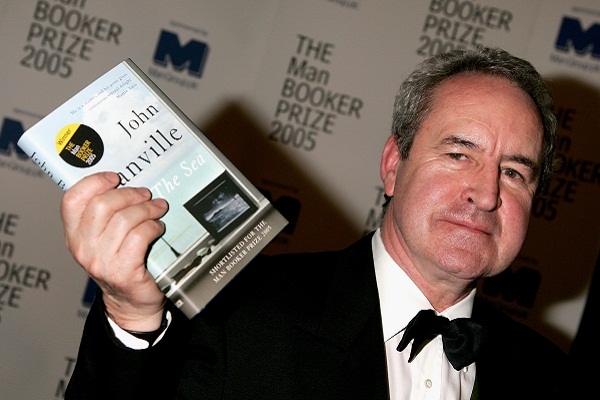
It is almost twelve months ago, following the below-par A Death in Summer, that I wondered aloud on these pages whether Benjamin Black (aka Booker-winner, John Banville) had what it took to write a crime series. A resounding yes comes in the form of the fifth instalment — sixth novel overall, after the 2008 stand-alone The Lemur — of the Quirke series, Vengeance. Black has finally rediscovered the formula that made his debut, Christine Falls, so memorable.
To be sure, crime fiction purists will still bemoan the absence of standard clue-laying. The novel begins with the suicide of businessman Victor Delahaye, witnessed by his business partner’s son, Davy Clancy, and proceeds to slalom in and out of these two rival families, channelling the story through various characters — Victor’s second wife, Mona; his sister, Maggie; Clancy’s mother, Sylvia — as well as the usual duo of Quirke and Inspector Hackett. When, midway through, Jack Clancy, the shady associate of Victor and father of Davy, is also discovered dead at sea, Quirke and Hackett have murder as well as suicide on their hands. Add in Victor’s two malevolent twenty-something twins, Jonas and James, and there is plenty of motive and cause to keep the novel ticking along at a fair clip.
However, whereas the plotting has seemed slapdash in previous novels, here it comes fortified with a new self-awareness, almost a manifesto of sorts for what crime fiction should be. Black uses the character of Jimmy Minor, a tobacco-fuelled hack, to articulate a vision for the type novel we are reading. Minor name-checks his childhood heroes — ‘Arthur Conan Doyle, Dorothy L. Sayers, John Dickson Carr and Carter Dickson’ — before contrasting them with the reality of crime where:
He left behind those illusions, he explains, because he ‘grew up’. It is a telling articulation of what Black is doing here. He is time-travelling back to late Christie-land (‘Agatha Christie; rather dull’ one character thinks early on) but reinvigorating it with grown-up realism. Thus Vengeance is free of red herrings, blind alleyways and chocolate-box conclusions. Instead, Black vividly conjures up the sheer dank reality of his Dublin: ‘this city, its crowds, its dirt, its smells…its incurable dinginess’. This is a world of Senior Service cigarettes, ‘Elvis Presley…whining about his blue suede shoes’, copies of the Evening Mail in grubby bars and many an oily (always a favourite Black word) pint of Guinness.‘Everything doesn’t get explained…You find a few pieces of the jigsaw puzzle, some of them fit together, some of them you just leave lying on the board…those detective stories I used to read – there was nothing that didn’t mean something, nothing that wasn’t a clue. It’s not like that in real life.’
Add this to prose that is tidier and sharper than in its last outing, while having lost none of its lyricism — who but Black, after all, would have cigarettes in a packet ‘like a set of miniature organ-pipes’ or a fridge ‘murmuring to itself, like a white-clad figure kneeling in rapt prayer’ — and it makes for an entrancing read. In Vengeance, Black has finally had the courage to present himself as a love-or-hate writer, establishing firmly his vision for the sort of crime fiction he wants to pursue, rather than toying unsuccessfully with the finicky aspects of detailed plot. This is not, now, a series for those who like their mysteries as crosswords rather than character studies. With (as my review copy hints) a TV series in development, it looks like Black could have recovered from a recent slump to be one of crime fiction’s most consistently ambitious and high-profile voices.
Such ambition sadly can’t be claimed for the other Banville offering out this year, Ancient Light. Or rather ambition is only evident in such an improbable narrative crux: the narrator, thespian Alexander Cleave, recalls an episode during his teenage years when he had an affair with his best friend’s middle-aged mother. Banville fans will remember Cleave, of course, from Eclipse (2000) — ‘Think of your ideal Hamlet and you have me’, as he described himself then — and here we pick up the story further on, as Cleave now mourns his daughter, Cass, star of another previous novel Shroud (2002), the plot of which hovers slyly around the edges here. Indeed, all the usual Banville elements are present: tricksy referencing (readers should be au fait with deconstruction), a fair fistful of affectation (‘Madam Memory’) and the usual sumptuous prose (‘the floorboards…glistened like sucked, sticky toffee’).
By releasing both books within a month of each other, however, it is hard not to spot the contrast. Ancient Light is so typically Banville it has almost lapsed into paint-by-numbers parody. If you wanted to write a ‘John Banville’ novel, this is exactly the novel you would write. The formula — first-person/unreliable elderly male narrator/epistemological uncertainty/heavily-adjectival prose/intellectual in-jokes — works in its usual smooth way. Hats will be jaunty, hearts will be aflutter and smells with always be sweaty; the word ‘joggled’ will risk overuse. Technically it works a treat, as it has done in most of the other books in his backlist. It’s just that, once you’ve read one — 2009’s more experimental The Infinities apart — each new volume prompts an increasingly heavy sense of déjà vu.
Early on, Cleave describes himself as ‘self-absorbed and unobservant’ and wonders elsewhere about the fact of others, ‘another human being, this separate entity, this incommensurable not-I’. It is, of course, precisely what you don’t get in Banville, suffocated as you are by the existential wonderings of the narrator. It is, though, exactly what you do get in Black, prodding into the consciousness of others. We appear then to be in rather a topsy-turvy position where the Banville literary novel seems all too formulaic, whereas the Black crime novel is structurally ambitious and daring. The irony, one hopes, would not be lost on their creator.





Comments