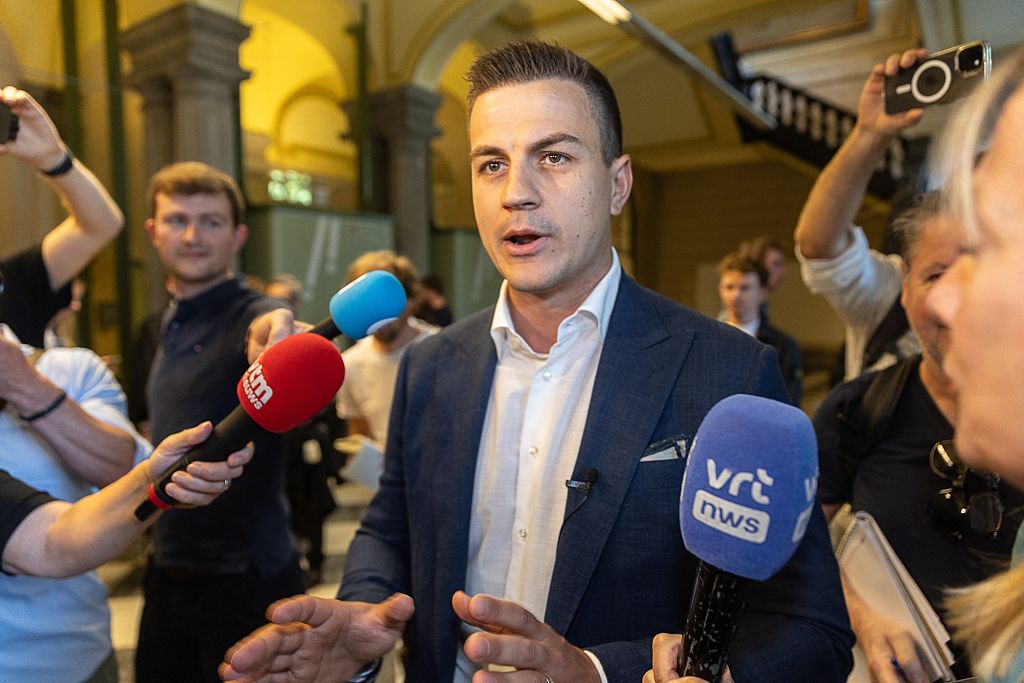
The conviction by a Belgian court of far-right activist Dries Van Langenhove has alarmed both the country’s right and left. Van Langenhove – let there be no doubt – belongs to some of Belgium’s darker far-right movements. He has previously been convicted of racism and Holocaust denial. Yet he has now been fined €4,000, for what the judge described as “apparently having the intention’ to incite hatred and violence, rather than for a crime he was clearly proven to have committed.
Bart Eeckhout, chief commentator of Belgium’s left-leaning daily De Morgen – certainly no friend of Van Langenhove – unexpectedly described the conviction for incitement to hatred, violence and racism as an injustice. Eeckhout’s objection to the court’s ruling lies in the absence of clear legal grounds.
Freedom of expression is a fundamental right that exists not so much to protect respectable opinions, but precisely to protect shocking, offensive or reprehensible ones
Van Langenhove’s conviction dates from a lecture delivered to the Flemish-nationalist student fraternity “NSV” at Leuven University in February 2024. According to the judge’s ruling, Van Langenhove’s core message on that occasion was that many of the problems facing Flanders today – including declining educational standards, rising insecurity, the disproportionately high number of people with a migrant background in the country’s prisons, the housing shortage, and the strain on the social security system – stem from “multiculturalism.”
Yet although Van Langenhove’s remarks were shocking to Eeckhout, he argues that the 14-page judgment nowhere concretely defines this alleged incitement. Nevertheless, the judge considered the charges of incitement to hatred, violence and racism to be “proven.” That, Eeckhout argues, is a dangerous line to take.
It is dangerous, says Eeckhout, because it opens the door to an extremely broad interpretation of hate-speech and anti-racism legislation. That is a slippery slope towards repression and the erosion of liberty. Freedom of expression is a fundamental right that exists not so much to protect respectable opinions, but precisely to protect shocking, offensive or reprehensible ones. The words of Van Langenhove cited in the judgment may be hurtful to some, but they still fall within the scope of that fundamental right, Eeckhout insists.

There is clearly something wrong with the current hate-speech legislation, according to Eeckhout. The scope of these laws should be restricted to explicit and concrete calls for violence against individuals. Otherwise, freedom of expression risks crumbling under the pressure of society’s overprotection against “wrong” opinions. He directs his appeal specifically to today’s progressive politicians, warning them that, in less congenial times, their own opinions may also fall within the sights of “hate” legislation. Furthermore, Dries van Langenhove should not be granted martyrdom, he says, and freedom of expression should be defended for what it is: a progressive, liberal and fundamental value.
We will soon see whether Belgium’s left-wing politicians take heed of Eeckhout’s words. The country’s center-right politicians, meanwhile, have already taken note.
Earlier this week, politicians from one of the country’s governing parties – the New Flemish Alliance (N-VA), led by Prime Minister Bart De Wever – called for reform of the country’s hate-speech and anti-racism legislation. Peter De Roover, speaker of Belgium’s Chamber of Representatives, argued in the Belgian weekly Knack that the law “overshoots its purpose.” During the previous legislative term, De Roover had already submitted a proposal to remove “incitement to hatred” from criminal law.
He stressed, however, that he was not commenting on the ruling itself in the Van Langenhove case. “I am not saying the judge applied the law incorrectly. I am a legislator. And if the legislation allows for these kinds of interpretations, then I question whether the law offers too many opportunities to restrict freedom of expression. My fear is that we are ending up on a downward spiral,” he told Knack. De Roover particularly objects to the concept of “incitement to hatred.” He argues that the law should instead be limited to “incitement to violence.” “There can be no debate about that: calls for violence must remain punishable,” he said.
Belgium’s straight talking defense minister Theo Francken (also of the N-VA) entered the fray as well, writing on X that, although he “recoils from the biological racism that shapes Van Langenhove’s thinking,” he is nevertheless concerned by the conviction.
Recently, a man in Belgium was not convicted after writing that he wanted to murder every Jew he encountered, Francken noted, while Van Langenhove has been convicted because, during a closed lecture for students, he linked issues such as insecurity, declining educational standards, prison overcrowding, the housing shortage and welfare dependency to non-European immigration. That, according to Francken, is pure arbitrariness, adding that much of the blame lies with the law itself: it is too vaguely worded and therefore grants judges excessive room for interpretation.
In the past, Francken continues, legal restrictions on freedom of expression were formulated far more narrowly. They focused mainly on slander, defamation and concrete calls for violence. Later, this was gradually expanded through the catch-all concept of “incitement to hatred.” Belgium, Francken argues, needs to return to basic principles: only calls for violence – or the glorification of violence – should be criminal offenses.
Overzealous judges such as the one in the Van Langenhove case are clearly trapped inside a politically correct bubble. But with commentators and mainstream politicians on both left and right – including members of the government – now broadly agreeing that the law is dysfunctional and dangerously open to interpretation, perhaps that bubble may soon be punctured.






Comments