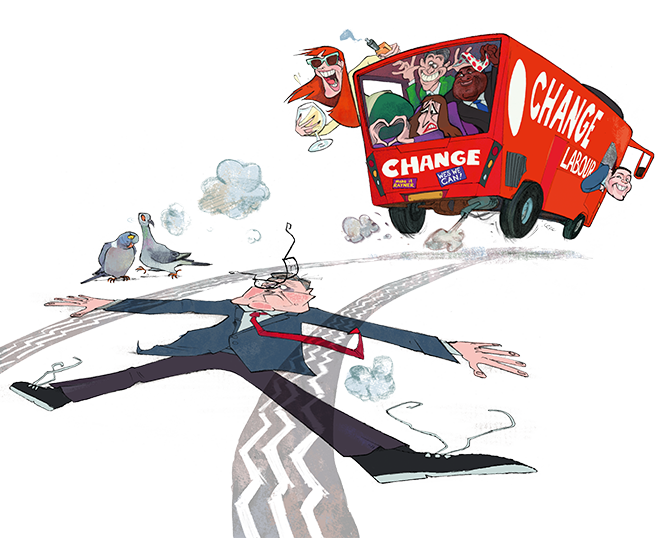


Years ago, Peter Mandelson, Britain’s former ambassador to Washington, shared a key lesson with his protégé Morgan McSweeney – until last week the prime minister Keir Starmer’s chief of staff. Reminiscing about his involvement in the Labour party’s 1987 general election campaign, he called it the “spray-paint election.” The manifesto was a “beautiful technicolor” document but the tax-and-spend shibboleths of statist ‘Old Labour’ remained, along with the policy of unilateral nuclear disarmament.
“I spray-painted the old Ford Cortina,” Mandelson told McSweeney, “but it was still a Cortina. Policy is at the heart of political communication.” Only after the election – a second three-figure landslide defeat – did Labour launch a policy review, out of which New Labour emerged. Even then it took another decade to win power.
Fast forward to 2020 and McSweeney helped Keir Starmer to the leadership, seized the levers of party power from the hard left, purged the former leader Jeremy Corbyn and, in 2024, led a ruthless campaign to target voters in key marginal seats, converting 34 percent of the vote into a landslide just short of Tony Blair’s 1997 victory.
‘How do you build a project around someone who doesn’t have any politics and hates the very idea?’
Yet after the worst week of Starmer’s leadership, in which McSweeney resigned, leaving the PM’s career hanging by a thread, ask those at the top of government where it all went wrong and the first answer is often: “In opposition.” McSweeney learned half of Mandelson’s lesson – that the party had to modernize – but Starmer foolishly left the preparations for government to Sue Gray, whom he hired as his chief of staff in 2023. He was sowing the seeds of his destruction.
Every single quote in this article is from a Labour source: a minister, member of parliament or party official, and most importantly eight serving and former Starmer aides.
“Keir travelled very lightly,” says a former Labour official. “He never defined himself, and when he came in, he was defined by events. Mike Tyson said ‘Everyone has a plan until they get punched in the face.’ The problem was Keir didn’t have a plan.” In opposition, Labour tied itself in knots over trans rights rather than debate whether, with money very tight, it was sensible to rule out major tax rises. As a senior figure under Starmer puts it bluntly: “We spent more time working out whether chicks could have dicks than on a program for government.”
The causes of the Keirtastrophe boil down to this: the manner of Starmer’s victory hindered his ability to govern. He, his aides and his chancellor (the equivalent to the Treasury Secretary), Rachel Reeves, made errors that damaged his relationship with the voters who had elected him to change Britain, then with the parliamentary Labour party (PLP), and finally with his closest aides. Everything flowed from the Prime Minister’s fundamental lack of politics.
The Gray appointment created a structure which many predicted would be a disaster. Tony Blair was one. “Everyone was begging Blair to call Keir up and tell him not to appoint Sue,” says one McSweeney confidant. “Tony says, ‘I’m not going to do that. It would be counterproductive. If he thinks it’s a good idea, the only way he can learn that it’s a terrible idea is by it happening.’ Keir thought Sue would create a serious governing vehicle, ready for him to drive off in after the election, and instead he was sent off in a cardboard box which very quickly fell apart.” Starmer had expected a plan for his first 100 days, and when one did not appear, he sacked Gray after just three months, replacing her with McSweeney.
The hands-off delegation of things he ought to have led is a feature of Starmer’s leadership, though. As Theo Bertram, a former aide to the last Labour prime minister Gordon Brown, says: “The absence of a detailed governing plan was not an accident but a feature of Labour’s campaign. Aside from tax, where they ruled out change, Labour avoided boxing itself in… leaving the canvas blank enough for voters to project their hopes onto it. That was electorally effective. It was never compatible with government.”
While Gray respected McSweeney’s genius for winning votes, she thought, rightly, that he was less adept at “intra-party politics,” the management and ego-stroking of ministers and MPs. “What Sue discovered when she arrived was that there was absolutely no relationship or communication between members of the shadow cabinet and the leader’s office – no attempt to consult on any tricky questions and bind them in.”
Gray’s friends point to Starmer’s equivocal stance on Israel’s incursions into Gaza, an existential issue for many MPs, as an example of McSweeney’s policy errors. “There was a disastrous interview,” one recalls, “where Keir suggested it was OK for Israel to turn the water and power off.”
If Gaza unsettled MPs, the first breach was with the electorate, who voted in Starmer to banish the miseries of the Tory years. The government’s original sin, perpetrated by Reeves, was to tell everyone that things were only going to get worse. This was used to justify the decision to slash the winter fuel benefit, a policy which did untold political damage to save the paltry sum of £1.5 billion ($2 billion). She then raised taxes by £40 billion ($55 billion) in her first Budget. “The Treasury delighted in being continuity Sunak and revived George Osborne’s austerity program, and defined the government as ‘life is rubbish’”, says a Labour strategist. “The mandate was for change and the emotional signal was more of the same. From that moment on, voters started shopping for Reform and the Greens.”
When McSweeney took over in October 2024, he tried to devise the plan that had been absent, leading to the publication of the Plan for Change that December. Yet it was a “shocking mishmash” of missions, boards, targets and priorities, where the cabinet committees set up to drive change dissolved into talking shops. They covered every major area of government spending. By claiming to prioritize everything, Starmer effectively prioritized nothing.
“How do you build a project around someone who doesn’t have any politics and hates the very idea of a larger project?” asks one of those who had tried to define Starmerism. “Advisors advise and prime ministers decide, and this prime minister doesn’t want to decide anything. Keir has never met a policy that he had a natural view on. That’s why he’s capable of thinking that ID cards are terrible and then ID cards are wonderful and must be compulsory and then that they mustn’t be compulsory.”
‘Starmer was more obsessed about the smart casual dress code of the meetings than the content’
Another of those who worked for him adds: “He’s completely incurious. He’s not interested in policy or politics. He thinks his job is to sit in a room and be serious, be presented with something and say ‘Yes’ or ‘No’ – invariably ‘Yes’ – rather than be persuader-in-chief” Even before he fell out with Starmer, Mandelson told friends and colleagues that the Prime Minister had never once asked him “What really makes Trump tick?” or “How will he react to this?”
Others dispute the claim of incuriosity. “There are subjects when he drills down and he’s really, really good,” says another aide. “The idea he can’t think politically is also wrong. He will often think ahead.” But even these loyalists admit Starmer lacks a “philosophical worldview.”
Nor does he seem to understand that the Whitehall system requires the PM to be very driven. Downing Street civil servants got used to Rishi Sunak constantly “bothering the policy team.” One official says: “You would never, ever see Keir charging around a building, asking ‘What’s going on with that?'”
A cabinet minister says: “You never get the 7 a.m. call on a Monday because he’s been thinking about something over the weekend.” Even Boris Johnson fired off pre-dawn salvos of thoughts at aides and ministers. A former aide agrees: “Nobody hears from the guy from Friday lunchtime through till about Monday morning.”
Perhaps the most damning observation is this from a senior figure: “It’s the weirdest thing. He was more obsessed about the dress code of the meetings than the content. You’d get a note the night before a meeting telling everyone to make sure they’re wearing smart casual.” This manifested itself in Starmer and the attorney general Richard Hermer being “decked out in a lot of Paul Smith, jackets with a polo shirt.” Little wonder the Starmer government has become the political equivalent of beige chinos.
In the end, Downing Street staff stopped bothering to ask Starmer what he thought. There was a meeting at Chequers one Friday recently to discuss plans for the next phase of his premiership. Junior aides had been asked to draw up a statement of Starmer’s values. When one of them asked what the Prime Minister thought they should be, a senior aide replied: “Don’t worry, he’ll go along with whatever I put on his desk.”
The period of what his friends call “the Morgan Supremacy” lasted from October 2024 to May 2025. All the while McSweeney was learning how to do government on the job. Within a fortnight of taking over, he was telling colleagues that former Boris Johnson advisor Dominic Cummings’s analysis of what was wrong with the British state was right – the civil service was no Rolls-Royce, unelected “quangos” (independent agencies) spent their time using taxpayers’ money to lobby against their own government and judicial review made it impossible to do anything quickly.
In December 2024, to turn this ship around, Starmer appointed Chris Wormald as his cabinet secretary, overruling the panel which had recommended Tamara Finkelstein and passing over both Oliver Robbins, who ended up at the Foreign Office, and Antonia Romeo, who is now set to succeed Wormald after a spell at the Home Office.
Wormald ran the Department of Health during the pandemic, without conspicuous success, and was seen as a time-serving creature of the Whitehall blob. Political sources claim the only explanation for his appointment is that Wormald told Starmer he was a Labour supporter. Wormald says there was no such conversation in his interview, a rather precise denial. One cabinet office colleague notes: “If a minister comes to him for advice he will provide it, but you need someone more grippy and proactive.” Robert Colvile, director of the Center for Policy Studies, puts it best: “Starmer appointed the candidate most like Starmer – against advice – and was then shocked when he failed in exactly the ways Starmer is failing.”
The Morgan Supremacy came crashing to a halt when Reeves announced welfare cuts of £5 billion ($6.8 billion), reducing disability benefits to plug the black hole which had opened up in the public finances. Starmer could have made a moral case that it was wrong to condemn the disabled to a life out of work and good for the economy to help them into jobs. Instead Labour MPs heard the Chancellor would balance the books on the backs of the worst off. “The approach was to save money,” a long-standing party official says. “You’ve got to have a compelling Labour story. The reality is the government has never recovered.”
After months of warnings from the whips that discontent was growing, Starmer still seemed blindsided when it erupted into a full-blown rebellion that forced him to back down. A serving official adds: “Once you lose authority, you’re fucked. It’s like virginity – once it’s gone, it’s gone.” Welfare was the first of about a dozen U-turns, the PLP next turning its attention to the two-child benefit cap, an issue about which Starmer, egged on by Gordon Brown, did care about.
Few who have worked closely with Starmer have much respect for Reeves or the Treasury. “Things are very tense,” a serving aide admits. Another insider recalls: “Rachel is the only person in the cabinet with worse political antennae than Keir.” A former cabinet minister says: “She has been one of the truly outstandingly awful chancellors of the post-war period.”
‘Even people who didn’t like the speech were stunned that he would try to wash his hands of it’
In recent months, Starmer has repeatedly overruled Reeves, rejecting her advice to ditch leasehold reform and reversing her inheritance tax raid on family farms. But political aides still shiver when they recall how Starmer caved in to his Chancellor last June when she announced a reversal in winter fuel cuts. “The entire political team was unified that we had to say how we would fund it or we would just fuel the rebellion further,” one said. “Before the meeting the PM agreed. He did a 180 degree turn in the meeting as soon as Rachel said she would do it in the Budget.”
It can be revealed that Starmer also wobbled over the deal to hand the Chagos Islands to Mauritius and pay £35 billion ($47.7 billion) for the privilege – an issue on which his soul-deep belief in international law trumped political common sense. “There was a very difficult meeting between the political team and Jonathan Powell,” an insider recalls. After a focus group in which voters reacted with incredulity to the details, “there were loads of people pushing to know why it was necessary, and all Jonathan would say was that it was in the interests of national security.”
Vidhya Alakeson, this week promoted to joint chief of staff to replace McSweeney, eventually snapped: “How is it in the interests of national security for Reform to win the next general election?”
“The next thing we know, the Prime Minister has changed his mind and is reconsidering. This went on for days,” says one of those who had to advocate for the deal. Starmer was talked around by two siren voices. “Jonathan Powell has absolutely zero regard for British politics,” a colleague says; Hermer was also a strong advocate for the deal, and even gave a speech comparing opponents of international law to the Nazis. “He bitterly resented having to apologize.”
The real breach with McSweeney’s team came after Starmer gave his speech in May 2025 warning that mass migration would lead Britain to become an “island of strangers.” Neither the PM nor his aides clocked that it would be seen as an echo of the anti-immigration politician Enoch Powell. “Keir doesn’t read,” a minister notes. “He has no hinterland.”
MPs saw this as McSweeney pandering to Reform voters, rather than going after those who were switching to the Greens in growing numbers. “It was not about chasing Reform,” a McSweeney ally insists. “It was about respecting where most of Middle Britain is.” Starmer was inundated with criticism from MPs “and his lefty lawyer mates.” Approaching the anniversary of his election, he agreed to a chat with Tom Baldwin, his biographer, and said “island of strangers” made him uncomfortable. Baldwin rushed an interview into the Observer, cutting across a Sunday Times profile which had been in the works for weeks. “He thought he was just having a drink with an old mate,” says a No. 10 source. “He didn’t tell anybody in the operation that he didn’t like the ‘island of strangers’ speech before he told Tom Baldwin. He shat himself at the first whiff of cordite.”
The effect on his staff was profound. “Keir basically threw everyone under the bus,” one says. “That really turned things in terms of the internal dynamics. Even people who didn’t like the speech were stunned that he would try to wash his hands of it and hang people out to dry. It also undermined those people with civil servants, who see that the boss won’t back them up.”
The third recognizable policy phase of Starmer’s premiership began in September 2025. A shake-up of staff saw the former Blair spin doctor Tim Allan return as executive director of communications, after two decades making millions in public affairs. Mandelson helped get him the job. “Tim was bored playing golf and always wanted to do that job,” a friend said.
McSweeney’s influence waned as the government ditched growth as its stated (though never pursued) top goal and focused on the cost of living. Allan, a close friend of Baldwin, who campaigned for a second EU referendum, advocated that Starmer lean in to closer relations with the EU.
McSweeney and Starmer’s final breach came after the appointment of Mandelson as ambassador to Washington in December 2024. Sue Gray had originally pushed for the incumbent, Karen Pierce, to stay on, since she was liked by the White House, but McSweeney pressed for his mentor to get the job. One of the most bizarre shortlists of all time was drawn up: Mandelson, former Conservative chancellor of the exchequer George Osborne and the rugged TV survivalist Bear Grylls, since it was believed he would appeal to Trump, also a star of reality TV. Starmer initially backed Osborne but McSweeney got his way.
In September last year, it emerged that Mandelson’s relationship with the pedophile Jeffrey Epstein was embarrassingly deep and enduring. After backing him in parliament, Starmer fired him the following day. At that point, it can now be revealed, many in No. 10 thought McSweeney was toast.
The Commons rose for the conference recess, not returning until October 13. Over that period, a team of advisors and officials from the Cabinet Office, the Labour whips’ office, and the office of the Leader of the House prepared in case the Tories used their first opposition day after the recess to submit a humble address motion seeking disclosure of all the email and WhatsApp exchanges covering Mandelson’s appointment and his resignation. Those involved told colleagues: “If the Tories pass a humble address motion, Morgan is fucked.”
Discussions focused on how to use Commons procedure to stymie the motion, and whether Labour MPs could be strong-armed into supporting an amended motion that would swerve disclosure of the most damaging messages. One source involved said: “There were no good options. Either the exchanges with Mandelson would come out, and force Morgan to quit, or we’d have to block them, and Morgan would end up going because of the row that would cause.”
But by the time parliament returned on October 13, the government was embroiled in an entirely different row, about the collapse of the China spying case. By the time the first opposition day came around on October 28, Leader of the Opposition Kemi Badenoch’s team had forgotten all about the row over Mandelson’s communications with McSweeney, and focused their attention on the spying case instead.
‘The PLP have responded to being unpopular by making the government do even more stuff the public hate’
It was more than three months before the full details of Mandelson’s perfidy – leaking details of market sensitive information during the financial crash to Epstein – came to light. Brown, about whom Mandelson had also gossiped with Epstein, was constantly on the phone to No. 10. “One of Keir’s people had to hold the phone two feet from their ear because he was shouting so much,” an insider said.
Last Saturday evening, McSweeney and Starmer had a conversation in which the chief of staff outlined three options: he could stay in No. 10, he could return to party HQ to lead on campaigns, or he could leave altogether. The talks were inconclusive. During a further call on Sunday morning, McSweeney concluded: “Since I don’t seem to have your full confidence, let’s call it quits.”
On Monday, Allan left No. 10 too. Colleagues assume he and Mandelson had exchanged messages disparaging Starmer, about whom, friends say, Allan had been “horrendously rude” before he went to work in Downing Street.
Starmer was incandescent about Mandelson’s betrayal and is hugely frustrated not to have got public credit for raising the minimum wage and introducing taxpayer-funded breakfast clubs. “He spends the weekends calling up old friends and complaining about how much he’s hating it and how worried he is about his family,” a Labour veteran said. “They don’t enjoy Downing Street. Victoria hates it all.”
Even the PM’s successes, like his generally deft handling of Trump, don’t seem to please him; a senior figure says: “Trump will suddenly call him on his mobile when he’s getting dressed or getting ready to go out with his daughter.”
The PM is not alone in his discomfort. “The King didn’t want Trump to come on a state visit here because he’s King of Canada and Trump threatened Canada,” says one of those familiar with the negotiations. “The palace doesn’t want the King to go on the return state visit, but they can’t get out of it.”
Even things which seemed to have been fixed have gone sour. The armed forces are short of cash and the service chiefs have warned Starmer it will be impossible to make any ongoing commitment to send troops to Ukraine. “He was told we will not be able to fulfill this promise,” a senior defense source said. “The Prime Minister nonetheless wanted to ingratiate himself with the Americans.”
This week Anas Sarwar, Labour’s leader in Scotland, called for Starmer to resign, and Wes Streeting, who wants to replace him, published his own messages with Mandelson, which criticized Starmer’s lack of an answer to the question “Why Labour?” With McSweeney and Allan gone, the PM’s remaining aides – co-chief of staff Jill Cuthbertson, political director Amy Richards, his oldest aide Stuart Ingham and acting comms chief Sophie Nazemi – opened a war room in the cabinet room and hit the phones, running an effective operation to line up cabinet support. Starmer and Streeting had “clear the air” talks after cabinet on Tuesday.
Addressing his staff, Starmer extolled their collective “driving purpose” of “public duty.” He praised McSweeney’s “service.” To the PLP on Tuesday evening, he was fired up when talking about how he leads “the most working-class cabinet ever.” Ed Miliband hailed this as the authentic Starmer.
But is the authentic Starmer one who can survive and prosper? The remaining communications with Mandelson are an unexploded bomb. Whoever is leader will have to contend with the PLP, whose collective instincts are not those of the nation. “The MPs are a bunch of bedwetters,” says one who has had to deal with them. “The PLP have responded to being unpopular by making the government keep doing even more stuff that the public hate.”
Starmer promised change but the question now is whether he can change. “Fundamentally, the Prime Minister cannot make a decision, stick to a decision, implement a decision, defend that decision when it gets tough, or explain that decision, ever,” a senior figure close to No. 10 says.
“The only thing I really care about at this point is who can beat Nigel Farage,” says the strategist. “And I don’t think Keir Starmer can beat Nigel.”
To most insiders, “letting Keir be Keir” is unlikely to be the solution: it is the problem. Or as one Westminster wit puts it: “We have nothing to fear but Keir himself.”
Watch the latest of Tim Shipman on Spectator TV:


Comments