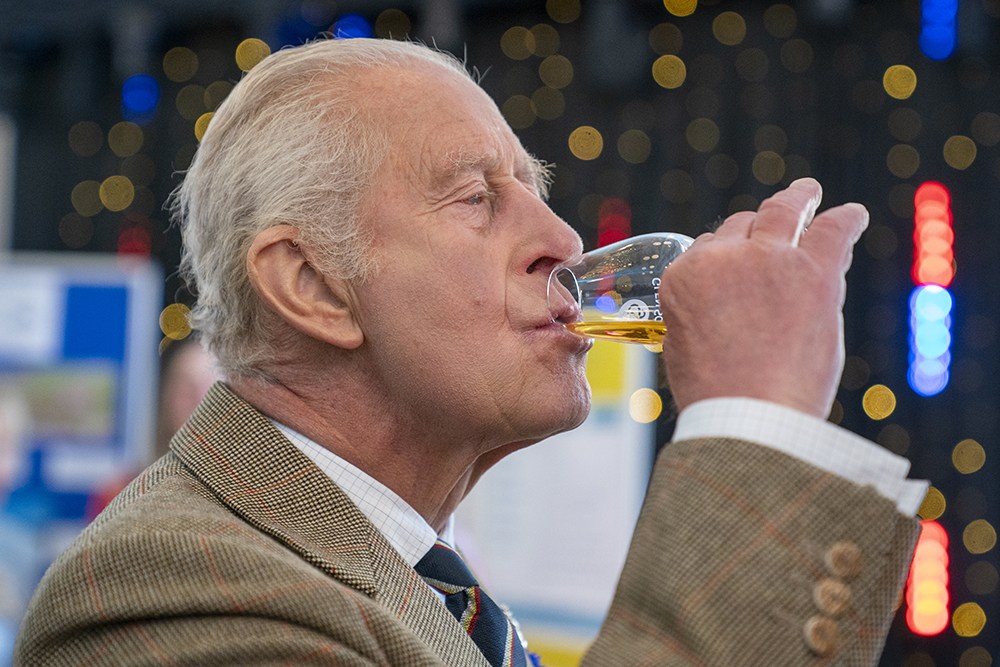


Is demand for the water of life running dry? I’ve just returned from a trip to Islay in Scotland, which has more whisky distilleries per square mile than anywhere else in the UK, and several of its famous single malts are struggling. Suntory, which owns Bowmore and Laphroaig, announced in February that it was merging the staff of the two brands, with Bowmore ceasing production until the end of the year, and Laphroaig putting its planned expansion on hold. Meanwhile, Sainsbury’s recently dropped the price of a bottle of eight-year-old Lagavulin to £40, down from its recommended retail price of £52.50. Are we in the foothills of a global whisky recession?
Alice from the Lagavulin visitors’ centre, who took Caroline and me on a tour on Sunday morning, seemed fairly bullish. She pointed out that the Diageo-owned distillery is still producing about 2.5 million litres of pure alcohol each year – enough for eight million bottles, although not that many reach the shelves. Production had momentarily halted during our visit due to a boiler fault, but it’s usually a 24/7 operation, with the sturdy machinery – some of it older than her, she told us – still belching out the raw ingredients. She remained good-humoured even after I told her my favourite local tipple was Laphroaig, a deadly rival. ‘Mouthwash,’ she said, laughing.
Alice’s job may be secure for now, but others on the island might soon be looking for work. Global Scotch exports fell by 4.3 per cent in 2025, with single malts hit even harder. Glengoyne and Rosebank, two mainland brands, have cut production by 30 per cent, while LVMH has halted production at Glenmorangie (although not at Ardbeg in Islay). But it’s not all doom and gloom. Demand for whisky in India is booming and two British entrepreneurs of Indian heritage – Sukhinder and Rajbir Singh – are building a distillery called Portintruan on Islay. I wasn’t able to visit because opening has been delayed after the first contractor they hired went bust, but it should start production this year.
Why are whisky prices falling? Declining demand is a factor, with Trump’s 10 per cent tariff putting a dent in the American market and Gen Z not drinking as much as Boomers like me. Squeezes on household incomes across the developed world also mean that people have less money to spend on luxuries like single malts. (A 16-year-old bottle of Lagavulin in the gift shop costs £84.) But a bigger cause of the downturn in production is over-supply. In the past 15 years, between 50 and 60 new distilleries opened in Scotland and some established brands doubled or tripled their output, fuelled by rising sales in the aftermath of the pandemic. Supply is now outstripping demand and there are about 12 billion bottles maturing in Scottish warehouses. As those begin to flood the market, prices are likely to fall even further.
That’s good news for us lovers of single malts. Caroline and I have been weekend guests of friends in Islay for three years on the trot and, thanks to their generosity, I’ve sampled40-year-old Lagavulin and 34-year-old Laphroaig. As Alice said on our tour, the whisky on Islay can be ‘quite confrontational’, but I’ve come around to its oily texture and smoky flavour. It’s of a piece with the austere, uncompromising landscape and the abundant local wildlife, including seals and otters. On a long walk on Saturday, I bent over a fast-flowing stream to scoop up water with my hands and it had the same peaty taste as the local whisky. I was told to bottle some and then have a splash of it with some 16-year-old Ardbeg that evening. It didn’t disappoint.
I bent over a stream to scoop up water and it had the same peaty taste as the local whisky
One of the quirks of a weekend break on Islay is having to go through security in the island’s tiny airport, which is unbelievably strict. You’re patted down as if you’re flying to Tel Aviv rather than Glasgow. As we were leaving on Sunday, an old boy was pulled aside at random for a full body search and had to sit down while two sturdy middle-aged women went to work on him. Is this to make sure that no one is leaving with more than their allocation of single malt? It’s not as if you get a discount for buying it locally. I paid full whack for my Distillers Edition bottle of Lagavulin.
It may just be a manifestation of that peculiar Scottish enthusiasm for ferreting out and punishing rule-breakers, a national trait which meant the Covid lockdowns were enforced with religious zeal. How these beady-eyed puritans became the creators of one of the finest alcoholic drinks known to man is an enduring mystery, but I sincerely hope the difficulty being experienced by the single malt industry is a blip. It would be a tragedy if this flower of Scottish civilisation were to wilt.



Comments