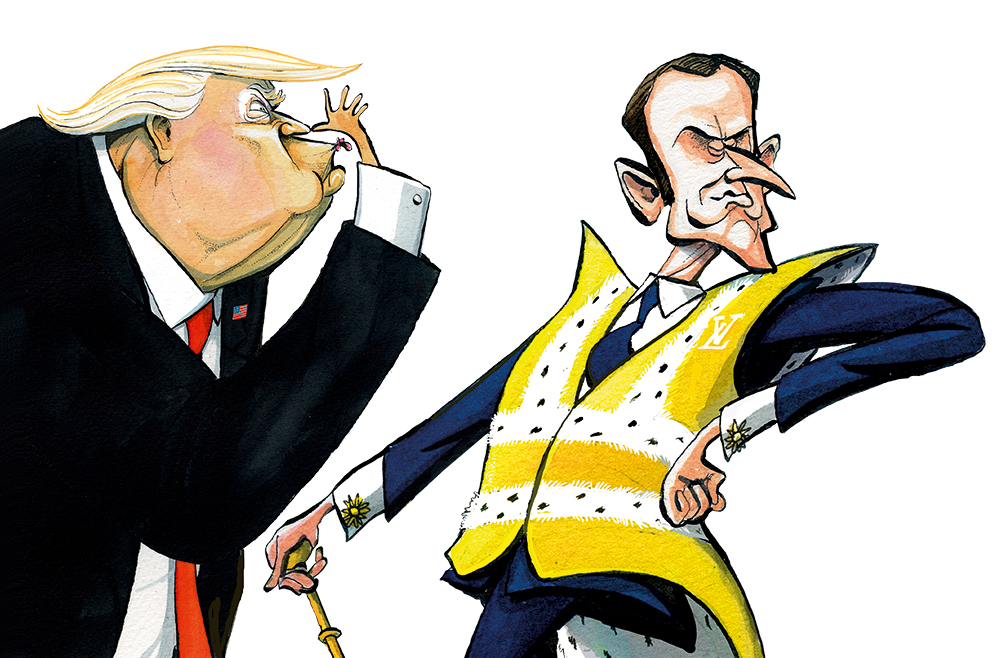


“Not perfect,” was Donald Trump’s reply when asked about Emmanuel Macron’s support for the Iran operation. “But it’s France, we don’t expect perfect.” The French President had initially distanced his country from the bombing campaign for, in his view, noncompliance with international law. Then Iran struck allied Gulf states and Cyprus. Macron immediately dispatched France’s Charles de Gaulle aircraft carrier to the eastern Mediterranean (while Britain was, humiliatingly, unable even to scramble a frigate). “We are not taking part in the conflict that is under way,” Macron declared with characteristic grandiloquence from the deck of the carrier. “France is a balancing and peaceful power.”
More than with other allies, Franco-American relations cleave to the emotional
The French love nothing more than tweaking the great sister-republic’s tail. Macron has met regional heads of state, even phoning the Iranian President. He has said he is defending France’s Gulf allies, while supporting Lebanon against Israeli bombardment. He talks of coordinating a defensive European naval force to liberate shipping in the Strait of Hormuz from Iranian strikes (although there is little sign of such an operation). Still, the French are reveling in this display. They have stood up to their American cousins, asserting both moral superiority and military strength. As Alexis de Tocqueville told John Stuart Mill in 1840: “National pride is our greatest remaining sentiment.” And they do it remarkably well. Macron’s poll rating is already up 6 percent. Trump has clearly found Macron irritating during his second term, at points calling him a “publicity-seeking” leader who “always gets it wrong.” During one particular spat, Trump threatened to “put a 200 percent tariff on his wines and Champagnes.” As Trump’s team talks of the continent’s civilizational decline, Macron’s calls for greater European autonomy. Neither side seems particularly impressed with the other. But then that’s always been the essence of the Franco-American relationship: revolutionary sister republics that can’t seem to get along.
Last month, a young conservative Catholic student was savagely beaten to death in Lyon by members of a far-left militant group. The group is affiliated with the Robespierriste firebrand Jean-Luc Mélenchon, a potential future president. The shock was felt well beyond France’s borders. Senior figures in the American administration saw this assassination as epitomizing European decay and said so openly. Among them was the American ambassador to Paris, Charles Kushner, father of Trump’s son-in-law.

An irritated Macron warned foreign politicians to keep out of French affairs, while his foreign minister proclaimed that France had no lessons to learn from the “international reactionary movement.” Kushner was summoned to the Quai d’Orsay but snubbed his hosts by claiming a prior engagement, sending a subordinate instead. The whole affair quickly descended into farce. The ambassador was informed that he would be denied access to French ministers, yet two days later he shared a photograph of himself at an Élysée function. The Franco-American tit for tat endures.
More than with other allies, Franco-American relations cleave to the emotional. Both have jealously competed for the other’s attention. France incessantly invokes General Lafayette’s military assistance in the young American nation’s independence struggle against Britain, and the US its sacrifice for France in two world wars. Testy relations between Franklin D. Roosevelt and General Charles de Gaulle in World War Two epitomized the Franco-American incomprehension: “How am I supposed to deal with a man who thinks himself both Joan of Arc and Napoleon!” complained the weary American president.
During the Cold War, de Gaulle vengefully distanced France from America, seeking to act as the middle path in a divided world. He opposed America’s Vietnam strategy, withdrew France from NATO’s military command in 1966 and sent packing 26,000 American troops stationed in France. In 2003, the Gaullist president Jacques Chirac publicly denounced America’s war in Iraq – and the US retaliated with widespread France-bashing, exemplified by the renaming of French fries as “freedom fries.”
At a more profound level lies creedal rivalry. The US and modern France share a common ideology born of the 18th century. Both are children of revolution and beholden to the messianic forces it unleashed. Both republics – uniquely among western nations – claim to be standard-bearers of universal values on behalf of humanity. “France, once soldier of God, today soldier of humanity, will always be the soldier of the ideal,” proclaimed France’s World War One leader, Georges Clemenceau, on November 11, 1918, shortly before welcoming to Paris that other self-proclaimed torchbearer of humanity, US president Woodrow Wilson.
Both France and the US compete to embody the values of freedom and democracy. On July 4, 1884, not without a degree of paternalism, France presented the Statue of Liberty to America. Not to be outdone, for the 1889 centennial of the French Revolution, Americans living in Paris donated to Parisians the “second Statue of Liberty,” now situated on Paris’s Île aux Cygnes in the Seine.
While rhetoric and historical sentimentality have their ups and downs, there is in France a deep antipathy toward the United States. It stems from a visceral anti-American intellectual trend characteristic of both the left and the right in France. With the formation in 1920 of the French Communist party (PCF), America came to epitomize the evils of capitalism, neoimperialism and materialism.
There is in France a deep antipathy toward theUnited States
From 1945 (26 percent) to 1978 (21 percent), the PCF commanded a sizable electorate, not to mention cultural influence, via people such as Jean-Paul Sartre. For the Catholic right too, materialistic Protestant America represented a spiritual anti-model. The celebrated Catholic writer François Mauriac, while praising the genius of the American people, described them as “more foreign to me than any other.”
This historical rivalry – albeit imbalanced since World War Two – is entering a cooler season. When Macron speaks of strategic autonomy in economics and defense, he is talking as much about the US as he is China and Russia. The French President spends much of his time in Brussels castigating EU states for buying American military equipment, not European (read: French).
Yet France continues to be the largest European entry point for Russian liquefied natural gas, despite sanctions and the ongoing threat of the Ukraine war. Such hypocrisy has not gone unnoticed by President Trump, who laid bare this funding of Moscow’s war effort. He has also made no secret of his dislike of the EU as despoiling American wealth through its massive US trade surplus. Hence his punitive tariffs on EU goods.
The French, as the self-appointed guardians of European values and civilization, felt particularly insulted by Vice President J.D. Vance’s speech at last year’s Munich Security Conference. Vance’s strident criticism of Europe’s destruction of its foundational values, of unchecked immigration and “woke” pieties, could not but antagonize Macron.
At this February’s conference, the French President sermonized that far from deserving criticism, Europe was a model of “a radically original political construction of free sovereign states.” Europe, he said, had given up centuries of rivalry and war “to institutionalize peace through economic interdependence.” What the EU needed most of all was to “learn to become a geopolitical power.” The Trump administration was unmoved. A few days later, to the same audience, US Secretary of State Marco Rubio conveyed the same message as Vance, albeit in more gracious terms.
The ordinary French person who rails against American woke ideology is unaware of its roots on the Left Bank
Despite this mutual blame, France and America are together responsible for injecting a deadly toxin into western thought, which is eroding its very foundations. First, “French Theory” crossed the Atlantic, buttressed by Jacques Derrida’s “deconstructionism” and its wholesale dismantling of traditional western values and norms. This was supplemented by French postmodernists – Michel Foucault, Jean-François Lyotard, Jean Baudrillard – who rejected the idea of objective social reality. In American universities, such ideas were retooled before being exported back to France (and Europe) as the “woke” movement with its hydra-headed incarnations: critical race theory, decolonization studies, queer theory, intersectionality. Today, the ordinary French person who rails against American woke ideology is blithely unaware of its fashionable French roots in the lecture halls and cafés of the Left Bank.
As Macron approaches the last year of his second term, he is in office but not in power. His vainglorious decision, in 2024, to dissolve the Chamber has hamstrung his presidency both domestically and internationally. Macron the risk-taker now has nothing to lose. Surveys of French views of Trump’s America are some of the most critical in Europe. Franco-American relations may be the opportunity to pluck the Gaullist chord and salvage his presidency from the ignominy of being the most unpopular of the Fifth Republic.
The French President should beware the danger of hubris, however. Across the Atlantic is another risk-taker. During the Six-Day War in 1967, de Gaulle sided with the Arabs against American-backed Israel. But that was the General. For Macron to push his luck too far by loudly opposing the US, worse still attempting to harness the EU for that purpose, could see Franco-American relations worsen from petty squabbling to outright hostility.



Comments