


Sean Thomas has narrated this article for you to listen to.
It has been obvious for some time that there are basic concepts that the liberal British Establishment simply does not understand. Like money. Or tax. Or business. Or going to the pub. Or the fundamental value of free speech.
Well, now we can add a whole new roster of more baroque concepts to this list: meme culture, e-girls, semiotics, détournement, the subtext of black chokers and basic human nature. And all because of a purple-haired young cartoon woman called Amelia.
Before we get to Amelia, we need to understand what created her – because the joke can only be grasped once you appreciate the lunacy that came before her minxy pink dresses. Amelia comes from a game called Pathways: Navigating Gaming, the Internet and Extremism. It was developed last year by local authorities in East Yorkshire with public money as part of the Prevent anti-radicalisation programme. Ostensibly, it was an educational tool for schoolchildren and college students.

The player starts as ‘Charlie’, a new student trying to settle into college life. Charlie seems to be gender-fluid and is referred to throughout as ‘they/them’. And poor old Charlie’s task is to learn what kind of thinking is officially permitted.
The game is simple. Certain actions are ‘good’; others are ‘bad’. Make too many bad choices and you are, within the logic of the game, deemed radicalised. Looking up immigration statistics? Bad. Expressing concern about job competition? Bad. Watching videos that criticise government immigration policy? Bad. Talking about English identity, heritage or cultural continuity? Very bad indeed: do not pass Go, do not collect £200, go directly to Prevent.
The effect is, to say the least, unsubtle. To question mass immigration, to care about national identity, to simply wonder about the merits of multiculturalism, is to place yourself on a conveyor belt towards extremism. Every Charlie is a potential fascist in the eyes of East Yorkshire educationalists.
This is where Amelia comes in. She appears in one of the early scenarios as Charlie’s friend: outspoken, political, sceptical of immigration, interested in protests and nationalist groups. Within the logic of Pathways, she’s a warning sign. Stay away from the fash-adjacent temptress.
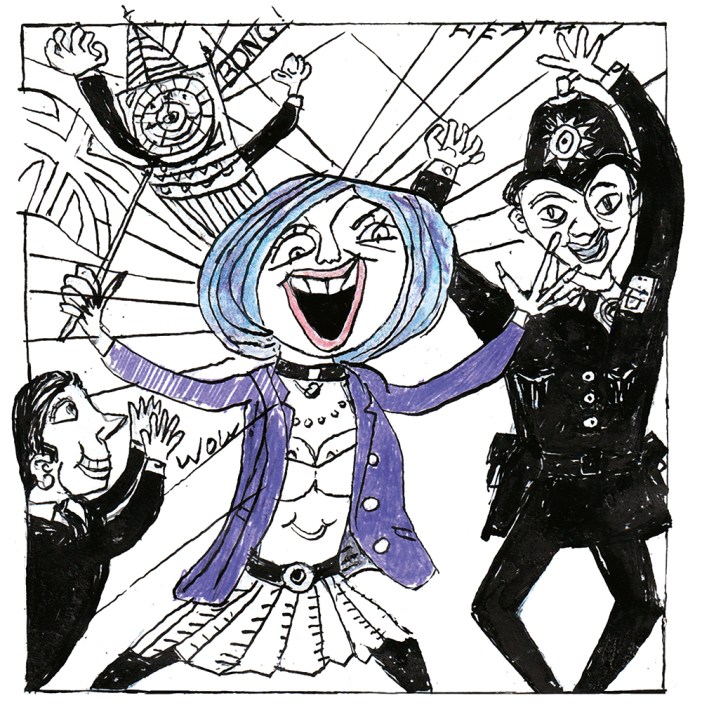
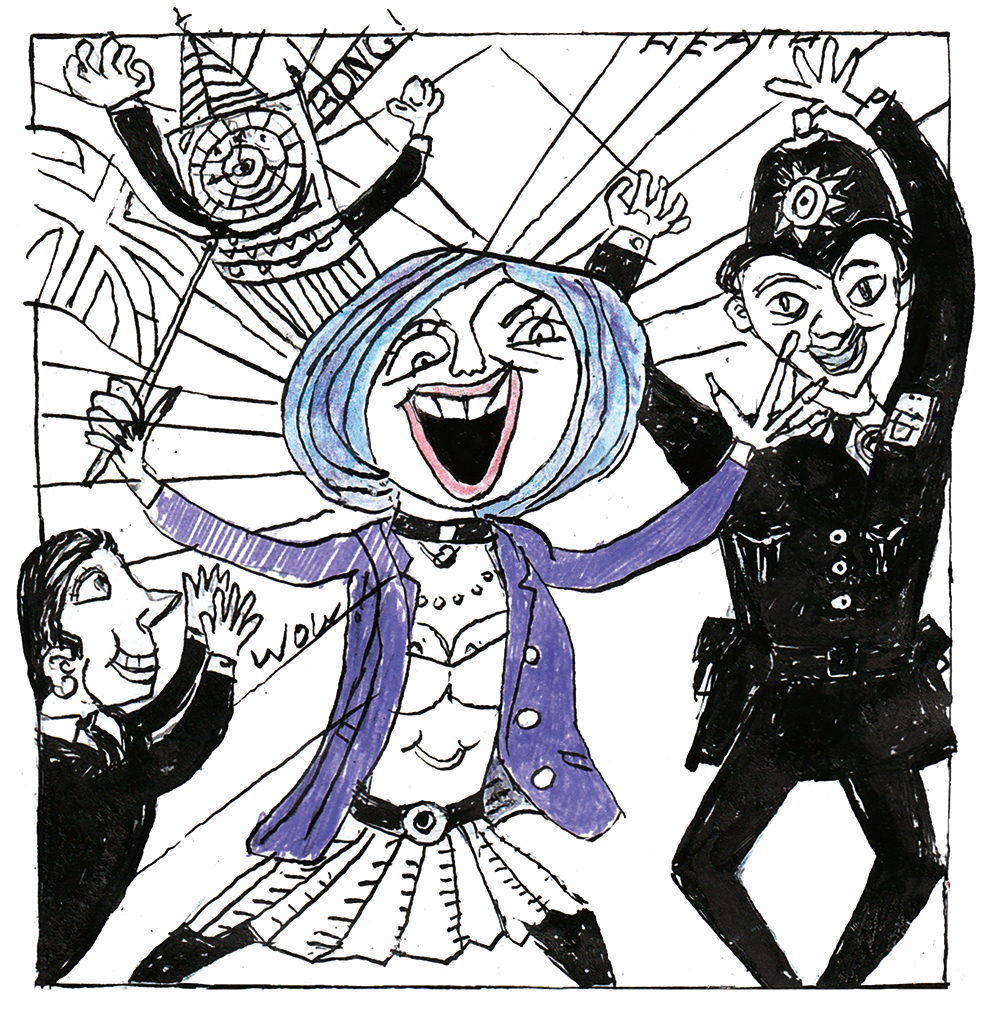
The problem is that Amelia does not look like a Nazi villain. She looks intriguing. She has purple hair, a black BDSM-y choker and a goth girl aesthetic.
For more than a decade, the goth or e-girl archetype has been one of the most consistently adored figures in online meme culture, from the ‘Big Tiddy Goth GF’ to the Doomer Girl. These characters are almost always sympathetic, desirable, aspirational, sexy. They signify non-conformity, authenticity and resistance.
On 9 January, the game escaped containment and went viral. Screenshots from it began circulating on X. The tone was ironic admiration – ‘Wait, they made the cute goth girl the racist?’ – but irony quickly melted into something warmer and more mischievous. Amelia became an object of playful devotion, deliberate provocation and delicious eroticism.
Fan art followed. AI-generated images and videos placed her in front of Big Ben, in English pubs, wrapped in Union Flags, laughing at Keir Starmer (‘How did we go from Churchill to you, you git?’), and leaping into a Spitfire to stop boats in the Channel. She was recast not as a cautionary figure, but as a symbol of exactly the sentiments the game was trying to suppress.
Amelia comes over as a cool outsider, a rebel, someone interesting in the dreary world of institutional beige
To get mildly pretentious, what happened was détournement in the Situationist sense: an institutional message hijacked and turned against itself. A state-funded warning against nationalism became a nationalist icon. The sign was turned upside down.
The authorities then made it all worse. Rather than owning and acknowledging the failure, they took the game offline. Links stopped working. The Amelia scenario became less accessible. What might have remained a niche embarrassment became a cause célèbre. The removal itself became proof, in the eyes of Amelia’s admirers, that the state was frightened of its own creation. Consequently, Amelia did not disappear. Go on X, Facebook, TikTok or many other internet sites and you will find Amelia doing all sorts of politically incorrect things. Her purple-haired rebellion has also been covered by Die Welt and the Guardian and birthed copy-cat equivalents across Europe and beyond.
Does it mean anything important, or is it all just amusing internet froth? I believe it does have significance, even if Amelia disappears tomorrow. Amelia is final proof, in the age of the viral AI meme, that the government no longer has any chance of controlling the narrative, let alone establishing one in the first place.
This goes against every instinct and reflex of the British Establishment. Because, if the Establishment exists to do anything, it is to control us. This is why Starmer is so desperate to ban X for putting fake bikinis on women, while taking a year to announce a possible inquiry into nationwide grooming gangs.
Happily, this is one battle the Establishment simply cannot win. It has been said that the internet is the subconscious of humanity. And, as Freud observed, in the end the subconscious will always decide what we do. Dreams denote desires, and desires determine reality. In other words: go, Amelia.



Comments