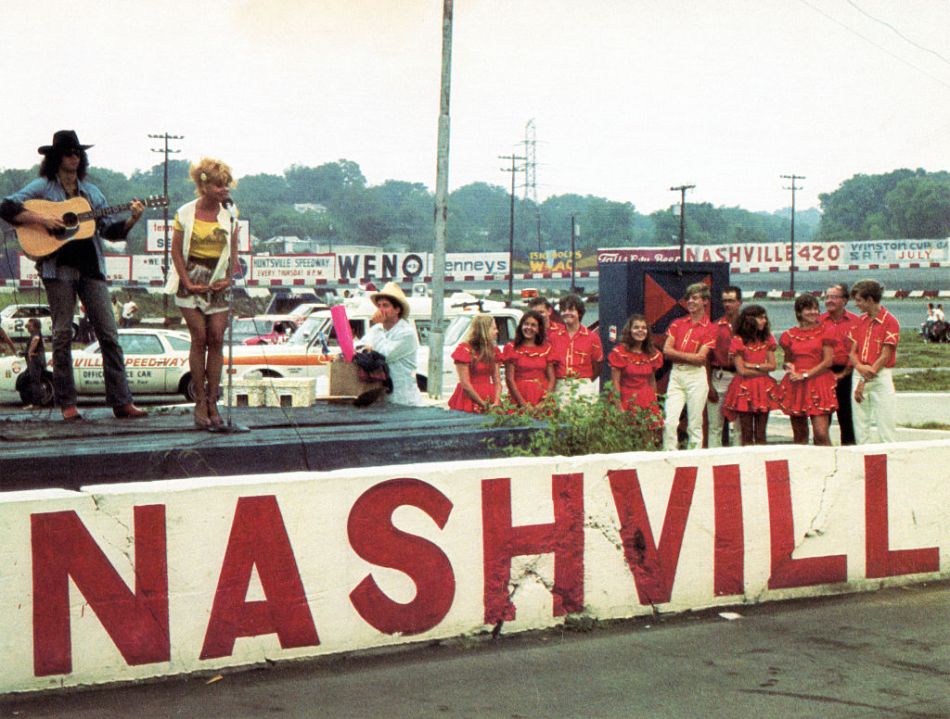


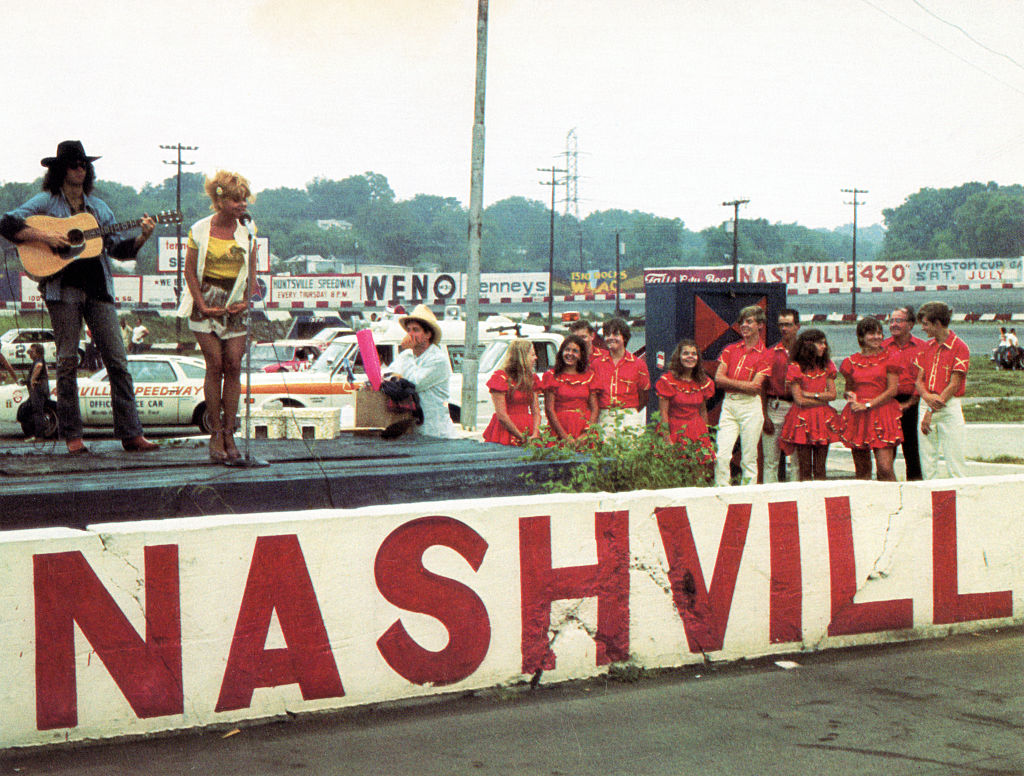
“There ain’t nothing like the loving of a hard-driving cowboy man,” as the country singer Barbara Jean puts it towards the end of Robert Altman’s movie Nashville, and, really, there ain’t nothing like Nashville itself, either. It’s surprising more has not been made of it this year, when the country’s 250th anniversary has got tangled up with the flailing Trump presidency.
Though he made the film in 1975, Altman set it a year in the future, amid a fictionalized and chaotic 1976 presidential campaign. He meant to give an account of a country that, on the 200th anniversary of its founding, had descended into unprecedented gaudiness and depravity. When Jimmy Carter wound up winning the White House, Nashville came to seem prophetic. But it is more than that. It is probably the greatest of American movies.
The plot is simple. A plain-spoken, establishment-baiting insurgent candidate named Hal Phillip Walker has entranced the country, to the horror of the political establishment. “New roots for the nation” is the motto of his Replacement party. Walker wants to tax churches, abolish the electoral college, change the national anthem and get lawyers out of politics. A slick advance man comes to the country-music capital to convince as many stars as he can to perform at a rally for Walker the following weekend. Funny things happen, as well as a certain number of humiliating, disturbing and violent ones.
To watch the movie’s characters at work is to recognize a kinship between celebrity and politics
The country is in a terrible mess. The lost war in Vietnam looms over everything, and so do the assassinations of Robert F. Kennedy and Martin Luther King Jr., less than a decade before. Desegregation has reached that stage when schoolchildren are being bused around metropolitan areas to achieve “racial balance” – a program that is being meekly assented to in so-called “Jim Crow” Louisville but meeting massive resistance in so-called “liberal” Boston.
In Nashville, the BBC journalist Opal, played by Geraldine Chaplin, tours a school-bus parking lot and delivers a monologue in which she marvels that all American school buses seem to be yellow. “I wonder how many little black children and little white children have yellow nightmares.” The clueless Opal is one of the great comic characters of American cinema. At a recording studio, seeing a white woman performing with a gospel choir, she turns to her companion and asks, “Is she a missionary?”
One of the things that will strike the watcher of the movie, though, is the relative uncomplicatedness of the social scene. It’s still a biracial country – it’s black people and white people. They may not understand one another, but they are patient with one another. Altman is known for filming scenes on real streets, in real, lived-in buildings – not sets. Anyone who was growing up then will be jolted and comforted by the vividness of certain sights and sounds: an aerosol can of Right Guard deodorant in a steamed-up bathroom. A waxy red, white and black box of Kentucky Fried Chicken. Men wearing ties with short-sleeved shirts. Men with nicknames like Pig and Frog and Trout. Boarding houses where an old man will rent you a room for $13.50 a week. The film has the feel of a documentary.
These are mostly musicians we are talking about – creative, charming, vain. In this semi-reality, several of the actors are performing their own songs. Keith Carradine plays a womanizing singer-songwriter named Tom. We’d probably call him a creep, though it’s by no means clear Altman felt that way about him. Standing beside a soldier who’s just back from Vietnam, Tom asks, “How you doin’, Sarge, you kill anybody this week?” His character is an extraordinary cinematic creation – performing in a crowded club before an audience that includes three women he’s recently slept with (and one he’s about to), he dedicates a love song he has just written to “someone kind of special who just might be here tonight.” But the song itself, “I’m Easy,” is not a cinematic creation at all: Carradine wrote it. In fact he won an Oscar for it.

The diminutive, toupée-sporting Henry Gibson, in real life a milquetoast comedian and washed-up game-show host, gives a stunning performance as Haven Hamilton, a lion of country music. He is the alpha male in a herd of sighing poets – he gets wrapped up in the politics of the presidential race because Walker wants him to run for governor of Tennessee. In the meantime, he performs cornball tunes:
Ain’t no use to sit and whine
When the fish ain’t on your line;
Bait your hook and keep a-tryin’
Keep a-goin’!
Again, the character Haven performed this song, but Gibson himself wrote it.
Above all there is Ronee Blakley, who plays Barbara Jean, a fragile, ethereal, neurasthenic, Dame aux Camélias-type beauty who is the most beloved singer of her day. She performs a tremendous song called “My Idaho Home,” not because Barbara Jean is from Idaho but because Blakley is from Idaho, and she wrote it (along with that one about the “hard-driving cowboy man”), before the idea of Nashville took shape in Altman’s head.
Go see it, as we used to say. To watch the movie’s two dozen characters at work is to recognize a kind of kinship between celebrity and politics. The drive for artistic fame (which we call “creativity”) is like the drive for political power (which we call “ideology”): they’re ulterior motives that trail behind the protagonists, sabotaging their common sense at every step.
Watchers of Nashville who shuffled out of movie theaters half a century ago, with the climactic scenes of that Walker rally in front of the Parthenon in Nashville’s Centennial Park still running through their heads, had reason to think they had seen the country as it really is. And perhaps is still.



Comments