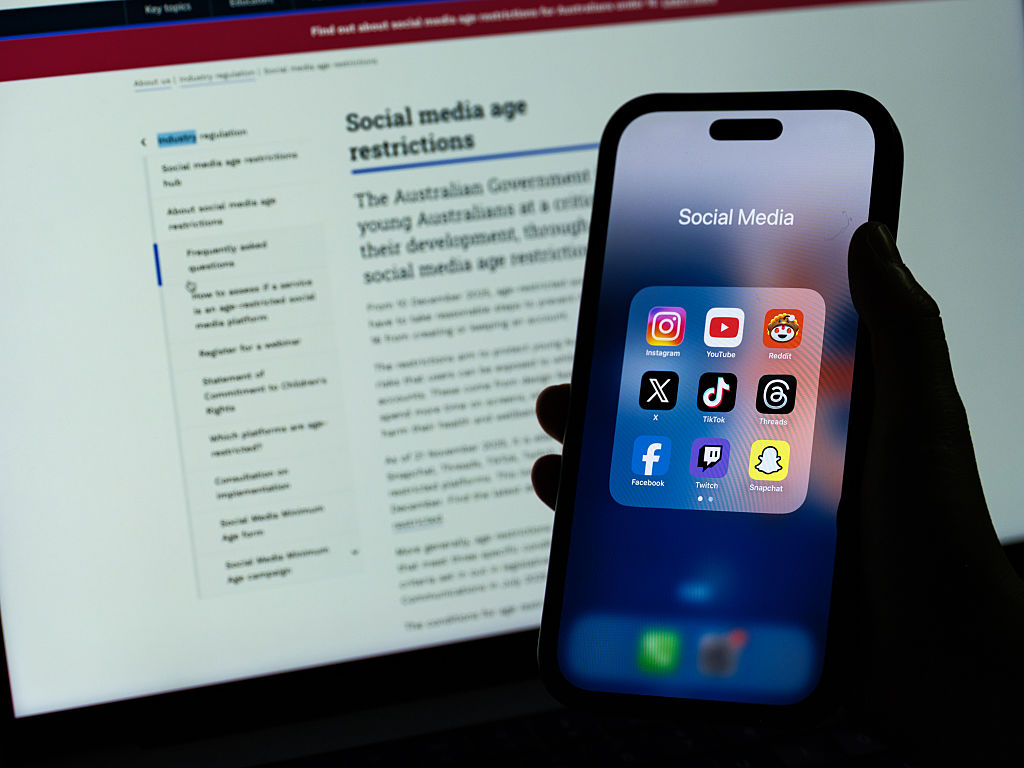
The Heritage Foundation’s tech policy team has endorsed European-style age verification laws for social media, likening them to alcohol and tobacco age restrictions. This is a comparison worth taking seriously – just not in the way Heritage intends.
Walk into a bar, and a bouncer checks your ID. In about 15 seconds, you’re inside. That’s it. Online age verification would be a very different experience, requiring the collection, storage and verification of sensitive personal documents at scale. This is a breach of privacy and free expression for adults. It also puts minors – a population 35 to 51 times more likely than adults to fall victim to identity theft – at risk.
None of this means we should neglect to take action to protect kids online, but we can do better than importing poorly-written European regulations. Lawmakers should focus on what works – empowering parents with real tools and investing in robust educational resources.
The unintended consequences stemming from age verification laws are no longer theoretical – these policies have been tested for years across the Atlantic.
The United Kingdom’s Online Safety Act (OSA), a 2023 law, requires online platforms to implement “highly effective” age verification rules – measures that went into effect last July. Under the law’s most stringent compliance requirements, Wikipedia would be compelled to allow users to filter out content from “unverified” users. In other words, many site editors would have no choice but to reveal their identities or quit editing the site altogether.
This comes with broad consequences. Wikipedia’s model depends on the ability to draw from a widespread, diverse and often anonymous pool of editors – the only way to sustain an encyclopedia of its scale and credibility. The nonprofit operating Wikipedia, the Wikimedia Foundation, rightfully argues ending anonymous contributions could “expose contributors to data breaches, stalking, lawsuits or even imprisonment by authoritarian regimes.”
Forcing the site to allow all users to block anonymous ones from editing or removing content they post empowers bad actors to post false information unchallenged. The British High Court dismissed Wikipedia’s challenge last year and the nonprofit now awaits a formal designation determining whether it will be regulated under the law’s strictest tier. If it cannot comply, Wikipedia could face fines of up to £18 million or 10 percent of its global turnover – and could go dark for all UK-based users.
Wikipedia is just one example. Attempting to comply with the OSA, social media sites like X and Reddit have already broadly censored topics, including content relating to the war in Ukraine and grooming gangs. In another case, Spotify warned users their accounts may be deleted if they fail to “pass new age verification tests.” In October, Discord admitted to the government-issued ID photos of approximately 70,000 users being “exposed.”
The pattern is already repeating domestically. The Kids Online Safety Act (KOSA) is garnering support in Congress and now enjoys support from 40 state Attorneys General. At least 16 states have enacted laws akin to those in Europe, and they have also been met with compliance-driven overcensorship in response, with some pulling out of states completely. The difference in the United States is that the courts have almost uniformly blocked these state laws on First Amendment grounds.
Europe, lacking a First Amendment equivalent, views free expression as something to be regulated like a utility. If the current ruling party arbitrarily decides a form of expression is “bad,” that party can enact a law restricting such speech, often with a simple majority or the stroke of a pen. In the United States, the bar is much higher, with the First Amendment offering formidable speech protections.
The American Framers made a bet the Europeans did not: that government cannot and should not be trusted to arbitrate which speech is harmful and that harmful speech should instead be challenged with more speech. The Framers got it right. Upholding this foundational value is not at odds with protecting kids online.
The alternative to a European-style censorship apparatus is not inaction, but investments in education and parental empowerment. Both the federal and state governments can fund awareness campaigns aimed at equipping parents, teachers, and other youth leaders with digital literacy curricula.
The Department of Homeland Security already has a demonstrated model with Know2Protect, a public awareness campaign, reaching over 200,000 through in-person presentations and garnering over 683 million online impressions. The campaign is partnering with tech companies like Meta, Google, and X, professional sports leagues, law enforcement, youth groups and other nonprofits.
The private and nonprofit sectors can and are taking leadership, too. NetChoice, a tech freedom trade association, has published guides on parental control tools and made the case for digital safety curricula as a constitutional alternative to age verification mandates. National PTA, through its PTA Connected initiative, offers a resource hub aimed at bringing parents and teens together to learn about digital safety, best practices, and expert resources. Through Internet Be Awesome, Google provides families with a guide packed with “the tools and resources to learn about online safety and citizenship at home.”
Europe has bet on government as the arbiter of speech and safety. The American tradition is an informed, empowered citizenry. We can achieve online child safety without digital ID checks, a surveillance apparatus, or a liability regime pushing platforms toward overcensorship. That bet – and that tradition – is worth defending.
Ed Tarnowski
Age-verification for social media puts kids at risk
Comments