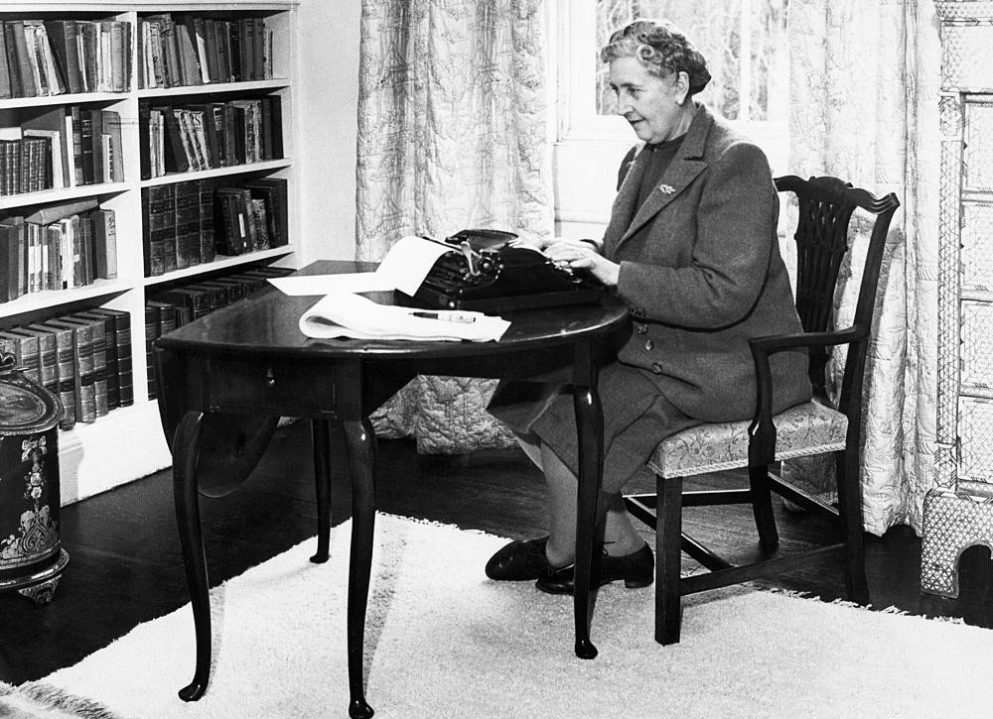
Half a century after her death, the crime and mystery novelist and playwright Agatha Christie still rejoices in the nickname ‘the Queen of Crime’. It is not hard to see why. Not only has she sold two billion copies of her works internationally – with another two decades to go before her books go into the public domain, she will remain big business for her estate up until 2046 – but she remains vastly influential in fields that she could not even have contemplated while she lived.
Christie was never more than an efficient prose stylist, who preferred to concentrate on creating indelible characters
Without Christie, there would be no Traitors, no Thursday Murder Club and no vogue for celebrities to write hugely variable novels in the ‘cosy crime’ genre. She is one of those rare authors who transcends barriers of all kinds, and whose novels are as likely to be enjoyed by a young man in Beijing as they are by a well-upholstered retiree in Bracknell.
Still, there are criticisms of Christie that can be made, both on literary and reputational grounds. The British Library’s comprehensive and rather excellent new exhibition, Agatha Christie: A World of Mystery, begins the pre-emptive case for the defence early on, when it notes, somewhat shamefacedly, ‘This exhibition contains complex and sometimes challenging topics including war, colonisation, violent crime, mental health and the use of offensive language.’
Some of this is priced in. It would be bizarre to visit a Christie exhibition and not be treated to loving and detailed depictions of the various forms of murder that were used throughout her 66 novels and 14 short story collections, although the decorous way in which she depicted the various killings and fashions that her characters met their Waterloos was a world away from the grislier torture porn that has become prevalent in contemporary fiction.

Yet Christie was never more than an efficient prose stylist, who preferred to concentrate on creating indelible characters – such as her two best-known detectives, Miss Marple and Hercule Poirot – rather than writing serious literature. Perhaps the only novel of hers that could be called truly great from a literary perspective is Poirot’s introduction in The Murder of Roger Ackroyd, complete with its gobsmackingly clever twist. But her legions of readers are not looking for High Art, but great storytelling, and this is what her dozens of books delivered throughout her career.
Agatha Christie: A World of Mystery – surely there was a temptation to call the exhibition Agatha Christie: Not Ancient History, given the unexpected focus on Christie’s archaeological enthusiasms that inspired many of her later works – is faced with the dilemma of how far to offer straightforward celebration and commemoration of such a much-loved author, and whether there should be even the slightest attempt at revisionism.
With the heavy involvement of Christie’s grandson Matthew Pritchard, there was never going to be much criticism of the author, although one exhibition label, ‘Stereotyping’, sighs that ‘Christie’s portrayals of Jewish characters drew on negative stereotypes, including physical descriptions’, and another laments that ‘Christie’s works include racial language and stereotypes typical of early 20th-century Britain, reflecting broader interwar attitudes’, even though ‘later editions and translations softened or removed offensive phrasing, while others amplified it’. Of course, the original title of her classic whodunnit And Then There Were None is nowhere to be seen: some phrases are too shocking to be repeated, even for historical reasons.
Still, nobody reads Christie to be improved, unless they want to discover the best way of murdering someone around them (thallium, apparently). The British Library’s exhibition excels in the sheer amount of surprising and often amusing detail that it throws up, which will delight Christie obsessives and fascinate more casual admirers. We learn, for instance, that the once-popular, now-forgotten author Eden Phillpotts was the first literary figure to encourage the young Christie, and then there is the caustic dismissal that ‘after his death, Phillpotts was discredited following sexual abuse claims from his daughter’.
Christie was never a literary lion, but she began a friendship with that other most English and, at times, undervalued of authors, P.G. Wodehouse, when he was 88 and she was 79, and complained in a letter included in the exhibition that ‘my dog [is] either barking or doing his utmost to pretend he is a lap dog’. And when it came to her personal life, which was most notable for the 11-day period in December 1926 when she vanished from view after her first husband left her, there is a judicious balance between information without attempting prurient speculation.
She later claimed to remember nothing about the period; you will find no startling revelations here. But her second marriage, to the archaeologist Max Mallowan, was a happier one. I was especially struck by the revelation that Christie wrote in her autobiography that she was ‘a married woman, that was my status and that was my occupation. As a sideline, I wrote books.’
Some of these books were adapted into films and television shows of wildly varying quality. While Christie would almost certainly have approved of the casting of Joan Hickson as Miss Marple and David Suchet as Poirot, she was less enamoured of the jolly-hockey-sticks Margaret Rutherford as Marple. In a letter included here, she wrote despairingly to her literary agent of a proposed film of Murder Ahoy! that ‘I certainly cannot approve of this script since it entirely distorts the character of Miss Marple herself… she has an established life, character and personality. You cannot expect me to agree or to like the complete distortion of one of my favourite creations, and therefore I am registering this formal protest.’ The picture was eventually made, but there were to be no more Rutherford-Marple films.
It said a huge amount for Christie’s standing not just in the literary world but in society in general that, when Poirot was finally killed off in her 1975 novel Curtain, a tongue-in-cheek obituary was included on the front of the New York Times. Ever since Christie herself died, on 12 January 1976, her characters have been given new life by an assortment of other authors, to variable effect, all under the careful watch of her estate.
Still, what Agatha Christie: A World of Mystery so enjoyably reminds the visitor is that she remains the doyenne of the genre. She was asked shortly before her death how she would like to be remembered, and the author replied, ‘As a good writer of detective and thriller stories.’ This modest self-assessment is unlikely to be contradicted as long as readers want a page-turning mystery to read beside the fireside on a winter’s night.





Comments