-
AAPL
213.43 (+0.29%)
-
BARC-LN
1205.7 (-1.46%)
-
NKE
94.05 (+0.39%)
-
CVX
152.67 (-1.00%)
-
CRM
230.27 (-2.34%)
-
INTC
30.5 (-0.87%)
-
DIS
100.16 (-0.67%)
-
DOW
55.79 (-0.82%)
Why did police handcuff Henry Nowak?
Britain’s police are meant to police without fear or favor, but there is plenty of anecdotal evidence that they don’t – think of how they hold, or too often do not hold, the ring impartially between supporters of Israel and Palestine, Muslim and Christian preachers, supporters and opponents of trans rights, or whatever.
Does all this matter? The Nowak case, with an obvious victim, shows clearly that it does
There is a tendency for the great and the good to say this is no very big deal; the police are doing their best in difficult situations, complainants are normally tiresome culture warriors or enablers of hate speech. Events in Southampton Crown Court over the last two weeks show how wrong they are. Partial policing can potentially be deadly.
A Sikh man, Vickrum Digwa, is standing trial for the murder of a Polish student, Henry Nowak, who died from loss of blood after being allegedly stabbed by him in a run-down student quarter of Southampton. Of Digwa’s guilt or innocence we say nothing, since he denies the charge of murder and the trial continues. But whether or not he is guilty, the account in court of how Nowak died is enormously worrying.

It is admitted that Nowak, already weak from knife wounds, was trying to reach help when the police arrived. The evidence is that, having arrived, the police interviewed both parties; told that Nowak had started a drunken fight and racially abused Digwa, they immediately handcuffed him. Afterwards, they realized his condition. When he collapsed, they removed the cuffs and administered first aid. But it was too late. He died in their hands.
Even accepting that dealing with a street brawl at midnight is not easy when it is unclear who if anyone was in the right, this raises questions. If someone is weak and spurting blood, one might have thought that arresting them was fairly pointless. They are unlikely to go far, and the first priority should be to get them to a hospital. A general policy of arresting anyone who has been involved in a fight (no-one knows who to believe) is one thing. Not making an exception where one party is seriously injured and needs immediate help isn’t, shall we say, in the best traditions of policing.
But this may not be the real reason why the victim was arrested and handcuffed. There is a more worrying possibility, at least hinted at in the reports: that Nowak’s arrest was an immediate reaction to the suggestion that he had racially abused Digwa, and had this simply been a case of a person alleged to have started a fight he would not have been cuffed but simply rushed to hospital. If this is right, then the Hampshire Police have a serious case to answer, and not simply because their arrest of Nowak may have led to his unnecessary death.
For one thing, a policy of almost automatic arrest for any allegation of a racial slur, whatever the circumstances, is a grossly one-sided use of police resources. The police are supposedly trained to act proportionately, which means occasionally exercising discretion not to arrest, and always having in mind their priorities for keeping the peace and preventing more general crime. Events like this provide disconcerting grist to the mill of those who allege that the police unduly concentrate on speech crime rather than, say, burglary, car theft or shoplifting, which affect a good deal more of us. But more to the point, they leave room for an uncomfortable suspicion that police policy is being dictated not by ordinary policing considerations but by optics, public relations concerns and a felt need to appease certain pressure groups or special interests.
Does all this matter? The Nowak case, with an obvious victim, shows clearly that it does. But it is not the only example. At least one cause of Axel Rudakubana’s rampage in Southport appears to have been the police’s failure to arrest him earlier when he showed disturbing signs of violent psychopathy, when one suspects that had he been a middle-class white child they might have acted very differently. The cutting back on the use of stop and search powers in order to avoid a disproportionate effect on black youths may well lead to a preventable deadly stabbing, and so on.
We’re told we need policing by consent. So we do. In the end, however, the policing that truly gains respect is dispassionate policing. True, it must respect the views of those representing minority communities. But it must also keep onside the majority of people, those who believe it is more important to deal with crimes such as theft that affect all of us, rather than more niche affairs merely affecting particular interest groups.
There will almost undoubtedly be an internal police inquiry into the death of Henry Nowak, and possibly a further investigation. And rightly so. But if it is to do any good, those conducting it need to keep these matters firmly in mind.
The Ministry of Defence is failing to prepare Britain for war
In the last 20 or 25 years, there has been a much greater understanding that a country’s ‘national security’ encompasses much more than the traditional duality of diplomacy and military power. Trade routes, public infrastructure, energy supplies and societal cohesion are all at play in terms of assessing threats and designing ways of defending against them.
One key issue to emerge has been the concept of resilience: how well-prepared is Britain? What risk mitigation have we undertaken? How would we respond to a sustained conflict? What is the public mood? At the beginning of the year, the House of Lords appointed a select committee on national resilience, chaired by former adviser on corporate responsibility and self-regulation Baroness Coussins, to report on the subject by November.
This week, the committee heard from three senior figures from the Ministry of Defence (MoD): Lieutenant General Sir Charles Collins, Deputy Chief of the Defence Staff (Military Strategy and Operations); Lieutenant General Paul Griffiths, Commander, Standing Joint Command; and Damian Johnson, Director of Home Defence and Strategic Threats at the MoD.
It all adds up to wishful thinking
They had a detailed if sombre story of meticulous preparation to tell. The MoD has a four-part strategy called ‘Fortitude’ to deal with hostile action on and against UK home soil. One of the elements sets out how military and civilian personnel will be involved in reacting to any attack on Britain. The regular armed forces would be expanded, the volunteer reserves would be mobilised and civilians would be encouraged to contribute where necessary to the defence of the realm. Griffiths explained:
This is our mass mobilisation, and how we would go ahead with increasing the size of the military workforce and the civilian volunteers to support us in time of crisis and conflict. We use the joint military commands at the very bottom of the organisation to connect to society, generate the inclination to serve and then pull them in as required.
The other parts of Fortitude focus on cooperation between military and civil authorities; the protection of military installations and critical national infrastructure; and the role of the police and other civilian organisations in assisting the armed forces to deploy from and return to the UK.
These are plans to address very grave threats like long-range missile strikes, cyber attacks, damage to infrastructure and various forms of hybrid warfare, but they sound serious and carefully drafted. The problem lies in the fact that ‘Fortitude’ is a castle largely built on sand.
Many of these ideas were prefigured in the Strategic Defence Review (SDR) which was published last June (later than expected, like everything which emerges from the MoD). It referred to the need to ‘build national resilience’ and ‘increase national warfighting readiness’, but precious little has actually been done in the 11 months since then.
The SDR also stressed the importance of ‘leading a national conversation to raise public awareness of the threats to the UK, how defence deters and protects against them, and why defence requires support to strengthen the nation’s resilience’. This has simply not happened, and the MoD is still talking about a ‘national conversation engagement campaign’ as a future event.
There are also critical pieces of strategy and legislation missing. The SDR recommended a Defence Readiness Bill to ‘provide the government with powers in reserve to mobilise reserves and industry should crisis escalate into conflict’. No such measure, however, was mentioned in the King’s Speech earlier this month and seems unlikely to appear before next year at the earliest.
Equally, the SDR’s high-level recommendations depend on concrete spending decisions which will be set out in the Defence Investment Plan. But this plan was initially promised for the third quarter of last year, has still not appeared and may not be published before the summer. It could easily end up being a year late.
This highlights a toxic intersection between two habits: that of Labour ministers to make bold announcements and think somehow that they equate to taking action; and the tendency of the MoD to assure any anxious interlocutors that, while there may be challenges or capability gaps or delays in procurement, everything will be all right and the armed forces are ready to defend the realm if necessary.
It all adds up to wishful thinking. The MoD is facing a financial shortfall of nearly £30 billion over the next four years. The Royal Navy’s battle fleet barely runs to a dozen active vessels available for operations. The Royal Air Force has no medium helicopter capability. The Royal Marines have no purpose-built amphibious assault ships. The Army’s Ajax armoured fighting vehicle programme is a decade behind schedule and the Royal Artillery has 14 proper guns.
The armed forces cannot currently meet the UK’s operational requirements, and there is no guarantee of adequate resources in the immediate future – indeed, some programmes may have to be cut. How on earth, then, are we to take seriously senior military and civilian personnel who describe elaborate plans to defend the United Kingdom through new systems, deployments and capabilities?
‘Fortitude’ currently has all the credibility of Billy Bunter’s postal order. It will arrive, we are assured, and it will address all our anxieties and vulnerabilities. When? That is a complicated matter. We must hope that our enemies – Russia, China, Iran, North Korea – will have the decency to wait for us to be ready before attempting to do us harm. Anything else would be unsporting in the extreme. But what else have we left to rely on?
France could block Britain from rejoining the EU
Labour’s dream of rejoining the European Union may be an ambition to warm the heart of Emmanuel Macron but it hasn’t gone down well with Marine Le Pen’s National Rally.
She is known for her Euroscepticism, and one of her MEPs has suggested the party may block any attempt by Britain to reverse Brexit. ‘To do so without a referendum would obviously be a denial of democracy because the people expressed their will through a referendum to leave,’ said Charles-Henri Gallois.
Neither Le Pen nor Melenchon champions Frexit but they understand the disdain the majority of French people have for the EU
In an interview with the Daily Telegraph, Gallois, who is the economic adviser to Jordan Bardella, the president of the National Rally, said: ‘Yes, we would oppose it without a referendum, I think, because in any case we’re against any enlargement of the EU anyway… given that there was a referendum to leave, that we can’t accept a country rejoining without a referendum.’
Referendums and the EU remain a sore point for France’s Eurosceptics. In 2005 the country voted ‘non’ to the EU Constitution, causing panic in Paris and Brussels. President Jacques Chirac promised to respect the result, but he didn’t and nor did his successor, Nicolas Sarkozy. In 2008 the constitution was ratified by parliament without the consent of the people.
That democratic betrayal provoked a schism within France’s Socialist party. Jean-Luc Melenchon quit and went in his own direction, eventually forming in 2016 the Eurosceptic La France Insoumise.
The following year he made no secret of his dislike for the EU when he contested the presidential election. Among Melenchon’s demands were the removal of the EU flag from the National Assembly.
The outgoing president, Francois Hollande, criticised him for daring to call into question ‘what has been the great European project’, while Benoît Hamon – the Socialist party’s candidate in the election – accused Melenchon of telling ‘fairy tales’ about the EU.
The winner of the 2017 election was Emmanuel Macron, a man even more committed to the European project than Francois Hollande. He has railed ceaselessly against Brexit in the last decade. In 2018 he called Brexiteers ‘liars’, and in 2020 he described Brexit as a product of ‘lies and false promises’. He was at it again last summer, blaming the small boats crisis on the ‘lie’ of Brexit. If that’s the case, what is responsible for France’s own illegal immigration crisis? Earlier this week it was revealed that the Republic is undergoing a wave of unprecedented migration, and it is estimated that there are now more than one million illegal immigrants in France.
Macron will be gone in April 2027 and with him will go France’s adoration of the EU. A recent report by the left-leaning think-tank, the Jean-Jaures Foundation, revealed that 45 per cent of the French electorate are ready to vote for the National Rally: evidence of just how calamitous Macron’s presidency has been.
With the centre-left and centre-right struggling to produce a viable candidate, it’s probable that Melenchon will reach the second round of the presidential election. That will pit one Eurosceptic against another, be it Marine Le Pen or Jordan Bardella. She will discover on July 7 if her appeal against her disqualification for misusing EU funds has been successful.
Neither Le Pen nor Melenchon champions Frexit but they understand the disdain the majority of French people have for the EU. Both have been highly critical of the trade deal agreed last December between the EU and South America, claiming it will be ruinous for French agriculture. A poll earlier this year found that only 38 per cent of the population view Brussels in a favourable light.
Macron has always been aware of this Euroscepticism. In January 2018 he admitted to the BBC that if France had the chance they would also ‘probably’ have voted to leave the EU. Macron never had any intention of giving them that chance. Instead he has made life as difficult as possible for Britain pour encourager les autres.
His successor in the Elysee could also be bloody-minded towards Britain but for another reason; instead of punishing Britain for leaving the EU, a National Rally president could punish them for wanting to rejoin.
Andy Burnham’s faux insurgent act fools no one
Today, in what will doubtless be just the first of many irritations inflicted on the unfortunate people of Makerfield, Labour launched their by-election campaign. The latest movement in what already feels like the 118th Brumaire of Andy Burnham.
The location he had chosen for the launch was a patch of irradiated tarmac; the sort of place criminals might take a mini fridge for an unceremonious fly-tipping. A van, parked on a slope, had a digital billboard attached, depicting a bizarre big-headed avatar of Burnham himself. It resembled a Funko Pop doll, the Japanese-inspired bits of plastic for which nerdy teenagers depart with obscene amounts of cash.
Next to the doll face was a plea: ‘Vote Andy for us’. Labour seems to specialise in these syntactically nonsensical slogans; is it asking people to commit electoral fraud? Is it an attempt to have Burnham extradited to the United States? Or have Labour just realised that their best bet is to come across as pitiable and craven as possible?
If I were Sir Keir, I’d cling to Burnham’s side
Around the van of doom were gathered a crowd holding placards bearing the same slogan. There were some signs that alluded to Labour, but these were mostly confined to the edges, presumably for easy cropping, like boyfriends not expected to make the course in a family wedding photo. Amongst this gaggle was Jonathan Reynolds, the chief whip who is, hilariously, in charge of maintaining Starmer’s authority. Yet the vagaries of party politics mean that here he was having to cheer on his would-be-executioner. His face said it all; he stood behind Burnham like a bald and bearded Madame Ceausescu.
Finally, Burnham arrived, just as the digital avatar screen began to malfunction and replace the top right corner of his head with an infinite black pixel void. Burnham started by saying how good it was to see friends and colleagues there, allowing for the fact that these were different categories. Reynolds looked like he wanted to drink glue.
‘Hope is in the air! Can you feel it?’ The crowd emitted an affirmative noise, which wanted to be enthusiastic but couldn’t help but sound sad. It was the sort of noise Florence Nightingale might have heard when asking a dying man if he wanted a drink of water on a particularly hot day in Scutari.
He tried to make the case that this by-election would be both about local issues, flooding and illegal waste disposal – and ‘a clarion call for change’. Burnham listed a lot of things that are wrong with the country – the care system, rail ticket prices, the housing ladder. It was hard to disagree with any of his diagnoses but even harder to work out what on earth he was proposing to do about anything. He used the word ‘change’ a lot without ever really clarifying what it meant.
The speech itself encapsulated the entire problem for the Mancunian Candidate. How can he possibly claim to be the person to bring about change when he is not only standing with a Labour rosette, but does so after having been an integral member of the governments that set the current catastrophe in motion? Burnham claimed this by-election was going to ‘put the main parties on the hook’. He managed to say this with a straight face today; whether he’ll be able to do so next week when he has to go door knocking with a certain Sir K. Starmer at his shoulder is a whole other matter.
Given Burnham is choosing to fight this as a faux insurgent, if I were Sir Keir, I’d cling to Burnham’s side. He’s probably booking out the presidential suite in the Makerfield Travelodge as I type.
When teenage rapists walk free
A gang of teenage traveller boys who filmed themselves raping lone schoolgirls on two occasions have been spared jail. It seems from Judge Nicholas Rowland’s remarks that ‘none of you need to go to prison today’ that he didn’t find this a difficult decision to make.
I can only imagine what the two girls must have felt when they learned that their rapists would walk free
The details of the case as reported make the judge’s choice incomprehensible. Two of the rapists, both 14 at the time, targeted a 15-year-old girl on Snapchat and lured her to an underpass where they filmed themselves laughing as they raped her. On one video one of the boys is heard saying ‘don’t film it mush’. Two months later the same two boys, joined by a 13-year old, gang-raped a 14-year-old schoolgirl, this time at knifepoint. They filmed that attack on their phones, goading one another to degrade their victim. The first victim attended the sentencing hearing. She read a poem which included the line ‘All I want to do is die, I no longer have fear for when that comes’.
In the second victim’s statement, read in court, she said ‘I feel ashamed, insecure and uncomfortable in my own body…the person I was before the incident has completely gone and sometimes I feel like I am grieving the person I used to be’. The harm to the second girl was exacerbated by the rapists’ decision to share videos of her assault on social media, under the pretence it was consensual.
Almost all civilised societies that have ever existed would execute these rapists without a second thought. They have committed crimes of surpassing evil, which they clearly took great pleasure in. Two of them raped on more than one occasion, escalated to using a knife, sought to degrade their victims and even filmed their crimes, meaning their guilt cannot be in question. Their relative youth is no excuse. If they are old enough to rape girls at knifepoint, they are old enough to be sentenced as men. A just Britain, which actually cared about the safety of women and girls, would send these boys to the gallows.
Of course, we do not live in such a country. Instead, Judge Rowland praised these rapists, remarking that ‘you have all done very well with the restrictions put in place throughout the trial’. He also remarked that, ‘I think of you as very young and none of you have been in any big trouble before’, as though this somehow makes their horrific crimes less serious. According to Rowland, one boy’s ADHD diagnosis and anxiety made him more susceptible to ‘peer pressure’, while the second boy was in the bottom 1 per cent in IQ for his age, and had also been diagnosed with ADHD and the third apparently had ‘low intellectual capacity’ and ‘a limited understanding of consent’. Having considered all this, and remarking that ‘I have to remember that you are not small adults. I have to think how likely you are to do serious things again and I need to make sure you do not do serious things again in the future’, Rowland decided that youth rehabilitation orders would be sufficient.
I can only imagine what the two girls must have felt when they learned that their rapists would walk free. I can’t imagine that the ten-year restraining order each rapist is subjected to will be any comfort. I spoke to Chris Philp, Tory shadow home secretary, who said this sentencing ‘undermines public safety. If traveller youths think they can gang rape schoolgirls and avoid jail because they are travellers it simply encourages such crimes.’ Indeed, how can any schoolgirl in England feel safe knowing that if she is raped at knifepoint her attackers will essentially face no punishment?
Putting aside the questions of whether having ADHD or being stupid make or excuse a rapist (because of course they don’t), this case reveals a deeper rot in how we approach justice and sentencing. Characteristics which make someone more dangerous and more likely to offend are officially defined in the sentencing guidelines as mitigating when they are aggravating. Those criminals who are low IQ, don’t understand the concept of consent and are easily led are much more likely to continue committing crimes. As noted criminal barrister Adam King said to me, ‘given their disproportionately high rates of reoffending, young, impulsive criminals can be seen as precisely the people law-abiding citizens need protecting from.’
There’s something even worse about this case. It is well-understood in criminological risk assessments that early involvement in rape reflects a deep-seated antisocial personality type. Such a personality type is known to be highly predictive of more serious lifetime criminality and a higher likelihood of committing more sexual crimes. In plain terms, boys like these who, aged 13 or 14, rape schoolgirls are very likely to commit more rapes. Their escalation to using a knife during their second crime may have been an early indicator of this.
So we need to invert our sentencing system. Those whose criminality is more likely because of their personality, intelligence or mental health should not be treated more leniently. They pose a much greater risk to the rest of us, and should be sentenced accordingly. Instead of sentencing in the interests of criminals, we must begin sentencing in the interests of victims.
What’s wrong with supermarkets making money?
The British public struggles to distinguish between large numbers and large margins. On Wednesday, amid swirling debates about the government’s nudging of supermarkets to implement price caps, I made the apparently controversial observation on X that supermarkets tend to operate on very small margins, and so should not be vilified. Tesco, for instance, makes somewhere in the region of about 4 per cent. In most sectors, this would not exactly qualify as gangster capitalism.
The response was telling.
Those that disagreed did not really dispute the margins themselves. Instead, the objections were to the fact that I had mentioned them at all rather than the actual numbers. ‘Tesco made £3 billion profit’, came the reply, delivered as though the figure were sufficiently obscene to end the discussion on its own.
Tesco turns over about £70bn annually. A business operating at that scale will naturally generate large nominal profits even on comparatively thin margins. These are not contradictory statements, but the same phenomenon expressed differently.
Yet increasingly, Britain seems unable or unwilling to think proportionally about commerce. A large number is assumed to be evidence of exploitation, no matter how small a return as a percentage.
The irony is that supermarkets are perhaps one of the worst targets for this argument. Food retail is an intensely competitive, low-margin industry with enormous operating costs. Distribution networks, refrigeration, staffing, logistics, rents, spoilage, energy costs and supply chains all have to be covered before a penny is made.
Oxford Economics recently found that on a basket of essentials costing a little over £20, the entire food supply chain made just 29p in profit. Not just a supermarket alone. The entire chain.
This is what makes the growing enthusiasm for supermarket price caps so economically illiterate. Even if supermarkets eliminated profit altogether, the difference to household shopping bills would be marginal. The British public appear to believe that there is a giant hidden surcharge on their grocery bills that is waiting to be expropriated. In reality however, the margins are already remarkably tight.
An IFS report shows that in 1977, food made up around a quarter of all household expenditure. Today, food makes up a little over 11 per cent.
Why then, does the suspicion continue to persist?
Part of this is because political discourse has become increasingly detached from scale. The phrase ‘£3bn profit’ appears scandalous because human beings are not particularly good at intuitively processing large figures.
If Tesco, or any other supermarket, had made £3bn from £5bn turnover, that would indeed be extraordinary. But that is not remotely what is happening.
More interestingly though, Britain’s reaction to corporate profit increasingly feels cultural rather than economic. Profit itself is widely treated as morally dubious. This can be traced back centuries to medieval and Renaissance Europe where practices like charging interest (usury) or making money purely from trade or finance rather than physical production were viewed as moral sins.
One sees this mentality almost everywhere, and no matter the sector. Housebuilders are condemned for making money during housing shortages. Energy firms are condemned during energy crisis. Banks are condemned for lending expensively and then condemned again if they haven’t lent insufficiently. Supermarkets are condemned for food inflation despite operating on slimmer margins than many independent cafes.
The assumption seems to increasingly be that if a company is large and profitable, and if the brand itself is visible, then somebody somewhere must be being cheated.
But prosperous societies require profitable enterprises. They require investment and risk-taking. A country or a people cannot endlessly demand higher wages and better services whilst simultaneously resenting the firms that generate the underlying wealth. If such entities continue to be demonised, Britain will likely not see rising living standards.
Britain increasingly speaks about profit as though it were extracted from the economy rather than generated within it
Even the criticism of executive salaries often collapses under inspection. Tesco’s CEO reportedly earns around £9m annually. To many people, this sounds outrageous, but mainly simply because it is a sum unobtainable to them (or so they imagine). Tesco employs hundreds of thousands of people, serves millions of customers and manages one of the largest retail operations in Europe. A single poor strategic decision in procurement or logistics could destroy far more value than £9m.
If his salary were to be spread across Tesco’s product range, it would have absolutely no effect on bringing prices down, given the scale of the business. What’s more, it would leave the business unable to attract the talent needed to run such a successful and vital business.
This is not to argue that every corporate decision is ‘virtuous’, nor that businesses should be immune from criticism. It is simply to point out that Britain increasingly speaks about profit as though it were extracted from the economy rather than generated within it. This matters, because countries ultimately get the economic culture they cultivate.
If a company feeding much of the country on margins of a few per cent is considered intolerably ‘greedy’ then Britain’s broader economic stagnation starts to become much less mysterious. Until we shake off this poverty of spirit toward those who are capable of turning a profit, we will continue in the poverty of growth that has held Britain back for nearly two decades.
Why did police handcuff Henry Nowak?
Our police are meant to police without fear or favour, but there is plenty of anecdotal evidence that they don’t – think of how they hold, or too often do not hold, the ring impartially between supporters of Israel and Palestine, Muslim and Christian preachers, supporters and opponents of trans rights, or whatever.
Does all this matter? The Nowak case, with an obvious victim, shows clearly that it does
There is a tendency for the great and the good to say this is no very big deal; the police are doing their best in difficult situations, complainants are normally tiresome culture warriors or enablers of hate speech. Events in Southampton Crown Court over the last two weeks show how wrong they are. Partial policing can potentially be deadly.
A Sikh man, Vickrum Digwa, is standing trial for the murder of a Polish student, Henry Nowak, who died from loss of blood after being allegedly stabbed by him in a run-down student quarter of Southampton. Of Digwa’s guilt or innocence we say nothing, since he denies the charge of murder and the trial continues. But whether or not he is guilty, the account in court of how Nowak died is enormously worrying.
It is admitted that Nowak, already weak from knife wounds, was trying to reach help when the police arrived. The evidence is that, having arrived, the police interviewed both parties; told that Nowak had started a drunken fight and racially abused Digwa, they immediately handcuffed him. Afterwards, they realised his condition. When he collapsed, they removed the cuffs and administered first aid. But it was too late. He died in their hands.
Even accepting that dealing with a street brawl at midnight is not easy when it is unclear who if anyone was in the right, this raises questions. If someone is weak and spurting blood, one might have thought that arresting them was fairly pointless. They are unlikely to go far, and the first priority should be to get them to a hospital. A general policy of arresting anyone who has been involved in a fight (no-one knows who to believe) is one thing. Not making an exception where one party is seriously injured and needs immediate help isn’t, shall we say, in the best traditions of policing.
But this may not be the real reason why the victim was arrested and handcuffed. There is a more worrying possibility, at least hinted at in the reports: that Nowak’s arrest was an immediate reaction to the suggestion that he had racially abused Digwa, and had this simply been a case of a person alleged to have started a fight he would not have been cuffed but simply rushed to hospital. If this is right, then the Hampshire Police have a serious case to answer, and not simply because their arrest of Nowak may have led to his unnecessary death.
For one thing, a policy of almost automatic arrest for any allegation of a racial slur, whatever the circumstances, is a grossly one-sided use of police resources. The police are supposedly trained to act proportionately, which means occasionally exercising discretion not to arrest, and always having in mind their priorities for keeping the peace and preventing more general crime. Events like this provide disconcerting grist to the mill of those who allege that the police unduly concentrate on speech crime rather than, say, burglary, car theft or shoplifting, which affect a good deal more of us. But more to the point, they leave room for an uncomfortable suspicion that police policy is being dictated not by ordinary policing considerations but by optics, public relations concerns and a felt need to appease certain pressure groups or special interests.
Does all this matter? The Nowak case, with an obvious victim, shows clearly that it does. But it is not the only example. At least one cause of Axel Rudakubana’s rampage in Southport appears to have been the police’s failure to arrest him earlier when he showed disturbing signs of violent psychopathy, when one suspects that had he been a middle-class white child they might have acted very differently. The cutting back on the use of stop and search powers in order to avoid a disproportionate effect on black youths may well lead to a preventable deadly stabbing, and so on.
We’re told we need policing by consent. So we do. In the end, however, the policing that truly gains respect is dispassionate policing. True, it must respect the views of those representing minority communities. But it must also keep onside the majority of people, those who believe it is more important to deal with crimes such as theft that affect all of us, rather than more niche affairs merely affecting particular interest groups.
There will almost undoubtedly be an internal police inquiry into the death of Henry Nowak, and possibly a further investigation. And rightly so. But if it is to do any good, those conducting it need to keep these matters firmly in mind.
In praise of Thomas Tuchel’s England squad
For England coach Thomas Tuchel, the real work has just begun. Forget the phoney war of a qualifying group in which England played eight matches against the mediocrities of Albania, Andorra, Latvia and Serbia and won the lot without conceding a goal. Disregard the end-of-season friendlies when the squad was shaped by club commitments and injuries. It was in picking his World Cup squad that Tuchel started to show how he intends to win the trophy that has evaded England for 60 years.
Tuchel has more freedom as England coach than any of his recent predecessors, and the squad shows that he intends to use it. As a foreigner who came to the job with a stacked trophy cabinet, his reputation will not be made nor lost by how England fare in the US. Nor was he trying to prove anything to the FA. He was offered a short, 18-month contract with a single purpose. He has been freed of the accompanying baggage of trying to build a squad for future tournament cycles. He also has the luxury of a much deeper talent pool to pick from. Even with a larger squad size of 26, every place is competitive.
These advantages have enabled Tuchel to take a genuinely bold approach. He has been clear that he will pick players based on their performances for their clubs rather than their reputation in the game. This is a major departure how things usually work. Tuchel trialled it during the qualifiers, by picking Aston Villa’s Morgan Rogers at 10 ahead of Real Madrid’s Jude Bellingham, and was happy with what he saw.
This principle means there is no place for either Manchester City’s Phil Foden or Chelsea’s Cole Palmer. Plenty of England fans will be aghast. Palmer was England’s best player during their defeat to Spain in the final of Euro 2024. But viewed through Tuchel’s lens, these are relatively straightforward calls. Foden has only started two league games for his club since the beginning of March. Palmer’s season has been disrupted by injuries. Their replacements in the squad, Rogers and Eberechi Eze, have been playing every week.
Tuchel’s approach to Trent Alexander-Arnold is further evidence of how he is cutting through perceived wisdom to take a simpler and more sensible approach. Alexander-Arnold is a wonderful player, whose highly unusual skills enabled him to stretch the definition of what a right back can do while playing for Jurgen Klopp at Liverpool. But his passing range is much less useful if the manager wants his full-backs to play as defenders. Tuchel’s predecessor, Gareth Southgate, turned himself inside out trying to accommodate Alexander-Arnold. In the run-up to Euro 2024, he decided to try him as a midfielder, a last-minute panic that he scrapped midway through the tournament. Tuchel has refused to get caught up in any of this hand-wringing and simply picked a group of other talented right-backs instead. Again, it shows a clarity of thought that England squads have previously lacked.
There will be no tactical innovation or frippery in the coming weeks
This is really the theme of the squad. Tuchel had a wealth of options and he has narrowed down his choices to a very clear plan. There will be no tactical innovation or frippery in the coming weeks. More so than ahead of previous tournaments, it is quite straightforward to identify his first-choice XI: Pickford; James, Stones, Guehi, O’Reilly; Rogers, Rice, Anderson; Saka, Kane, Rashford. The back-ups match neatly player for player: Anthony Gordon and Noni Madueke will get plenty of minutes as cover for the wide forwards. Ivan Toney and Ollie Watkins will battle to replace Kane. Ezri Konsa and Jarell Quansah are the reserve centre-backs. Jordan Henderson, Kobbie Mainoo and Bellingham are the spare midfielders. Djed Spence is in because he can play on either side of defence.
Club and international football are diverging tactically. Club managers have year-round access to their players, which has enabled them to build increasingly complex systems. International managers get several short camps a year, which are usually disrupted by club commitments and injuries. Imposing detailed playing structures is almost impossible. This World Cup will be hot and teams will do a lot of travel. England will have a talent advantage over almost every team that they encounter. With the caveat that tournaments usually throw up a few surprises, these circumstances favour keeping it simple. With this squad, Tuchel has shown he gets it.
Thomas Tuchel’s England team has angered everyone
Thomas Tuchel is an England boss who isn’t afraid to be brutal and he doesn’t apparently much care for big names or what football fans think. That’s why there’s plenty of controversy following confirmation of Tuchel’s 26-man squad for the World Cup finals this summer.
Unlike his predecessor, Gareth Southgate, Thomas Tuchel is a serial winner of big trophies
Embarrassingly, the news of his final choices had leaked out 24-hours earlier. Out goes Trent Alexander-Arnold. Tuchel chose Djed Spence of relegation-threatened Tottenham over the Real Madrid right back: Tuchel has previously hinted that he doesn’t trust the right-back defensively. Even so, losing his ability on the ball in attacking play is a big risk that could come back to bite the England manager if things unravel during the tournament.
Phil Foden of Manchester City is another who won’t be on the plane. So too Cole Palmer who has struggled for form in a poor Chelsea side, and Tuchel has always had reservations about him. There’s also no room for Morgan Gibbs-White, another fan favourite. These are undoubtedly big decisions that carry risk, but it’s Tuchel’s job to pick the team. Everyone else simply has to trust him to get it right.
Another surprise is the selection of Ivan Toney, who has played just three minutes under Tuchel. The Al-Ahli striker was part of Gareth Southgate’s Euro 2024 squad, but has has hardly featured for England since June 2025. He has been prolific in the Saudi Pro League, scoring 42 goals, but it’s not exactly Premier League standard. Aston Villa’s Ollie Watkins gets a call-up (a good decision) as one of the back-ups for England captain Harry Kane. Getting the nod in midfield is Jude Bellingham (another the England manager has publicly voiced reservations about), Morgan Rogers and Eberechi Eze. Manchester United’s Kobbie Mainoo makes it into the squad after an impressive end to the season.
The Manchester United defender Harry Maguire won’t be going to the World Cup. He was far from happy, saying he was “shocked and gutted” and there were plenty of angry social media posts from members of his family. His mum said she was “disgusted” by the decision. The public strop from Maguire will not have endeared him to many neutrals. It suggests a degree of entitlement that is not merited. Tuchel’s preferred choices in defence are John Stones (who has hardly played this season), Dan Burn, Ezri Konsa, Marc Guehi and Jarell Quansah.
“It’s hard to please everyone,” Tuchel said. An understatement if ever there was one. He added: “The connections have to be there. It is about energy, connection and trust.”
Well, only Tuchel can know in fine detail who among the players justifies their place. Plenty of fans are unhappy, understandably so, with social media full of angry supporters arguing over his decisions. Plenty are accusing Tuchel of losing the plot. Well, no one said it would be an easy job. Tuchel has just one task, which is to lead the national team to triumph in Canada, Mexico and the US.
The jury is still out on whether Tuchel is the right man to do it. Unlike his predecessor, Gareth Southgate, Tuchel is a serial winner of the biggest trophies in football. No one doubts his tactical abilities and game management. His problem is that Southgate’s England team made it to the latter stages of the biggest tournaments, only to fail at the final hurdle. Winning the World Cup is the only standard by which Tuchel can, and will, be judged. Anything less will rightly be deemed a failure. In the meantime, it is a case of hoping that he gets it right.
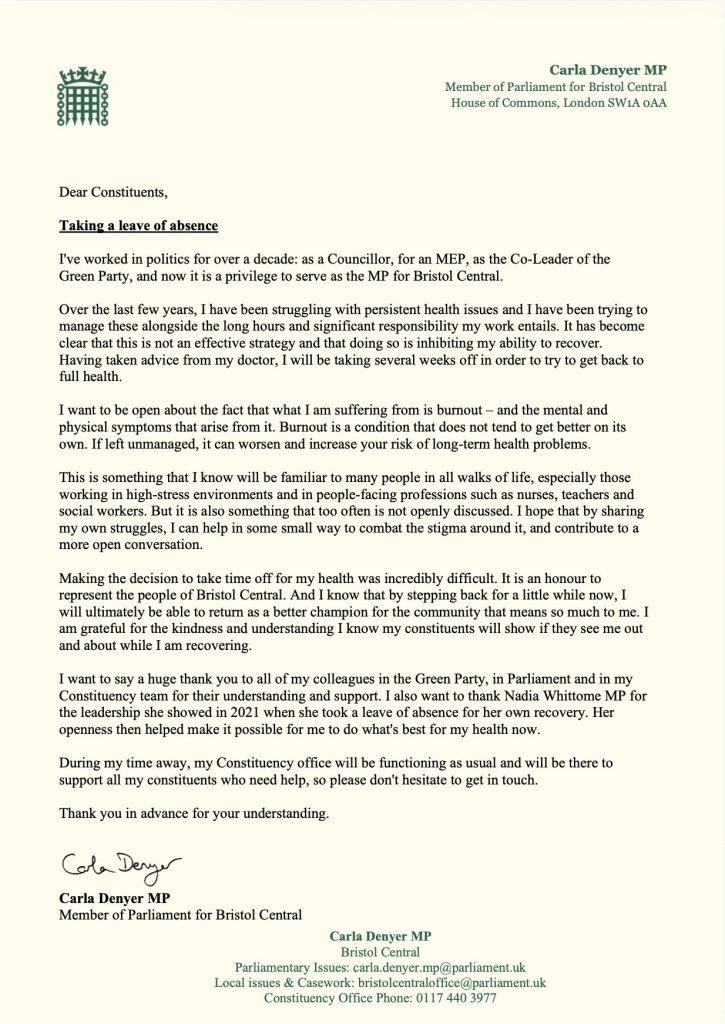
Green MP takes ‘burnout’ leave
Residents of Bristol Central will not be represented in parliament for ‘several weeks’, the Green Party announced today. And why is this? Does the local MP, Carla Denyer, require maternity leave? Has she been hit by a car in a freak accident? Nope. Denyer is taking a leave of absence because she has been struck down by ‘burnout’.
The Green politician says her decision to step back from parliamentary duties follows ‘advice’ from her doctor. She insists she will be able to ‘better champion’ constituents after taking weeks out to recover from the ‘long hours and significant responsibility’ involved with being an MP. In her explanatory letter, she wrote:
I want to be open about the fact that what I am suffering from is burnout — and the mental and physical symptoms that arise from it. Burnout is a condition that does not tend to get better on its own. If left unmanaged, it can worsen and increase your risk of long-term health problems.
She added: ‘I hope that by sharing my own struggles, I can help in some small way to combat the stigma around it and contribute to a more open conversation.’
Households in Bristol Central can rest assured, however, that Denyer’s office will remain open to deal with enquiries. She valiantly declared that those ‘who need help’ should not ‘hesitate to get in touch’. Mr S hopes locals will respond with the ‘be kind’ energy they so clearly cherish, having elected a Green MP. At least, unlike in many other cases, she is a true example of getting what you vote for…
Does Andy Burnham know what a woman is?
Can Andy Burnham define ‘a woman’? The correct answer is ‘an adult human female’, though I would also accept ‘someone with no chance of being elected leader of the Labour party’. Burnham’s position on gender is under scrutiny after the resurfacing of an exchange from 2022 in which he was asked about men who self-identify as women using female toilets.
Ordinarily, I dislike this kind of journalism. The formulation ‘after past comments resurfaced’ is usually a dead giveaway that a news story isn’t news. The journalist who wrote it, or the editor who commissioned it, wants it to be news, often because they have an axe to grind. I make an exception in this case because Burnham’s answer undercuts his fatuous branding as a salt-of-the-earth, plain-speaking northerner.
Burnham began:
Clearly there is a group of people who do feel that toilets should be a safe space only for women and there should not be anyone biologically a male allowed in that space.
Note how he describes the mainstream view – men should use the men’s, women should use the women’s – like David Attenborough narrating a far-flung tribe’s elaborate ritual to appease the sun god. Of course, for a fully embedded member of the political elite like Burnham, public opinion on this subject is utterly alien, which is why he went on to say: ‘I don’t think that’s a majority view. I think it’s a minority view and quite a small minority view, actually.’ Behold, your tribune of the Mancunian working classes. They like three things up north: whippets, gravy and gender-neutral bathrooms.
Burnham deserves half a point of credit here. He did go on to say that, of those who hold this supposedly minority view: ‘Possibly they might be women who have experienced male violence at some point in their life.’ However, he then added:
The idea that people are falsely portraying their gender in a different way just because they want to abuse a women’s space or encroach on women’s safety… maybe it happens but you are talking a tiny, tiny, tiny number of people.
That’s a sentence you have to back up from to take in. Is he really that naive? Why does he think women’s toilets exist in the first place? It’s not just old-timey modesty and prudishness. In many ways, this is the most frustrating aspect of these comments, because it assumes that women who don’t want to share intimate spaces with men are irrational bigots hiding behind spurious safety concerns.
Go back ten years or so, when the conversation actually was about discreetly accommodating a tiny number of gender dysphoria sufferers, and a majority of women would have agreed to turn a blind eye. Far from a moral panic, it has taken years of feminist activism and awareness-raising to shift public opinion among women.
After the usual rhetorical shibboleths (‘this really polarised and terribly hateful debate’), Burnham concluded with a pledge of ideological loyalty: ‘I am going to make it really plain: I support trans rights and I want that to be known.’ Only too happy to oblige, Andy. Incidentally, the best way to support trans-identifying men and women is to ensure their rights are upheld, shield them from discrimination and violence, and increase support for people suffering from dysphoria. You don’t support them by reiterating the talking points of radical trans activists, either because you sincerely agree with them or because you figure this necessary for advancement within the Labour party.
The gender question isn’t going away, as the fresh guidance from the Equality and Human Rights Commission confirms, and if Burnham hopes to become leader of the Labour party he will have to address it. Whether he doubles down or U-turns or comes up with a fudge isn’t as important as what Burnham’s instinctive siding with elite progressivism in 2022 says about his supposed proletarian authenticity. It’s not so much that be believes the people’s flag is blue and pink, it’s that he repeats the nostrums of the establishment while posing as a political outsider. Andy Burnham self-identifies as a man of the people.
Putin’s nuclear escalation is a sign of desperation
As Vladimir Putin senses the momentum of the war shifting in Ukraine’s favor, he has redoubled his attempts to coerce Kyiv and its European partners. Russian troops are in retreat, losing territory overall for the first time since Ukraine launched its Kursk offensive in August 2024. Drone strikes have forced all of central Russia’s major oil refineries – accounting for a quarter of the country’s refining capacity – to halt or reduce output.
Meanwhile, the cracks are beginning to show as Russians cease believing in their President, with some openly calling for an end to Putin’s so-called special military operation. His only available response, it seems, has been to resort to nuclear intimidation and threats of military confrontation with the Baltic states.
The Belarusian defense ministry posted footage on Telegram this morning showing heavy vehicles said to be transporting nuclear warheads through a forest
In Belarus, Moscow launched joint military exercises involving nuclear forces and 64,000 troops. The Belarusian defense ministry posted footage on Telegram this morning showing heavy vehicles said to be transporting nuclear warheads through a forest en route to the drills. Such nuclear posturing is usually interpreted in Kyiv as a sign that Putin is running out of options. This time, though, Russia’s increased activity in Belarus comes amid warnings from Volodymyr Zelensky that Putin is attempting to draw his ally Aleksandr Lukashenko deeper into the war.
Zelensky said Moscow may be preparing to revive its northern offensive toward Kyiv and Chernihiv. Russian forces operating from Belarus failed in their attempts to seize the capital in 2022. Until now, Lukashenko has been reluctant to jeopardize his regime by directly involving Belarusian troops in the war, given that the vast majority of Belarusians strongly oppose any participation in Russia’s invasion of Ukraine. Zelensky has ordered Ukraine’s military to strengthen defenses along the Belarusian border in case Lukashenko changes his mind.
It comes as Nato jets were scrambled this morning after an unidentified drone entered Latvian airspace for a third day in a row. Just last week, Latvian Prime Minister Evika Silina resigned over her government’s handling of Russian-bound Ukrainian drones that had veered into Latvian territory and crashed into empty oil tanks.
Ukraine’s foreign ministry later apologized publicly to Latvia, Lithuania, Estonia and Finland over similar incidents, accusing Russia of jamming the drones and deliberately redirecting them into Nato territory in an attempt to drive a wedge between Kyiv and its allies. Zelensky offered to send Ukrainian drone experts to the Baltic states and Finland to help them strengthen their air defenses.
So far, none of the affected countries have publicly blamed Ukraine, instead saying it’s Russia’s fault that Ukrainians are forced to fight at all. Poland’s defense minister Wladyslaw Kosiniak-Kamysz was the only one who advised Kyiv to direct its drones more precisely.
The Kremlin attempted to escalate matters, falsely claiming that the Baltic states had granted Kyiv access to their airspace to launch attacks on Russia. On Tuesday, Russia’s foreign intelligence service threatened military action against Latvia, accusing it of preparing to facilitate Ukrainian drone launches from its territory. The agency claimed that Russia was fully aware of “decision-making centers on Latvian territory” which it could target, adding: “NATO membership will not protect terrorist accomplices from fair retribution.”
Ukraine, the EU states and Nato rejected Moscow’s allegations. Alexus Grynkewich, the American general serving as Nato’s Supreme Allied Commander Europe, said that the alliance gave no such permission to Ukraine. “If we were allowing drones to go through Baltic airspace in order to get to Russia, we wouldn’t be shooting them down,” he pointed out, after a Romanian F-16 jet shot down a Ukrainian drone over Estonia on Tuesday. European Commission President Ursula von der Leyen called Moscow’s threats “unacceptable” and pledged further measures to strengthen security along the eastern flank of the alliance.
It seems that, for now, Putin’s game has failed to sow division between Ukraine and its allies to make them force Kyiv to scale down drone attacks against Russia. But, he is unlikely to stop trying.
Colbert quit the stage with a whimper not a bang
Before the final episode of the Stephen Colbert-hosted Late Show, President Trump was asked what he thought about the demise of a program that was as well-known for the digs that it leveled at him as for its comedic monologues and high-profile special guests. Trump replied, ominously, “I’ll have a message at a later date.” And the verdict duly came in, as Trump wrote on Truth Social that “Colbert is finally finished at CBS. Amazing that he lasted so long! No talent, no ratings, no life. He was like a dead person. You could take any person off of the street and they would be better than this total jerk. Thank goodness he’s finally gone!”
It was broad, self-referential, star-studded and played it very safe. It wasn’t even particularly political
Colbert is indeed gone, and he departed the CBS stage in what would either be seen as a blaze of glory or with his tail between his legs, depending on your perspective. Amid persistent rumors that Paramount Skydance’s decision to cancel the show was politically motivated – they have claimed that it was financial, but few are convinced this is true – Colbert, like Jimmy Kimmel before him, has gone on an unlikely journey from mainstream entertainer to tribune of the liberal left. Kimmel, notoriously, was canceled then reinstated, but it looks as if Colbert will be heading off to spend some more time with hobbits than hosting another chat show of this nature. Will he be missed?
On the evidence of the last ever Late Show, his legacy will be as polarizing as the last few years have been. He was, of course, surrounded by partisans, both in a selection of faintly cringe-inducing special guests and in the adoring audience, and his opening monologue struck a largely sentimental, valedictory note, as Colbert said “We call this show the Joy Machine. We call it the Joy Machine because to do this many shows it has to be a machine, but the thing is, if you choose to do with joy, it doesn’t hurt as much when your fingers get caught in the gears, and I cannot adequately explain to you what the people who work here have done for each other, and how much we mean to each other.”
If Colbert saw this final show as an audition to host the Oscars when its new regular host Conan O’Brien tires of the responsibility, it was not a bad call, even if the idea was better than the execution. There was the expectation that it would end with a very special guest, and it had even been mooted, apparently semi-seriously, that this might be the Pope – Colbert is a devout Catholic – although in the end this was turned into a running joke, just as a parade of star cameos, led by Bryan Cranston, Paul Rudd and Ryan Reynolds, all leant into the cutesy meta idea that they were not worthy of being anointed as Colbert’s final guest. Cranston asked if he could be the “surprise celebrity cameo popping up out of nowhere”, only for Colbert to reply, “no Bryan, those always feel kind of forced.” My sides remained unsplit.
There was, of course, an A-list special guest, in the form of Paul McCartney, currently promoting his forthcoming album The Boys of Dungeon Lane. Nobody would expect penetrating inquisition on a show of this nature, but Colbert went even easier on McCartney than usual, allowing the former Beatle to rhapsodize about the Ed Sullivan Theater, where the show was recorded from 1993 until the present day and where the Beatles made their debut in America. The problem is that McCartney, if unchecked, falls easily into “wasn’t-it-a-grand-old-time-back-in-the-day” mode – otherwise known as “your grandpa remembers” – although there was a modestly pointed moment when Macca, after saying “where all the music we loved came from, all the rock ‘n’ roll, the blues and the whole thing…America was just the land of the free, the greatest democracy,” remarked, “Yes, that was what it was. That’s what it still is, hopefully.”
The show ended with a pair of musical performances, featuring a suitably star-studded selection of guests. Colbert himself demonstrated reasonably impressive vocals on a pre-recorded performance of Elvis Costello’s “Jump Up” with Jon Batiste, Louis Cato and Costello himself, and the song’s knowingly mournful lyrics – “No tombstone would ever surprise me” – were of a piece with the sentimental, slightly schmaltzy feel of the final Late Show.
But, of course, the grand finale featured McCartney, Colbert et al on a suitably valedictory “Hello Goodbye,” harmonizing to no great effect, and inadvertently reminding the viewer of how much better the original was. Then an apparently endless stream of staffers come on the stage to sing and dance and celebrate, before Colbert and McCartney are filmed mournfully shutting down the building’s power for the last time, whereupon the Ed Sullivan is zapped by a green lightning bolt and turned into a snow globe. I am not making this up.
In other words, The Late Show’s finale was everything that longtime Colbert – or Letterman – viewers would expect. It was broad, self-referential, star-studded and played it very safe. It wasn’t even particularly political at the end, meaning that Trump’s criticism felt unnecessarily mean-spirited, but as Colbert bade his viewers farewell, only the most fervent fans might feel that this show really was quitting before its time.
Ben-Gvir’s crass gloating isn’t the worst thing about the Gaza flotilla
Imagine if, in 1941, as we were fighting for our lives against the German menace, a boatload of foreign narcissists rocked up at Dover to make fun of us. Worse, imagine these self-regarding seafarers cheered on our enemies. Imagine they waltzed up to the nearest soldier or copper and barked ‘Victory to Germany!’ while sporting the smuggest smirk you have ever seen.
Everyone is frothing over the behaviour of Israel’s hard-right national security minister, Itamar Ben-Gvir, which was indeed oafish
We’d be annoyed, right? More than annoyed: there would be national fury. Every paper in the land would denounce the preening aliens. Lines of boys in blue would have to hold back angry Brits yelling ‘Let me at ’em!’. Well, now you know how the good people of Israel must feel after yet another armada of cranks sailed their way to remonstrate with their soldiers and tell them how demonic they are.
For me, that was the most revolting thing in the clips that went viral this week showing members of the Gaza-bound ‘aid flotilla’ being detained in Israel. Everyone is frothing over the behaviour of Israel’s hard-right national security minister, Itamar Ben-Gvir, which was indeed crude and oafish. He was seen jeering at the activists who were all knelt on the floor with their hands bound behind their backs.
But there was something even more jarring than Ben-Gvir’s crass gloating, something even more contrary to the rules of civilisation. It was the very presence of these hostile elements from the West. It was the staggering hubris of these Israelophobes to sail towards Israel in order that they might shame it before the eyes of the world even as it fights for its life against armies of anti-Semites.
In one of the clips, one of the detained white saviours can even be heard shouting ‘Free, free Palestine!’. Can we take a minute to clock how vile it is to bark that trite slogan at men and women whose nation was invaded in the name of ‘Palestine’ not even three years ago? And whose fellow citizens, possibly their loved ones, were raped, murdered, kidnapped and burnt to death under the Palestine flag? I fear the understandable anger about Ben-Gvir is blinding us to a far graver moral transgression: this giddy taunting of a nation at war by smug Westerners who know nothing of war.
Everyone agrees Ben-Gvir behaved badly. Even Benjamin Netanyahu criticised him. The flotilla activists on their ‘humanitarian’ jolly to Gaza were intercepted by Israeli naval commandos in seas near Cyprus on Monday. They were taken to Israel to be processed. They should not have been filmed or mocked. Israel should have just jotted down their details and sent them back to their leafy, war-free suburbs where they can defame the Jewish state to their hearts’ content.
And yet, I fully understand the anger of Israeli soldiers and politicians over these well-fed Westerners basically shouting ‘Victory to Palestine’ in their war-scarred faces. Imagine sailing to a warzone and making it all about yourself. Imagine the imperious arrogance it must require, the industrial-level brass neck, to trek to a country at war and demand that the spotlight be put on you and your emotions.
That’s what I saw in those viral clips: lines of foolish, self-infatuated activists so high on their own supply of moral vanity that they even insist on central billing in a foreign nation’s war for survival. Talk about Main Character Syndrome.
It speaks to the West’s neo-religious veneration of self-esteem that we have birthed a new generation that thinks it has the right to centre itself in other people’s wars. Nothing has done more to reinforce my belief that we need to bring back the cane than the sight of these sanctimonious sailors heading to a warzone and crying: ‘Look at me, mum! I really CARE.’
Then there’s the misinformation. Listening to those keffiyeh clowns sunning themselves on the Med as they sail towards war, you could be forgiven for thinking that they and they alone might save the people of Gaza from Israel’s inhuman cruelty. It is lie upon lie. Not one crumb of food has been delivered to Gaza by these white saviours, while Israel has distributed tens of millions of meals to hungry Gazans.
Israel has given food, water and medicine to Gaza. It is currently overseeing the arrival of around 100 trucks of aid every single day. While those suntanned Westerners were on their stupid boats tweeting about Israel’s genocidal strangling of Gaza, Israel was feeding Gaza. It is the world turned upside down, a wholesale gutting of truth, to present these activists as Gaza’s valiant liberators and Israel as its executioner.
Be honest: you’d be angry too if such flagrant lies were being told about your nation. And at the very moment your nation was facing down Islamo-fascist armies like Hamas and Hezbollah and the Islamic Republic that funds them. Here’s a tip if you don’t want to be detained in a warzone: don’t sail to a warzone. Stay home. Do something useful for once. Get a job.
Afghanistan is crumbling
On Monday, an engineer set himself on fire in a Kabul street because he could not find work to feed his wife and three children. He died in hospital. It was the latest sign of desperation in Afghanistan, a nation that has seen people selling vital organs and even their daughters to buy food. ‘The country is experiencing the sharpest surge in malnutrition ever recorded,’ according to the World Food Programme, quite a claim for an organisation with data going back six decades. Seventeen million people face acute food insecurity, with women and children the hardest hit.
Apart from paying for repression the Taliban do little other governing, and take no responsibility for the collapse of the economy or the starving and dying people around them
Severe drought is a factor, but Afghanistan’s humanitarian crisis is manmade. The men who made it are the misogynist tyrants of the Taliban, whose only governing principle is repression of women, backed up with extreme violence. The assault on rights and dignity for women is not just an add-on, an element of the Taliban’s moral code, it is the foundation on which they base their control of Afghanistan. Apart from paying for repression they do little other governing, and take no responsibility for the collapse of the economy or the starving and dying people around them.
Life for women gets worse by the day. There are some women still working in limited roles in health and midwifery, but as they retire they are not being replaced as there is no training, so access to basic health care is deteriorating. Secret girls’ schools and protest groups face fear being discovered by an increasingly sophisticated spying network. With China’s support, the Taliban are installing 60,000 security cameras around the country. In another technique from the Nineteen Eighty-Four playbook, they are demanding that people, including children, spy on their own families, according to the most comprehensive survey of women since the Taliban takeover in 2021. ‘Many women cooperate with the intelligence group,’ one woman told researchers. ‘I am afraid that the neighbours will report me.’ The Taliban make an absurd claim that their rules are designed to protect women, but this survey by the women’s rights group Farageer found that more than 60 per cent of Afghan women feel unsafe.
The worsening crisis has meant that thousands of people continue to flee Afghanistan in search of a better life and in most recent years Afghan migrants have been the largest group among those crossing the channel. Afghanistan is also once again a crucible for global terrorism, including acting as host for al Qaeda’s global HQ.
Nine ambassadors from the former Afghan republic remain in post almost five years after the fall of their government, flying the flag for another vision for Afghanistan, and are granted diplomatic immunity. But the UK and US were among the countries who forced the closure of their embassies, and there are increasing signs of a move towards ‘normalisation’ of relations with the Taliban, putting pressure on the remaining ambassadors to close their doors.
Russia is the only country to have formally recognised the Taliban, but there is creeping recognition by China, which has an embassy in Kabul in all but name, and others. Despite the humanitarian crisis, the instability caused by major refugee flows and the threat of terrorism, the UK is going along the same road. Apart from securing access to send in humanitarian aid, the UK wants to improve links with the Taliban to return migrants. Twenty other European countries have signed a joint appeal to the European Commission to negotiate a returns policy with the Taliban, and some, including Germany, have shamefully allowed Taliban diplomats to open consulates on their soil to facilitate migrant returns.
Given deep fractures at the top of the Taliban, as previously reported in The Spectator, and the increased likelihood that their hold on Afghanistan cannot last for ever, the single-minded determination of western nations to improve relations and pretend that Afghanistan is a normal country where returned migrants can live at peace is at best fanciful, and at worst dangerous. If the Taliban fracture with no alternative political plan in place, Afghanistan will collapse into chaos, with armed militia groups and increasingly dangerous Islamist terrorists fighting over the scraps.
Three years ago, the world signed up to a plan which charted a path to move towards a more inclusive government in Afghanistan. It proposed increased engagement in return for the Taliban agreeing to improve human rights, particularly for women, and engage in talks with opposition figures. The west’s current moves towards engagement without preconditions shows a failure of nerve and political will to support a return to stability in Afghanistan.
A more coherent policy would include some element of coercion, threatening to withhold money, at the same time opening space for armed opposition, while actively pursuing unity among opposition groups to create a platform for dialogue. Groups which include many members of the government of the former republic meet in various configurations in Europe, but without international sponsorship will not make the final leap towards unity. It would take very little funding to support this process, but instead of creating political space to build a coherent opposition platform, the west wants to open the doors to the Taliban. They seem to have forgotten that any Taliban consulate would be a Trojan horse for a terrorist regime.
Green party’s former Makerfield candidate shared anti-Semitic conspiracies
Yesterday, the Green party announced that its candidate for the Makerfield by-election was quitting the race fewer than ten hours after joining it. Chris Kennedy had to withdraw for ‘personal reasons’, the ever-so-understanding socialist brigade declared. ‘Family has to come first’, Zack Polanski’s party naturally told its followers.
But there was – shall we say – an inconvenient detail omitted from the announcement. Registered nurse and safeguarding specialist Kennedy had quite the colourful social media history. In one instance, he shared a post describing the attack on Jewish ambulances in Golders Green as a ‘false flag’ operation.
An Instagram video called the arrests of two men over the attack ‘total bullshit to keep the false flag flying’. To remind you, those charged with arson were Hamza Iqbal, 20, Rehan Khan, 19, and a 17-year-old boy. Kennedy also shared a post by the self-described ‘proud ethno nationalist’ Hugh Anthony claiming that the Golders Green attack made ‘no sense’.
When asked by the Times about the posts yesterday, the party insisted that be-kind Kennedy ‘apologises for the offence caused’. Purely coincidentally, no doubt, he later withdrew from the race for those entirely understandable ‘personal reasons’.
To be fair to Kennedy, as Kermit always said: ‘It’s not easy bein’ Green’.
Four bets for the weekend and Royal Ascot
Newmarket-based Robert Cowell is known as the ‘sprint king’ for a reason: for many years he has been a masterful trainer of horses that race over the minimum trips of five furlongs and six furlongs.
It was telling that in an interview for his Racing Post Weekender stable tour last week, he indicated he would rather train another winner of the King’s Stand Stakes at Royal Ascot – now the King Charles III Stakes – than the Epsom Derby. The King’s Stand is a race that he won in 2011 with Prohibit but it’s probably fair to say that every other trainer in the country would much prefer a Derby winner on their CV.
I have a feeling that JAKAJARO could just be Cowell’s next top-class sprinter, judged on the way he defeated a decent field of handicappers at York with some ease just eight days ago – despite the fact that he was dawn on the unfavourable far side of the track. Cowell clearly has a high opinion of this improving sprinter because he has given him an entry in the Grade 1 King Charles III Stakes at Royal Ascot next month.
Tomorrow Jakajaro faces some proven Group 1 performers in Haydock’s Grade 2 William Hill Temple Stakes (3.30 p.m.) over five furlongs. This horse reminds me of Jim Goldie’s American Affair who started in handicap company early last season, including winning the same race as Jakajaro did at York this month, before doing this column a favour by winning the King Charles III Stakes.
Back Jakajaro one point each way at 10-1 with both Paddy Power and Sky Bet, both paying four places. In fact, American Affair is in opposition to Jakajaro tomorrow and not without a chance in a competitive contest.
I would have put up Jakajaro at 40-1 for the King Charles III Stakes next month too but for the fact that Cowell says his charge is best with cut in the ground. Royal Ascot in June often has ‘good to firm’ terrain which means the horse might not run – always an unwelcome outcome for an ante-post wager.
The Stuart Williams-trained KING OF LIGHT is another in-form sprinter and he ran well in his seasonal debut last time out when second at Goodwood to another Robert Cowell speedball, Lexington Blitz.
Despite that fine run, King of Light’s official rating of 91 remains unchanged meaning he looks well handicapped in tomorrow’s William Hill Epic Boost Handicap at York (2.40 p.m).Back the four-year-old gelding one point each way at 17-2 with bet365, paying five places.
I am also sweet this weekend on the chances of Ed Walker’s ALMAQAM, but with the proviso that he is another horse who is ground dependent and ideally wants ‘soft’ in the going description. The ground at the time of writing at the Curragh was ‘good to yielding’ but, with drying weather between now and the off. The terrain for Sunday’s Group 1 Tattersalls Gold Cup (3.55 p.m.) could just become too quick for Almadam to make his seasonal debut.
The suggestion therefore is one point each way Almaqam at Starting Price (SP) with the bookmaker offering most places, often Paddy Power or Sky Bet, in the hope there will be eight or more runners declared. Backing the horse SP means the stake will be returned if he does not line up on Sunday.
The entries, but not the weights, for the Royal Hunt Cup at Royal Ascot on June 17 were published last week and I was hoping one name would be there – and sure enough it was. Trainer James Owen’s ROGUE DIPLOMAT has been unlucky in two big runs this season – a close second in the William Hill Lincoln followed by a fifth in the Win Unique Experiences at OLBG Prizes Spring Cup at Newbury despite a troubled passage.
The straight mile at Ascot should be perfect for Rogue Diplomat but he is yet another horsethat I am putting up who would prefer to race on rain-softened ground. However, he does at least have winning form on ‘good to firm’ at Leicester last year.
As a hold-up horse, he will always need luck in running but at big prices I will take that chance. Back Rogue Diplomat one point each way for the Royal Hunt Cup with bet365, Paddy Power, Sky Bet or Unibet, all offering 25-1, four places.
Pending:
1 point each way King of LIght at 17-2 in the William Hill Epic Boost Handicap, paying 1/5th odds, 5 places.
1 point each way Jakajaro at 10-1 in the Temple Stakes, paying 1/5th odds, 4 places.
1 point each way Almaqam at SP in the Tattersalls Gold Cup with the bookmaker offering most places.
1 point each way Venetian Lace at 12-1 for the Oaks, paying 1/5th odds, 3 places.
1 point each way Rogue Diplomat at 25-1 for the Royal Hunt Cup, paying ¼ odds, 4 places.
1 point each way Rahiebb at 14-1 for the Ascot Gold Cup, paying 1/5th odds, 3 places.
Last weekend: + 1.5 points.
1 point each way More Thunder at 10-1 for the Lockinge Stakes, paying 1/4 odds, 3 places.2nd. + 1.5 points.
2026 flat season running total: – 14.2 points.
2025-26 jumps season: – 57.785 points
2025 flat season: + 84.12 points on all tips.
2024-5 jumps season: – 47.61 points on all tips.
2024 flat season: + 41.4 points on all tips.
2023-4 jumps season: + 42.01 points on all tips.
2023 flat season: – 48.22 points on all tips.
2022-3 jumps season: + 54.3 points on all tips.
Total for seven full seasons of tipping: + 68.215 points
Hay Festival has forgotten about books
Can it be anything more than sour grapes when a writer (who has not been asked) gets snarky about Hay Festival? I’d like to think it can. For there is a lot to snark about.
Don’t get me wrong. The one time I was invited to speak at Hay, about a decade ago, it was jolly nice. Benedict Cumberbatch said hi to me in the green room, thinking I was someone he was meant to recognise, while Ian McEwan milled about topping up his coffee. Hay is, of course, a pornographically pretty town amid the rolling sheep-studded fields and quaint little streets with pop-up Eccles cakes shops and independent bookshops.
The problem with Hay these days, though, is the problem with everything relating to the cultural establishment: it takes itself seriously in ways that are no longer merely fodder for some fond eye rolling. In short, it has become sinister. Gaza cheerleading, the signal toxin of our era, is one example that comes to mind. In one event scheduled to take place next Tuesday, the terrorist group Palestine Action is normalised as part of civic culture and treated as if it might have a point by being folded artfully into an event called ‘Just Stop Oil, Palestine Action: A Public Nuisance or a Public Good?’
See the switcheroo there? The laundering of violence, sabotage, terror and vandalism – to say nothing of the pro-Hamas elements of both groups – as nothing more, at their worst, than a ‘nuisance’. The festival’s 2024 sponsorship row over the massive support of Baillie Gifford (deemed to have links to Israel) left – for this Zionist – an indelible stain.
What sells out is fairly predictable: Malala Yousafzai and BBC-core; think The News Quiz and Hugh Bonneville. So let us consider the festival’s themes this year. ‘Hay Green’ concerns ‘climate emergency solutions’. Then there is ‘South to North Conversations’ and memorial lectures on ‘truth’, ‘representation’, and ‘nuclear threat’.
Amid all the debates, discussions and important stories there is at least a little attention given to literature that people actually buy. Like Romantasy– only this one has all the romance firmly taken out of the equation. ‘Are you obsessed with Romantasy yet?’ pants the event description on the genre. ‘Book sales are growing faster than in any other genre… Here a panel of experts explain why it’s so successful and consider what we should learn about the huge appeal of worlds where women are in control.’ Good to see there is a panel of experts to explain what we should learn from tales of sexy queens and dragons.
If once the Hay Festival was a place that finance bros or military men might have been looked at askance, now it is clearly not a place where someone with, say, family in the Jewish state, or serious concerns about the green movement, would feel particularly at ease. So perhaps it’s best for our ilk to focus on its more solidly amusing aspects.
It is good to know that the macchiato drinkers of the festival, 95 per cent of whom arrive by car, are still doing their bit for climate justice
For me, the happiest pinnacle of all that makes Hay Hay is its food and drink. The sheer number of buzzwords it crams into its website bumph detailing the treats available for purchase by the hordes of Guardian-clutching greyheads is really something. Obviously, it’s all ‘sustainable catering, with plenty of plant-based and gluten-free options’. And obviously, as you rush from Malala to Nazanin Zaghari-Ratcliffe via Emma Thompson and David Miliband, you will be grateful that the coffee shops all serve Fairtrade. And not just that! ‘All our whole milk is being delivered to the site in reusable churns directly from a local farmer, supporting our aim to source local ingredients while further reducing our use of single-use plastic’, reads the website. This is, of course, a great relief, and it is good to know that the macchiato drinkers of the festival, 95 per cent of whom arrive by car, are still doing their bit for climate justice.
Those reusable churns are key, if, as the festival website opines, ‘the combined climate, biodiversity and nature emergencies are an existential threat to us all’. And given that ‘we all have a responsibility to help find solutions’ it’s a relief to know that the festival is ‘mobilising, harnessing and inspiring our whole community of writers, thinkers, readers, scientists, academics – everyone – to make the significant lifestyle changes that are urgently needed’. That’ll be why they all arrive by car, then? Not that I am displeased to read about how the festival embraces the Welsh Workplace Recycling Regulations.
The festival, if you are a punter who shares the politics of it all, or a speaker offered nice free accommodation and wined and dined, is a form of bliss. Wales is always lovely. And to be sure, there have always been many clichéd potshots taken at the festival. But it is important not to miss the darker side of all those reusable milk churns: the laundering of evil through phrases like ‘shared challenges’, ‘diverse voices’, ‘climate catastrophe’ and the most dreaded of all: ‘conversations’. Obviously, if I was invited to go and have one of those conversations myself, I’d say yes. I have a book to promote, after all, and I really do like Eccles cakes.
Why new mothers need the lost art of ‘nidgeting’
Before the birth of my first child, I had never been around a new baby. I had also never seen a woman in labour, so I wasn’t remotely prepared for my own. My first came close to an emergency caesarean because, after six hours of pushing, I still had not gotten my daughter out. When she was finally born, weighing over nine pounds, I felt overwhelming gratitude for the women who had stayed by my side through it. I will always remember one particular midwife with short-cropped grey hair and a barking voice, who coached me through the contractions like an unrelenting PE teacher. Without her, I don’t know if I could have done it. In her commanding presence I was part of a team and we had won a great victory together. But when the night shift ended, she left without saying goodbye. To her, it was just another night shift. But for me it was the greatest achievement I had ever accomplished. In the mighty struggle of childbirth, a bond of kinship had formed between me and that midwife. When she left, I felt bereft.
In the recent past, that bond would have lasted longer and it likely would have been with women I already knew well. Up until the era of hospital births, when a woman went into labour, other women living nearby would flock to her – mothers, sisters, aunts, friends, neighbours – all helping her through labour and its aftermath. As Jenni Nuttall points out in her excellent book on the history of women’s words, Mother Tongue (2023), there is an old East Anglian term for this gathering of women to the birthing room – nidgeting – and it is exactly what a new mother needs.
Nidgeting begins during labour and only ends when the new mother is capable of completing everyday tasks on her own. Her companions take over the washing, cooking and care of other small children, and crucially, hold the baby so the mother can sleep. This is also where the word ‘gossip’ originates, meaning ‘God sibs’, or God relations. Contrary to gossip’s modern negative connotation, this communion of women once fulfilled an essential role for each other.
Today, a new mother is generally expected to take on the gossips’ burdens by herself. In the days after giving birth, I could hardly get off the sofa; cooking dinner and doing the laundry were almost insurmountable tasks. When my husband’s paternity leave ended and he returned to the office, I was left alone at home with a baby I had no idea how to care for.
My second child was born just before the 2020 lockdown, and it was five months before I saw anyone outside our immediate family. I sank into a deep depression, and I believe a large part of that was because I could not see other women. Gossips and nidgeters are as important for the spirits as they are for the practical tasks of caring for a baby. Without them, I floundered.
Nidgeters are as important for the spirits as they are for the practical tasks of caring for a baby. Without them, I floundered.
Our third child was born seven months ago and the days and months since have been some of the happiest of my life. Since Covid, my husband and I have made many new friends in our small village. We have been surrounded by nidgeters who dropped off home-cooked meals, with no expectation of being hosted. They would stay for a glass of champagne and then be off, promising to visit again with more food.
My third baby was a caesarean birth and I was laid up at home for several weeks to recuperate. I wasn’t able to attend church for six weeks, and when I finally returned, now with my new baby, it felt fitting to mark the occasion with the other parishioners. This we did through the old Anglican ceremony of churching. Historically, the women who nidgeted the new mother accompanied her to her churching. The liturgy for churching appears in the Book of Common Prayer as a short ceremony which takes place at the beginning of the usual service. Mother and child kneel before the priest and he blesses them while speaking these words: ‘The snares of death compassed me round about: and the pains of hell gat hold upon me. I found trouble and heaviness, and I called upon the name of the Lord… I was in misery, and he helped me.’ The ceremony as a whole is called, ‘The Thanksgiving of a Woman and Child after Child-birth’, and it ends with the congregation thanking God for the mother and baby’s safe deliverance from the ‘great danger’ of childbirth. Our rector was thrilled to perform the service for us because it was the first time he had done so. It was also the first instance that anyone in the parish could remember occurring since the 1950s.
Churching was once commonplace in Anglican parishes but it fell out of favour after the second wave of feminism. For the modern woman, it seems to imply that a mother has been tainted by childbirth and so must be purified. Yet this is not what the words of the ceremony say. Thankfully I escaped the snares of death during childbearing but I had found heaviness; and certainly misery and pain. But my baby and I had made it through. My husband and I were touched that the parish celebrated this with us and grateful beyond words for the family and friends who nidgeted us. The first weeks after my third child’s birth were immeasurably happier and more manageable than the ones spent in Covid isolation. I had not known how important it was to spend time in other people’s company after a birth until I was denied the opportunity in 2020.
Lately, three more of my friends have become pregnant, and two weeks ago, one mother who nidgeted me gave birth to her third child as well. Now I can return the favour.
Burnham’s buses show why he will probably fail as prime minister
It’s one of those political facts that everyone parrots without really knowing whether it’s true: Andy Burnham has, in his own words, ‘transformed’ Greater Manchester’s bus service. Burnham’s publicly-controlled double-deckers are Exhibit A in the claim that his ‘Manchesterism’ amounts to more than a catchphrase. Real voters, including in Makerfield, bring it up spontaneously. And even the SW1 classes, while often dismissing Our Next Prime Minister as a weathervane and lightweight, usually mention the buses.
What’s the point of being in power if you’re never willing to use your political capital to do anything serious?
I’m a bus lover, a regular bus user and broadly a supporter of Burnham’s ‘Bee Network’, a London-style system operated by private contractors but with timetables, routes, fares and branding controlled and subsidised by the mayor. And I too claim some paternity. As Boris Johnson’s No. 10 transport adviser, I fought off heavy lobbying by one of the big bus companies which wanted us to stop it. As Burnham always forgets to mention, it was the last Tory government which gave him the legal powers, and the large sums of money, that made the scheme possible. Under Johnson we created a ‘bus service improvement’ fund, £95 million of which went to Burnham, and a fund for capital spending on new buses, bus stations, trams and tramlines – from which Burnham got £1 billion in the first tranche alone.
All that is why it’s mildly annoying – and more than mildly dishonest – of the mayor to claim that ‘Westminster just ignore[d] buses’, and that he did all the work. But the bigger problem with the Bee Network is this: it hasn’t been a failure, but because of Burnham’s weakness and cowardice, it hasn’t yet fulfilled its promise. The large sums spent have brought only modest-to-middling improvements.
There is an even more serious problem. Not reported until now, Transport for Greater Manchester’s auditors have refused to sign off its accounts unqualified because of ‘significant weakness’ in its financial arrangements. They have also warned of the risk of a big financial hole in Burnham’s bus project, caused by lower-than-expected fare revenue, which the Mayor has been quietly dipping in to his emergency reserve to fill.
Burnham always forgets to mention is that bus use in Greater Manchester is, in fact, down by 12 per cent since he took office in 2017. It has fallen almost everywhere over that time because of post-Covid working-from-home, rising traffic congestion and the decline of traditional high streets. But bus use has fallen more in Greater Manchester over this period than in any other large authority in the North West, including Merseyside and Lancashire.
To be fair, the Bee Network only started in March 2023, with the first of three tranches, and the final tranche was only completed in January 2025. Since 2022/3 there has, as Burnham says, been a clear increase in bus use in Greater Manchester – 19.4 per cent, according to the latest Department for Transport figures. That is more than double the national average over the period. But it is still nowhere near as good as many other places.
While Burnham has managed 19.4 per cent, the wicked, privately-controlled bus service in Bristol has grown passengers by 33.1 per cent over the same two years. Bus use over the same period in Leicester is up by 20.5 per cent, Southampton by 19.9 per cent, Cornwall by 29.4 per cent, to name a few, and all for a fraction of the sums per passenger that Manchester is spending. In the North West, two other authorities – Warrington and Halton – have grown usage more over this period than Greater Manchester. All these places still operate buses on the old, largely commercial model. Buses do not, in other words, prove Burnham’s claim – likely soon to be tested in the rest of the country – that publicly-controlled services are always better.
I do think that a common brand and ticketing helps drive passenger use, though you can do that with other ownership models. I also think Burnham’s £2 flat fare has helped – though, in something else done for buses by the previous government, the fare in the rest of England outside London was also £2 until Labour raised it to £3 last year. I also supported the Bee Network because I thought the threat of wider franchising would keep the big bus companies in line (as it did) with the broader changes we wanted to make across the industry.
But what really ‘transforms’ a bus service, and what actually gets people out of their cars, is not who controls the buses, who owns them, or what colour they are. It’s the humble bus lane. The main reason people don’t take the bus is that it’s often slow and unreliable. Bus lanes make buses faster, more punctual, and more attractive to passengers, bringing in more fare revenue.
Quicker journeys also let you run the same service with fewer vehicles and drivers, reducing your operating costs. A bus lane is deliverable in about a day, for pennies, with a few signs and a pot of paint. It amounts to one of the most virtuous circles in public policy. Both publicly-controlled London, and privatised Bristol, drove huge increases in ridership with lots of new bus lanes. The ownership model mattered much less than the political willingness to take roadspace for buses.
Even motorists, in the end, can benefit from bus lanes, because more drivers taking the bus frees up space for those who remain. But in the short term, removing roadspace from motorists and giving it to buses makes car journeys slower and creates a political backlash.
That is what Burnham and the other Greater Manchester politicians – unlike the leaders of London, Bristol, and other places – have been almost completely unwilling to risk. As transport adviser, I spent a lot of time asking them to put in more bus lanes. But they mostly wouldn’t, and when Boris moved on, so did I. Result: lots of nice new buses, still stuck in traffic. Another consequence: Greater Manchester’s improvements have been small relative to the amounts of public money spent.
Since the Bee Network began, annual revenue subsidy to GM’s buses has more than doubled, from £40 million in 2022/3 to £84 million in 2024/5 (Transport for Greater Manchester’s own accounts say it has more than trebled, to £122 million). Franchising has incurred set-up costs of a further £134 million. Hundreds of millions more have gone in capital spend. Several rather nice new bus stations – ideal venues for politicians to have their pictures taken – have been built, and Burnham has paid at least £80 million to buy the existing operators’ bus garages, which was totally unnecessary (most of the same operators are still using the same depots as contractors to the Bee Network; publicly-controlled London doesn’t own the vast majority of its bus garages.)
But Greater Manchester’s actual bus service hasn’t doubled or trebled. It has risen by only 7.5 per cent, from 47.14 million vehicle miles in 2022/3 to 50.67 million miles in 2024/5. In Bristol, over the same period, service levels have risen by 24.5 per cent – while subsidy, according to the DfT, has almost halved.
What ‘Manchesterism’ means on the ground is a few new routes, but not that many; some major frequency improvements, but not that many; and quite a lot of routes getting a few extra journeys, often early in the morning or late at night. Makerfield, Burnham’s putative constituency, is typical. The main route serving its principal town, Ashton, ran every 12 minutes before the Bee Network and runs every 12 minutes now. The evening and Sunday service has increased from one bus every 30 minutes to one bus every 20, and the last bus now runs an hour later. Against that, the end-to-end journey time is slower than it was.
I’ve come to realise that the bus network does symbolise something important about a prime minister Burnham
Burnham claims he’s ‘never known anything as impactful’ as the Bee Network. But even his own stated plan for it is incredibly unambitious – to reach 200 million journeys a year by 2030. That is, only fractionally more than the 195 million made in his first year as mayor.
It’s been impactful in another way, of course. The Bee Network has been a PR triumph for Burnham. Little can be more visible than 1,600 big yellow buses. And the myth of transformation, even if it’s not really true, still matters and has power: the network is a real source of local pride.
I’ve also come to realise that the bus network does symbolise something important about a Prime Minister Burnham. First, it shows how useless he is at taking even slightly difficult decisions. In 2024, he won re-election as mayor by a 53-point margin over his closest rival. Yet he still didn’t feel he had the political strength to put in a few bus lanes and annoy a few motorists. What’s the point of power if you won’t use your political capital to do anything serious? That’s a question to which we’ll all soon find out the answer.
Second, it shows he’s bad with money – and not just because of the relatively modest gains he’s shelled out so much to achieve. Close scrutiny of Transport for Greater Manchester’s latest accounts reveals that the auditors have refused to sign them off unqualified.
As they put it: ‘We are not satisfied that the Authority has made proper arrangements for securing economy, efficiency and effectiveness in its use of resources… [there is] evidence of a significant weakness in TfGM’s arrangements for governance.’ The accounts, they said, were submitted months late because TfGM couldn’t properly value the equipment and property it had taken leases on for the Bee Network, such as the new buses and the unnecessary depots.
In another report, also unrevealed until now, the auditors found a further, potentially even more serious, problem. They say there is a ‘significant level of uncertainty in relation to funding to support Metrolink [tram] and bus network services as a result [of] revenues not growing in line with pre-pandemic forecasts.’ Government funding, they say, is ‘non-recurrent’, so Burnham has been dipping into his reserves to pay for his buses. TfGM, they demand, must implement ‘efficiency savings’ (cutting the service back again?) to avoid this supposedly emergency pot becoming drained.
Burnham’s buses are indeed a perfect preview of the soft left in government. But not, alas, in the way he intended.