
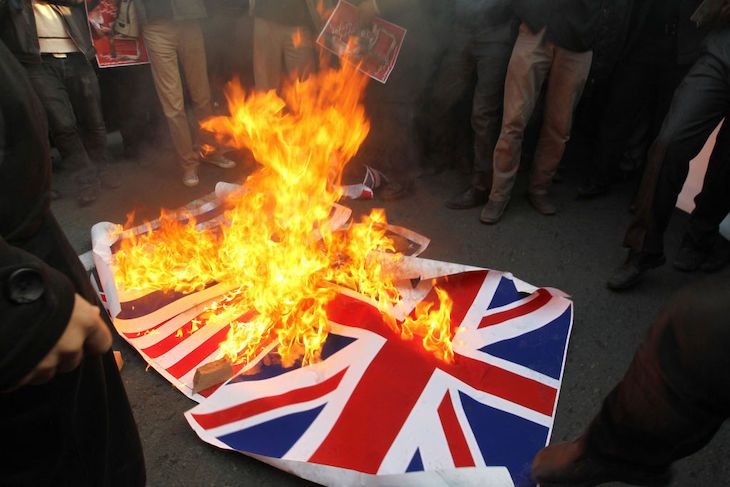
Iran has declared the Royal Navy and Royal Air Force to be “terrorist organisations” and designated MI6 a “hostile group”. The measures, announced by Iran’s Foreign Ministry following a decision by the Supreme National Security Council, took effect immediately. Under Iranian law, the Royal Navy and RAF will be treated formally as terrorist organisations, while MI6 falls under legislation covering espionage and cooperation with states Tehran considers hostile. The temptation to laugh is great. Don’t. This is deadly serious.
Tehran has every reason to believe that Britain fears escalation more than Iran fears British retaliation
The accusation would be grotesque enough in isolation. Coming from the Islamic Republic, whose Revolutionary Guards have spent decades sponsoring terrorism, arming proxies, conducting covert operations and destabilising other countries, it is an inversion so brazen that it almost reads as parody. Tehran says it is retaliating against Britain for bringing the Islamic Revolutionary Guard Corps under the State Threats Act in July, and for what it claims was British assistance to US and Israeli military operations against Iran, including the use of British-controlled bases and logistical facilities.
That declaration has landed while British prosecutors are dealing with an alleged Iranian intelligence operation centred on RAF Fairford in Gloucestershire, a base used by the US Air Force. Prosecutors claim one defendant carried out reconnaissance around the base, while another allegedly helped procure vans, phones, dashcams and fuel for an operation directed remotely by a handler known as “Ali”, whom investigators believe was acting for Iran. Mohmed Ahmad Abdulkarim appeared last week at Westminster Magistrates’ Court in an electric wheelchair and has been charged with assisting a foreign intelligence service. The case is moving to the Old Bailey, where the allegations will be tested. Israel Prime Minister Benjamin Netanyahu, who our government loves to publicly hate, said Israel gave Britain advance intelligence about an impending Iranian-sponsored attack shortly before the RAF Fairford incident: “We gave the Brits the intel that there was going to be an attack, and it’s an Iranian-sponsored attack”, he told Fox News last month.
The Fairford case sits within a much broader pattern that Britain’s own security services have been describing with increasing bluntness. On 13 October, MI5 Director General Sir Ken McCallum used his annual threat update to say that Iran-linked operations had led to more than 50 arrests in Britain over the previous 12 months. Much of that activity, he said, had been directed at British Jewish communities, Iranian opposition figures, media organisations and Israeli sites. McCallum also identified a more serious development in 2026: Iranian attempts to move towards what he called “harder targets, like military sites”. He said members of the IRGC had been behind a front group claiming arson and sabotage attacks against synagogues, ambulances and businesses in Britain and elsewhere in Europe. Those seeking to cause “mayhem on British streets”, he warned, would meet an “unflinching response”.
The warning came shortly after one of our nation’s most pathetic pieces of diplomatic theatre in recent years: at September’s UN General Assembly in New York, our Instagram-brained Foreign Secretary met Iranian Foreign Minister Abbas Araghchi for a posed joint photo and meeting. The two warmly shook hands just as our own airbase was being targeted, apparently by his own proxies.
Britain has long permitted Tehran’s ideological and political projection into our society. For more than 40 years, Britain has allowed the Iranian regime’s Al-Quds Day mobilisation to take place on the streets of London. Created by Ayatollah Khomeini after the 1979 Islamic Revolution, the annual event has repeatedly featured support for Tehran and its proxies, including Hezbollah flags before the organisation was fully proscribed, as well as rhetoric calling for the destruction of Israel and hostility towards the United States. Only in March 2026 did the Home Secretary finally ban the march itself, after police warned of a serious risk of disorder; even then, a static demonstration was still permitted to proceed, with participants displaying images of Iran’s supreme leader.
Then there is the Islamic Centre of England in Maida Vale. For years, this registered British charity operated with a formal constitutional requirement that one of its trustees be the UK religious representative of Iran’s Supreme Leader; that requirement was only removed during a Charity Commission investigation, after concerns about conflicts of interest and the centre’s independence. Parliament’s Intelligence and Security Committee has gone further, reporting that the centre is largely funded by the Supreme Leader’s Office, that its director was the Supreme Leader’s religious representative in Britain, personally appointed by him, and that – given those links – it “may well provide” Iranian intelligence agents with a useful base from which to act. The centre insists it is an independent charity and “not an official office or representative of any government” and “does not represent, promote or advocate for political views or agendas of any regime”. Yet it remains open at 140 Maida Vale, still a registered charity, nearly four years into a Charity Commission inquiry that has yet to conclude.
The human cost of the UK’s weak Iran policies is already visible. Craig and Lindsay Foreman, a British couple in their 50s from East Sussex, have been imprisoned in Iran since January 2025. He is a carpenter and she is a psychologist and life coach. Both are now serving absurd ten-year sentences for espionage, charges they deny. Their appeal has been rejected and they remain in custody in one of the scariest places on earth. Most Brits haven’t even heard of them. Their family met Miliband last week to pressure the Government to formally declare the detention arbitrary, to grant diplomatic protection and to consider action at the International Court of Justice. The British approach so far has achieved nothing.
That failure sits alongside a wider British reluctance to confront Tehran even as the Iranian threat has become harder for our government to hide. When Israel struck Iran in June 2025, Sir Keir Starmer’s immediate response was to urge “restraint, calm and a return to diplomacy”, only later authorising American use of RAF Fairford and Diego Garcia for tightly circumscribed “defensive” operations against Iranian missile threats when the United States and Israel struck again in February 2026. He stressed that Britain had played no part and later repeatedly insisted: “This is not our war.”
Britain has long permitted Tehran’s ideological and political projection into our society
None of it helped protect us. Iranian activity inside Britain has never stopped or slowed. Quite the contrary. The Government says that since 2022 the UK has confronted more than 20 Iran-backed plots posing potentially lethal threats. MI5 says much of Tehran’s recent aggression has been aimed specifically at British Jewish communities. This year alone, an Iran-linked proxy group claimed seven attacks on UK locations connected to Jewish and Israeli communities and Persian-language media. Among them was the antisemitic arson attack on four Hatzola ambulances in Golders Green in March. The Government assesses that members of the IRGC Quds Force sat behind the group and almost certainly directed its attacks across Europe. Britain and 23 other countries have also publicly accused Iranian security services of using criminal networks to kill, kidnap, intimidate and attack Jewish and Israeli targets overseas.
British citizens are imprisoned in Iran. British Jews are being threatened by networks linked to the Islamic Republic. MI5 is warning about Iranian activity directed at increasingly hard targets. Prosecutors are pursuing an alleged intelligence operation involving an RAF base. Iranian-linked proxies have claimed attacks in Britain. And Tehran’s answer to British pressure on the IRGC is to label the Royal Navy and RAF terrorist organisations. And all our Foreign Secretary did through all of this was posed for a friendly photograph with the man directing it all.
Throughout all this, Britain has repositioned itself from quietly supporting the one state which has long identified, warned of, and actively confronted Iran and its proxies, to repeatedly obstructing it: our government has recently applied massively increased and overtly aggressive diplomatic, legal and political pressure on Israel, even as the Jewish state fights the very regime and armed networks that Britain itself identifies as a growing threat. Britain today is deliberately attempting to isolate Israel after decades of it suffering the very Iran aggression we are now experiencing more and more regularly. All for having driven that regime and its proxies into its weakest state for decades. Rather than embrace an allied country which stands ideologically opposed to and willing to fight the Islamic Republic’s aggression and ruthless brutality, our Labour government has decided now is the time to love-bomb Israel’s enemies, no matter how closely they are aligned with, trained by and even operated by the Iranian regime. Britain needs Israel’s expertise and support, not to separate from it.
Restraint has a purpose when it preserves room for manoeuvre, protects national interests or prevents a worse outcome. Repeated long after the other side has concluded that restraint carries no meaningful cost, it becomes something else. Iran has been probing that weakness for years. Dissidents have been threatened. Jewish Britons have been targeted. Criminal networks have been used as instruments of state pressure. British nationals remain in a dismal, far-off prison. Our own military sites are at risk.
While it is distinctly British to try to extinguish our enemies’ bombast with humour and mockery, we ought to remember that this technique does not actually work. Tehran’s inversion of the truth is comic, but it is also a tried and tested strategy: accuse others of the very crimes you commit; recast the forces which stand for security and justice as threats to the world; portray forces of good as forces of evil.
They told the lie for long enough, loudly enough and brazenly enough. We let them
This is precisely what the Islamic Republic and its network of state and non-state proxies have done to Israel and the Jews. At first, nobody took them seriously. Then only a fringe of extremists and lunatics did. In time, those people showed enough determination to exert pressure on everyone else. Through a mixture of fear, repetition and sheer persistence, they made headway. Black became white. Armies were rebranded as terrorists. Security separation became apartheid. Defensive military action became belligerence. Efforts to prevent weapons entering in aid consignments became starvation. Targeted military action and adherence to international law became genocide. Ask yourself how many times you have heard Israel’s army labelled as terrorists over recent years, and now listen again to what they are saying about our army.
They told the lie for long enough, loudly enough and brazenly enough. We let them. Now NGOs, universities, trade unions and even entire countries have internalised those claims so completely that they simply declare them to be true. It worked on Israel. Britain is, as many of us warned, next.
Tehran has every reason to believe that Britain fears escalation more than Iran fears British retaliation. That is the strategic problem underneath the individual incidents, and it is becoming harder to conceal with another appeal for calm or another carefully staged handshake. The absurdity of Iran calling the Royal Navy and Royal Air Force terrorist organisations is easy to mock. The more uncomfortable question is what Tehran has learned from Britain that gave it the confidence to do it.



Comments