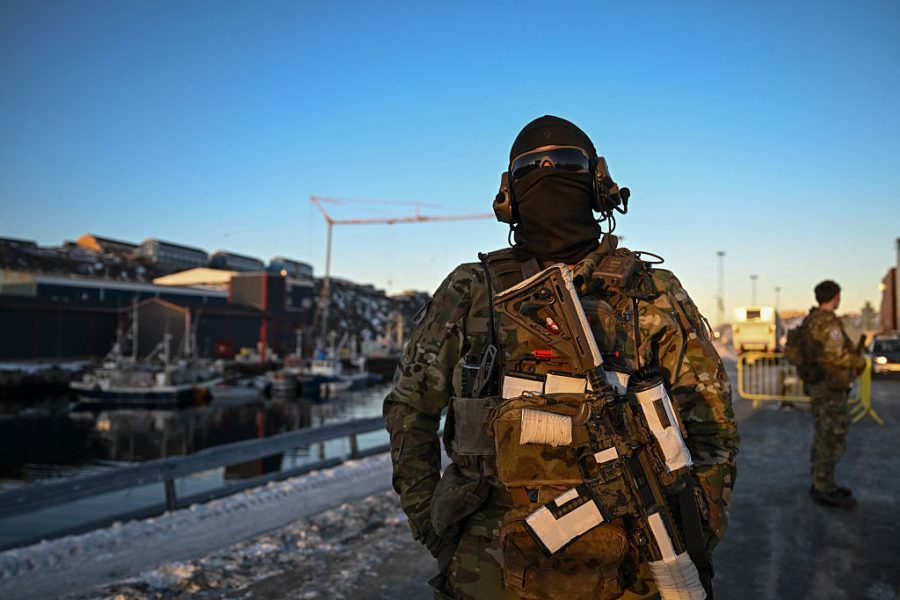
The UK Commando Force (UKCF) had a busy summer this year. The Force’s mission, led by the Royal Marines, is defined by a year-round permanent presence in northern Norway and the High North. Based at Camp Viking, the UKCF trains in Arctic warfare training, coastal surveillance and contributes to the defence of Nato’s northern flank. The stakes are getting higher as the threat posed by Russia not only includes aggressive cyberattacks and disruptive behaviour along the land border with Norway but also offshore activities designed to repeatedly test Norwegian resolve in the Barents Sea and the archipelago of Svalbard.
UK military personnel have not, however, spent this past summer in and around Camp Viking, some 25 miles east of the military air station of Bardufoss. They and other UK armed forces personal have been active in what we might think of as northern ‘dots on the map’. A term used by James Callaghan in the 1970s, it was a shorthand reference for places like British Honduras and the Falkland Islands that the former Labour prime minister thought could become national crises.
Having served in the Royal Navy during the second world war, Callaghan was perhaps more attuned than others to what the UK’s military reach was in an era dominated by a divided Europe and a British Army on the Rhine. Fearing possible Argentine agitation over the Falklands in 1977, a British nuclear-powered submarine HMS Dreadnought was dispatched to the South Atlantic. Operation Journeyman was designed to deter – whether the Argentine military regime knew about it is another matter.
A new generation of Russian-sponsored Q-ships could yet menace European coastlines
Decades later, the focus is now on Allied dots on the map. Norwegian and Danish islands such as Jan Mayen and the Faroe Islands are located in the Barents Sea and North Atlantic respectively. British forces went first to Jan Mayen in August and the Faroes in September. The small volcanic island of Jan Mayen is a Norwegian territory south of Svalbard. UKFC, working with Norwegian and US counterparts, undertook military exercises designed to test readiness and operational resilience.
Codenamed Atlantic City, and held in late August and early September, it was part of Nato’s Arctic Sentry mission and designed to test joint operation readiness in the High North. Moscow was unsurprisingly critical of the deployment, including the temporary basing of mobile missile infrastructure linked to the exercises. Any enhanced militarisation and surveillance around Jan Mayen will be seen emphatically as a direct challenge to Russia’s strategic assets in the Kola Peninsula.

In the North Atlantic, UKCF sent the Special Operations Maritime Task Group to the Faroe Islands as part of Exercise Lion Protector, which lasted some ten weeks. As with Jan Mayen, the training focus was on boarding drills and landing on inhospitable coastal environments. If Jan Mayen sits close to the all-important Bear Gap, the Faroes lie at the heart of the GIUK Gap, the body of water Russian ships and submarines will pass through to reach the North Atlantic region.
Part of UKCF’s remit will increasingly involve both land-based deterrence in remote islands in the High North and search and seize capacity where there are concerns around the shadow fleet. Working with Danish and Faroese partners sends a clear signal to US counterparts of the commitment on the part of the UK and its European partners to step into the collective defence of a wider arc which includes the High North, North Atlantic and the Baltic Sea.
From the American point of view, the participation in High North operations of US Marines offers opportunities to bring training learnt in other dots on the map in the Pacific Ocean to bear. Islands in Japan and Philippines have played host to various deployments as part of concerns around sea lanes and airspace in East Asia including Taiwan.
The threat perception for the High North is stark. Russia is a first-order disruptive power. For the last 12 months, the First Sea Lord and senior naval officers have warned about Moscow’s concerted efforts to conduct covert surveillance of sub-sea critical infrastructure as part of a prelude to offensive action against Nato states including the UK. Foreign Minister Sergei Lavrov has been clear that he regards the enablers of Ukraine’s resistance against Russian military operations as fair game.
In the Barents Sea, Russia has been conducting a suite of live-firing exercises and military drills designed to showcase its military presence in and around the Bear Gap – a body of water that separates the shallower Barents Sea from the deeper North Atlantic. Some of this has involved missile firing in the Barents Sea that spans both sides of the Norwegian-Russian maritime border. All of it is designed to be unsubtle and unsettling if legal.
Further west in the High North, the Danes last month concluded an agreement with the United States on the future of Greenland. The most significant element is the confirmation that an independent Greenland would become a Nato member. While independence is not an immediate option for Nuuk, the signalling is clear. President Trump is not prepared for the world’s largest island to become part of either a Chinese or Russian geopolitical orbit. From Denmark’s point of view, while the last 18 months have been exhausting, they have focused European strategic minds. EU and Nato parties alongside the UK have stepped up with a steady procession of European contingents travelling to Nuuk to offer political support and operational solidarity.
Despite President Trump’s best efforts to add a heavy dose of entropy to Arctic geopolitics, the year will end with an EU Arctic strategy on the verge of being published, which should firm up strategic and security commitments. As with anything the bloc tackles, there will be gaps and exemptions as countries such as Greece have distinct shipping interests which have weakened sanctions against Russian shipments of oil and gas.
The Russian-sponsored shadow fleet remains a persistent thorn more generally and European countries will need to be on their guard against ships that are capable of being weaponised at low cost. Unpleasant though it might be, a new generation of Russian-sponsored Q-ships could yet menace European coastlines; Norway has recently confiscated a Russian vessel in Svalbard. Putin accused Norway of ‘piracy’ and threatened to retaliate.
Regional responsibility for the Arctic, North Atlantic and the Nordic region now rests with the UK’s General Nick Perry, who is Commander of Nato’s Joint Force Command in Norfolk. No doubt he will be only too aware of those ‘dots on the map’.






Comments