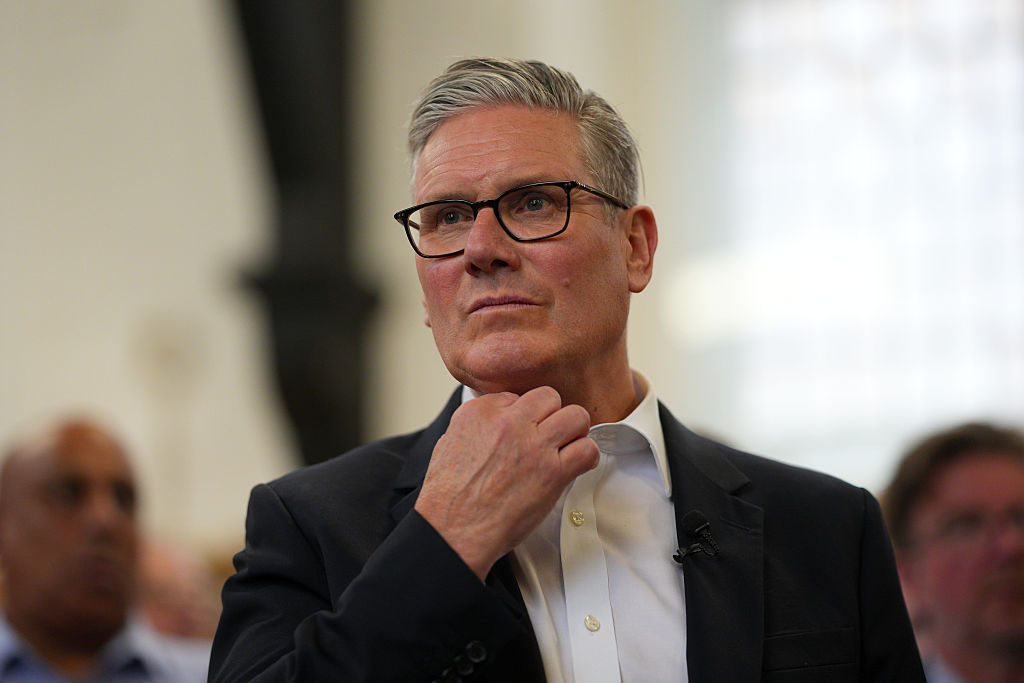
You get two impressions of Britain at the moment. First, that nothing works. Second, that the state is not on the side of those who try to work for a living and generally do the right thing, but on the side of those who intend to ride on the backs of others and generally take the mick. Keir Starmer today leaves the country in a worse place on both counts. Let us take them in turn.
People are understandably coming to the conclusion that they might as well not bother, and instead take the dole from the outstretched hand of the state
Starmer did not cause the broken state but, as one of the bureaucracy’s chief princelings, he has done nothing to fix it. He got as far as a few pointed words and sacking his cabinet secretary, Chris Wormald (only to elevate him to the Lords in his final days of office. Such is the gilded life of a mandarin). But of serious attempted reform of the civil service and public services, there was none.
What of the other charge, that of unfairness? Starmer has hiked taxes on work while continuing lavish handouts. We are forecasted to have more people claiming long-term disability benefits than ever before. Even the Economist now reports on the madness of council house tenants effectively being subsidised to the tune of £32,000 per household per year to live in Kensington and Chelsea. Meanwhile, debt-laden graduates in top jobs are relegated to flat shares in scuzzy outer zones.
Small-boat asylum seekers live at taxpayer expense in hotels that once played host to silver wedding anniversaries. Those on benefits seem to be able to enjoy things that ordinary families struggle to afford – from the small things, like a day out at the Tower of London (those on Universal Credit pay £4; others will pay £111), to bigger things like cars. The scandal of the Motability scheme’s abuse – with those claiming anxiety and even acne using their benefits to buy BMWs and Audis – took ordinary citizens to expose, while Whitehall bureaucrats were oblivious or simply unfussed.

People are understandably coming to the conclusion that they might as well not bother, and instead take the dole from the outstretched hand of the state. The economy will not withstand this. Sooner or later, the magic money tree will wither: either gradually or – with looming signs of a debt crisis – slowly and then all at once.
The pervading sense that the state now punishes the good guys while letting the wrong’uns get off scot-free is not limited to the economic realm. We see it in the prosecution of tweets over thefts. Overbearing authority manifests itself at every turn. The recent case of a man cleaning rubbish from a local river, whose good deed earned him an investigation by the Environment Agency for operating without a permit, is typical of the ‘anarcho-tyranny’ of Starmer’s Britain. Volunteers scrubbing graffiti off Tube carriages were accused by TfL’s chief of vandalism in a pitiful attempt to cover for the state’s own incompetence. The Prime Minister’s vow, as he stood outside the door of No. 10 on 5 July 2024, to ‘Tread more lightly on your lives’ now seems simply laughable.
How did it end up going so wrong for Starmer? In reality, he never had a chance given he couldn’t bring himself to accept the country really needed fixing.
The political dividing lines in Britain today come down to your response to this question: ‘Is Britain broken?’ For Reform, the answer is an unequivocal yes. For the Tories: no, but also yes; it is the state which is broken. And for Labour? Even asking the question is apparently divisive and taken as evidence that the right just want to do Britain down.
Starmer decided his best chance of a legacy was standing up for the institutions that the right recognise are no longer fit for purpose: the blob, the courts and the BBC. Starmer saw himself as the last line of defence against a restless, bubbling tide.
As for being on the side of shirkers instead of the grafters, much is downstream of the failure to generate growth. As wealth-creation looked ever less likely, Starmer’s reflex was to double down on old Labour hobby horses: class warfare, nationalising things and dolling out ever more rights without responsibilities.
It is an unimpressive bequest to his successor. Labour will, I suspect, experience a bounce under Burnham, the Prime Metro Minister. Simply coming across as the sort of person you could tolerate having a pint with down the pub counts for a huge amount in modern politics, and Burnham passes that test in a way Starmer never did. Yet the country feels unmistakably despondent.
Whatever happens next, Starmer should have no place in it. He has left Britain more dysfunctional and less fair. The best thing he could do now is focus his time on family and football – and staring at the Legion d’honneur on his mantlepiece. As for the rest of us, there is little reason for anything other than dejection. For even after the low of Starmer, and however hard the New Labour spin-doctors will now try to persuade us, it looks unlikely that ‘things can only get better’.

Comments