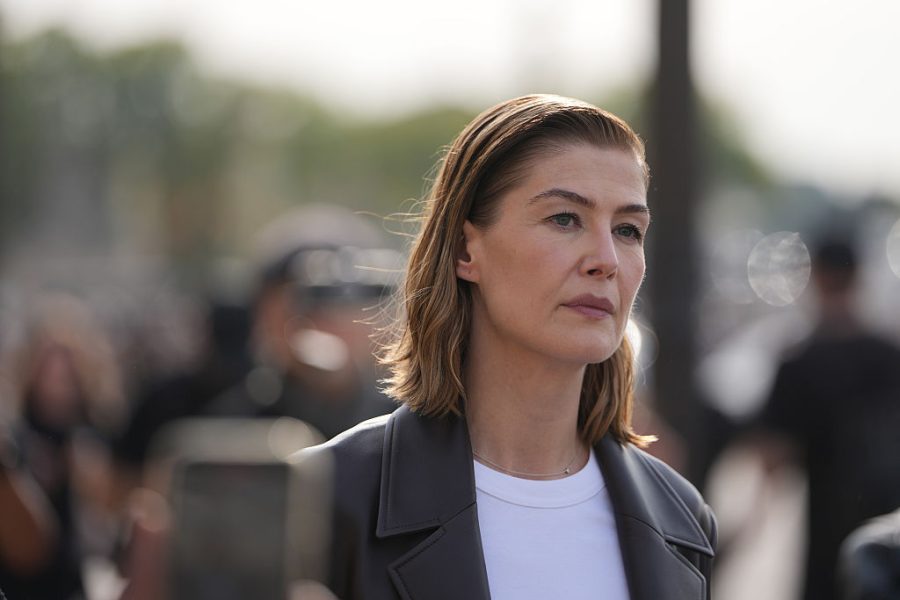
Many people find the idea of actors breaking the fourth wall while on stage mortifying. As such, they will react to the news that Rosamund Pike, the Olivier award-winning star of the new play Inter Alia, berated an anonymous member of the audience during the curtain call for her show last weekend with skin-crawling embarrassment.
Yet Pike was wholly justified in her actions. During the performance of a play which deals with some hot-button issues of family and sexual abuse, the actress observed someone sending a text in the particularly emotional denouement. After taking her applause, she decided to say something about it. Pike expressed her justified displeasure at the texter’s actions. She said that:
I just wanted to say for anyone going to the theatre, it’s a huge thing that we’re trying to give you. I am trying to tell you a story, and I’m feeling you, and I hope you’re feeling me too.
To cheers and applause, she added:
If actors are competing with someone checking their WhatsApp messages, their work will suffer
Maybe it was very important, and maybe you’re a doctor, and you’re saving someone’s life, and I hope you are, but we do see these, we do feel them. I’ve got you, I feel like I’ve got to hold you all, so when I feel that and see it, it’s hard.
It would, undoubtedly, be a difficult moment for anyone to stand up and deliver such an unscripted speech, but Pike’s brave and forthright actions have drawn attention, once again, to how appalling theatre etiquette often is.
To an extent, such behaviour is now priced in. If you go and see a West End show like Mamma Mia! or any other jukebox musical, it is expected that the audience – who may have had a few drinks beforehand – may want to sing and dance along with the actors. So it becomes the job of the ushers to try and keep the rowdiest revellers in line.

Yet anyone going to see a serious, distressing play like Inter Alia presumably knows what they’re in for – although it should be noted that Pike’s character, a judge, is partial to a spot of karaoke. Audience members should, theoretically, be adult enough to be able to turn off their mobile for a couple of hours. Clearly, this is a task beyond some screen addicts, who would be better advised to stay at home with their iPhones instead.
Pike joins a long and noble tradition of actors who have berated members of the audience for bad behaviour. The late Richard Griffiths was a particular stalwart in this regard, often pausing the action to tell off malefactors whose phones rang during performances. Everyone from Kevin Spacey to Daniel Craig has, at one time or another, been driven to express their anger at having their work on stage interrupted by an audience member’s thoughtless and selfish actions. The great Lesley Manville has also criticised a new trend for theatregoers to film the curtain call at the end of shows, saying:
We are all in this room, we are telling you a story, you’re listening – clap or don’t clap, but don’t just stick your phone in our face. I find it insulting.
There will be those who think that Pike and Manville are somehow not entitled to express these views and that ‘luvvies’ should simply shut up and get on with their jobs. To which the only response is that actors, especially great ones like those two, are not just grinning automatons but real people whose stage work, in particular, depends wholly on the audience giving their undivided attention.
If actors are competing with someone idly checking their WhatsApp messages, then their work will suffer. The rest of the audience will have a considerably less good time as a result – which, given the high cost of theatre tickets these days, is a real waste of money and effort, as well as the actors’ abilities. Switching phones off during a performance is a basic courtesy, and if Pike’s intervention reminds people of that, she has done everyone a valuable service.




Comments