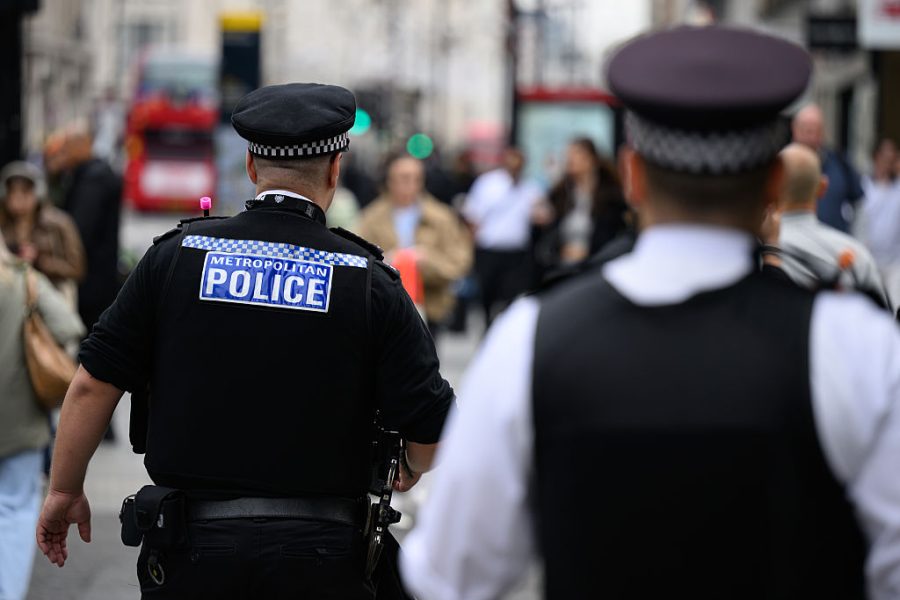
After months, years and even decades of dismay about the state of law and order in this country, a leader of one of Britain’s most renowned retailers has intervened to make the simple plea most have been making for ages: can the police, and the authorities charged with overseeing law enforcement bodies, just focus on their job of preventing, stopping and punishing crime?
Those in charge of businesses don’t intrude on politics lightly. Their main job is to sell produce, not change the world or potentially alienate customers with their opinions. So it tells us a great deal about the state of crisis in Britain now that in the wake of the disturbances in Clapham, south London, in recent days, Thinus Keeve, Marks & Spencer’s retail director, has felt obliged to make an intervention.
The scenes of mayhem in Clapham that have reverberated throughout the nation – not least because they seem so distressingly familiar to the inhabitants of the towns and cities of this country. Referring to this, Keeve has launched an attack on London Mayor Sir Sadiq Khan, urging him to get a grip on the lawlessness and violence that is putting his staff and the public at risk. He urged Khan, who only a few days ago dismissed the ‘lies’ people were telling about the capital, to ‘prioritise effective policing’ as ‘more brazen, more organised and more aggressive’ attacks escalate across Britain’s high streets
Most people would prefer their police to simply protect the community it serves
It’s a most welcome intervention. Keeve has articulated what small retailers, and what the voiceless and powerless ordinary people of this country, have been reporting and witnessing in the past few years: the seemingly inexorable collapse in civic society and the breakdown of our formerly high-trust society. While London is not the dystopian cesspit some depict it to be, there can be no doubt that the public sphere throughout the land is in a parlous state. The exponential increase in shoplifting – done openly and with barefaced swagger – and the epidemic of phone thefts, are the most glaring symptoms of a country on the brink.
Perhaps an even more worrying cause for concern is the fact that most people no longer bother to confront or report thieves anymore. There is now the perception that the police will not make any attempt to pursue and prosecute wrongdoers. A sense of passivity and fatalism now pervades. Khan’s boast, to the effect that ‘at least you’re less likely to get murdered in London’, feels very perverse indeed, itself even having a strangely dystopian ring to it.
In a grim circular irony, the road to this current nadir began some time ago with the emergence of the notion that we were no longer autonomous citizens and responsible human beings, but instead passive cogs in the machine of something called ‘society’. This conceit, one of the most fundamental shifts in the postwar consensus, dictated that people weren’t responsible for their own behaviour. They were passive victims of circumstances – first poverty, later racism and ‘low self-esteem’. This ideology fully insinuated itself into all our institutions, not least into our police forces themselves.
Over subsequent years, the police made the fatal mistake of drawing their numbers no longer from the ranks of working-class men who could spot, and knew how to deal with, a miscreant, but from a graduate class who subscribed to this new ideology. They refused to judge or blame anyone. For this well-meaning, naïve coterie, there were no good or bad people in the world. For them, the only crimes left were ‘being judgemental’ or ‘blaming the victim’.
The politicisation of the police at the hands of this detached liberal class bequeathed us the hugely destructive 1999 Macpherson report, the principal legacy of which was to instil the fear of God into any white officer who even thought of apprehending a black suspect. It gave us the nebulous concept of ‘hate crimes’, which effectively made hurting people’s feelings an offence. It also gave us the only recently-abolished ‘non-crime hate incident’, a measure introduced on the understanding that this country consisted not of rational individuals, but one in which no part should behave to the detriment of another. The notion that we are all cogs in a machine has also been responsible for our ‘two-tier’ justice system and this year, ‘anti-Muslim hostility’: what punishment you receive now depends on how bad your words affect ‘community cohesion’.
It gave us the spurious notion that police forces should ‘reflect’ the community they serve. Yet most people would prefer their police to simply protect the community it serves. They want a police force to stop crime from happening and punish those who commit it – and with no excuses. As the hugely successful Chief Constable of Greater Manchester Police, Sir Stephen Watson, put it in a recent Spectator interview: ‘Here’s a novel concept – arrest bad people.’




Comments