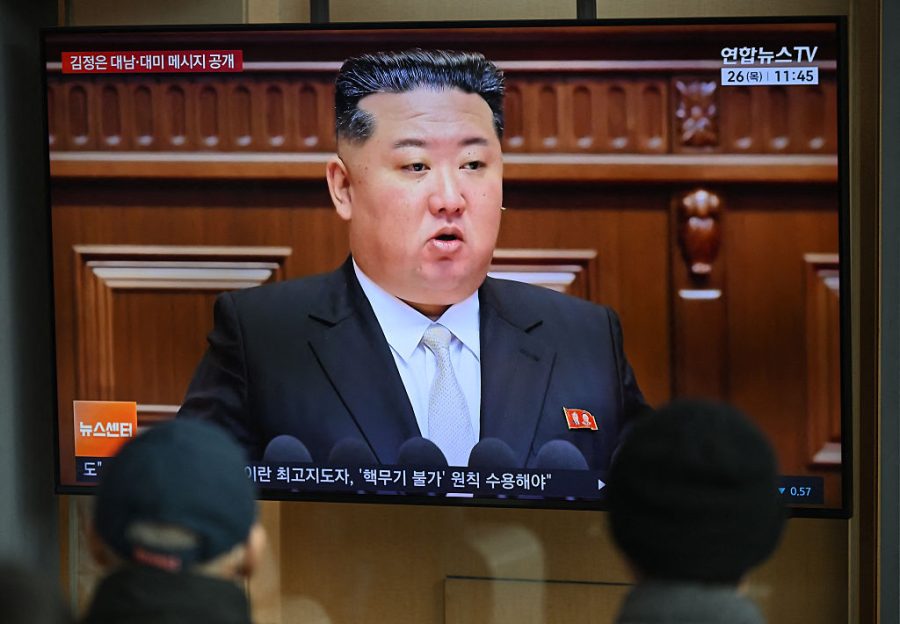
North Korea’s ninth party congress, held this week, was little more than a rubber-stamping exercise. That much was clear when the Chinese premier Xi Jinping congratulated Kim Jong-un on his re-election as the general secretary of the Workers’ party of Korea. But we would be wrong to dismiss this gathering as merely symbolic.
The last time North Korea held such a congress, in January 2021, Kim outlined a shopping list of desired weapons and missiles. Since then, North Korea has tested or obtained each item. All this week’s congress did was cement North Korea’s self-perceived status as a nuclear-armed state. Whilst Kim underscored how North Korea’s nuclear weapons will never be up for grabs, he did not rule out the prospect of talks with the United States – albeit with a caveat. The week-long event also saw Kim promote his sister, Kim Yo Jong, and praise the country’s economic development.
In contrast to his father, Kim has convened these five-year congresses with surprising regularity. These gatherings are deliberately opaque, with few concrete details revealed whilst they are ongoing. At the same time, however, the information that is disclosed offers crucial insight into the hermit kingdom’s domestic and foreign policy priorities, whether regarding its nuclear ambitions, economic plans, or the promotion (and demotion) of officials. Whilst this year’s event, which attracted over 5,000 party members, contained few surprises, it did emphasise the Kim regime’s main priorities for the next five years.
Kim’s decision to promote Kim Yo Jong must also not go unnoticed
State media glorified Kim as the ‘greatest man in the world’ and ‘great mother of all miracles for the people’. The latter ‘miracle’ was no unsubtle reference to North Korea’s self-proclaimed economic development since 2021, with respect to which, as Kim hailed in his opening statement, ‘everything ha[d] fundamentally changed’. Whilst five years ago, the North Korean economy was on crutches following a self-imposed lockdown a year earlier, Pyongyang has been able to benefit from its economic ties not just with China but, crucially, its new ally Russia. Kim didn’t mention Moscow in his speech, but that does not mean that Pyongyang’s ties with the Kremlin will weaken.
What is more, Kim’s closing remarks to end the congress made clear how North Korea’s nuclear development is only going to accelerate. Kim announced how Pyongyang’s ‘position as a nuclear weapons state has been consolidated to be irreversible and permanent’ in what is ‘of most important and strategic significance’. As if it were not already clear, the Kim regime views North Korea’s nuclear weapons as anything but negotiable. As expected, Kim declared his plan to ‘expand and strengthen’ the country’s nuclear capabilities, deeming doing so to be crucial for ‘regional stability’. Whilst his determination to have North Korea recognised as a nuclear-armed state is anything but declining, Kim also called upon his party to ‘study and develop core technologies’ in energy, space, and even artificial intelligence sectors.
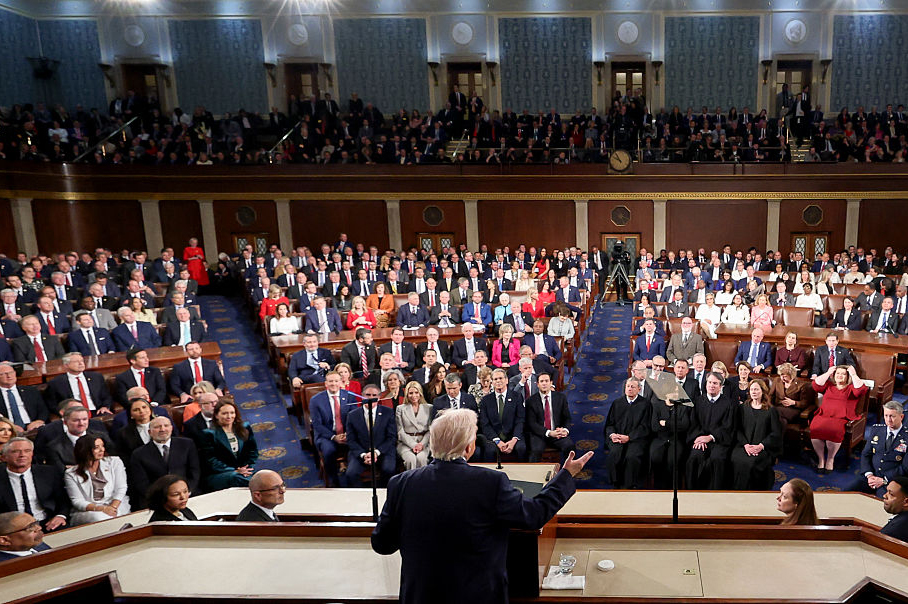
Kim offered no direct olive branches to the United States. The North Korean leader wasted no time in criticising the US’s decades-long ‘hostile policy’, which amounts to any criticism or actions against Pyongyang. Taking aim at the Trump administration and criticising its ‘America First’ policy, Kim said Pyongyang would ‘fully prepare [itself] for confrontation with the US in the future’ and ‘maintain the toughest stand’ in its approach towards Washington.
Kim did not shut the door to talks with his adversary completely, however, saying that the North could ‘get along’ with the US. But the proviso was clear: dialogue would only happen if the US accepted the North’s ‘permanent’ nuclear status, a move which Washington should not take. As for South Korea, however, even the prospect of getting along was ruled out. With ‘nothing to discuss’ with its ‘most hostile entity’, Kim said, the South would be excluded ‘from the category of compatriots forever’.
Kim’s decision to promote Kim Yo Jong must also not go unnoticed. Currently the deputy director of North Korea’s propaganda and agitation department (responsible for disseminating propaganda across the country) Yo Jong’s elevation – the specifics of which remain unknown – highlights how she looks to become an increasingly key member of her brother’s inner circle.
The congress ended with a military parade. Whilst no nuclear weapons were showcased, the stars of the show were, of course, Kim – but also his daughter, Kim Ju Ae, beaming together and clad in near-identical leather jackets.
In what was Ju Ae’s first appearance since the congress began, Kim Jong Un was sending a clear message that neither father nor daughter plans to go anywhere, anytime soon. She remains an important extension of her father’s rule and is likely to be seen more frequently in the future. For now, however, we must resist the temptation to rush to conclusions with respect to her alleged designation as her father’s successor. Recent speculation has suggested that she has been given a leadership position of a missile bureau. But the young Ju Ae is barely a teenager.
From Kim Jong Un’s perspective, his dynastic regime is here to stay; so too is North Korea’s ‘treasured sword’ of its nuclear arsenal. Any dialogue with President Trump will only be conducted on North Korea’s terms, such that Pyongyang ultimately emerges victorious. After all, North Korea is the master of knowing that bad behaviour can pay.

Comments