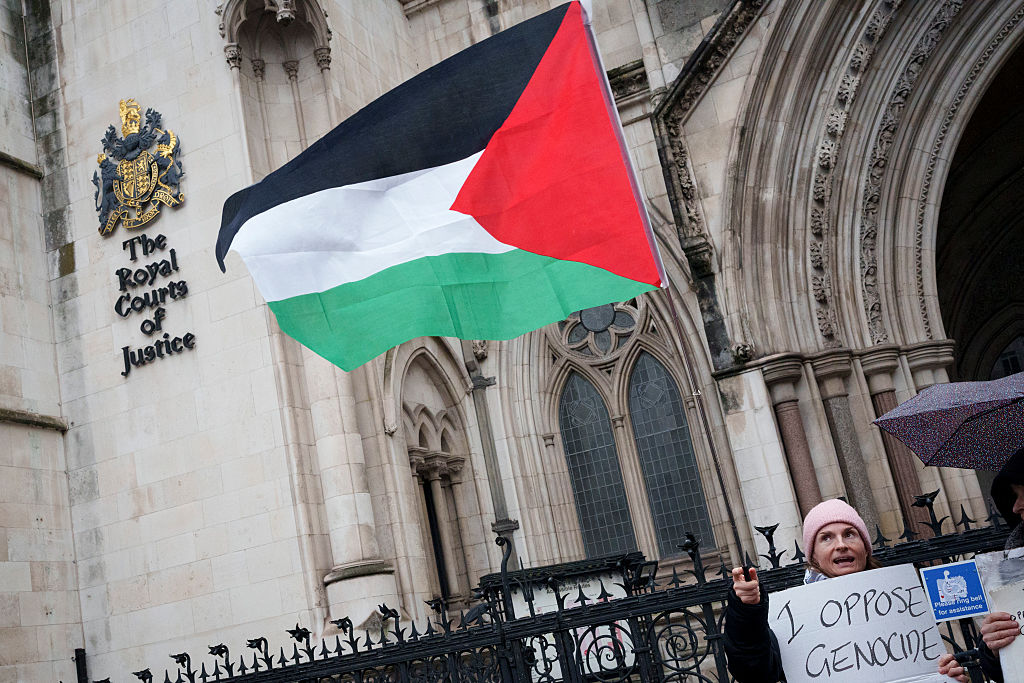
The Divisional Court has dramatically upheld a legal challenge to the decision of the then-Home Secretary, Yvette Cooper, to proscribe Palestine Action – despite recognising that it is ‘an organisation concerned with terrorism’ which the Home Secretary has statutory power to proscribe. The judgment is not an abuse of judicial power as such – it does not come out of nowhere – but does vividly highlight real problems with judicial review and human rights law. The government is right to appeal but should also propose further legislation to overhaul the proscription regime.
The decision to proscribe Palestine Action was made in June 2025, shortly after three Palestine Action activists broke into RAF Brize Norton and damaged two military planes. But the government had been considering proscription since late 2024, in view of a series of terrorist incidents. In July 2025, Parliament approved the draft order proscribing Palestine Action, which duly came into force, making it a serious criminal offence to belong to Palestine Action, to support it, or to invite support for it. Thousands of people have since been arrested.
The Terrorism Act 2000 empowers the Home Secretary to proscribe an organisation if she believes the organisation is concerned in terrorism. Palestine Action is clearly an organisation concerned in terrorism, as the Divisional Court’s judgment itself ruled. Not every terrorist group intends to commit mass murder and the 2000 Act defines terrorism to be the ‘use or threat of action’, involving either ‘serious violence against a person’ or ‘serious damage to property’, ‘designed to influence the government… or to intimidate the public or a section of the public… for the purpose of advancing a political, religious, racial or ideological cause’. Palestine Action met the statutory test.
But not every organisation concerned in terrorism is proscribed. The Home Secretary has a discretion as to whether to proscribe an organisation. The exercise of that discretion is vulnerable to challenge in the courts on a familiar range of public law grounds and by reference to the European Convention of Human Rights. Surprising though it may seem, the courts can quash the Home Secretary’s decision, despite her order having been affirmed by each House of Parliament.
In this case, Huda Ammori, one of the founders of Palestine Action, challenged the Home Secretary’s decision. Most of her grounds of challenge failed, but it only takes one ground to succeed for the lawfulness of the proscription to be undermined – and thus, in all likelihood, for all the related criminal proceedings also to fall away.
The Divisional Court found that Yvette Cooper had failed properly to apply her own policy for when an organisation would be proscribed. It found in addition that the proscription breached Convention rights of speech and assembly because it was disproportionate to proscribe Palestine Action in the circumstances.
Under the heading ‘What determines whether proscription is proportionate?’, the Home Secretary’s policy had said that in deciding whether to exercise her power she would take into account various factors, including (1) the nature and scale of the organisation’s activities, (2) the specific threat that it poses to the UK, (3) the specific threat that imposes to British Nationals overseas, (4) the extent of the organisation’s presence in the UK, and (5) the need to support other members of the International community in the global fight against terrorism.
In this case, the Home Secretary had also taken into account ‘the operational consequences and advantages of proscription’. The Divisional Court held that this was incompatible with the policy, because: ‘The purpose of this policy is to limit use of the discretionary power to proscribe’. Ironically, on this ground at least, the proscription would have been lawful if the Home Secretary had expressly departed from her policy – or had not adopted a policy at all.
Under the law of judicial review as it has developed, judges now routinely interpret government policy and find that ministers have acted unlawfully for failing properly to apply it. It is hard to see this as an attractive change in the law. It is far from clear that the Court correctly interpreted the policy or that this should be for it to decide. The Home Secretary did not wrong Palestine Action by taking into account the operational advantages of proscribing it. Indeed, this would seem an obviously relevant matter to consider in deciding to exercise the statutory power.
The proscription made it an offence to be a member of Palestine Action, to support it, or to express support for it and thus interfered with Convention rights of speech and assembly. The Court concluded that because the Home Secretary had not followed her own policy, the interference with Convention rights was not ‘according to law’ and thus breached the Human Rights Act 1998.
In addition, and more importantly, the Court held that the interference was ‘disproportionate.’ The Court noted that only a very small number of Palestine Action’s actions amounted to terrorism and that the criminal law was already available to prosecute those concerned. Having considered ‘the evidence available to the Home Secretary when the decision to proscribe was made’, the Court concluded that ‘the nature and scale of Palestine Action’s activities, so far as they comprise acts of terrorism, has not yet reached the level, scale and persistence that would justify the application of the criminal law measures that are the consequence of proscription’.
It seems remarkable to assert, in effect, that the Home Secretary had to wait until more acts of terrorism were committed before she could use her power to proscribe a terrorist organisation – especially when that organisation had just attacked an RAF base and seemed intent on escalating its campaign. Surely the right time to proscribe ‘an organisation concerned with terrorism’ is for the Home Secretary to decide, and for Parliament to question, not for a court to second guess. Still, this is a predictable consequence of the Human Rights Act, which makes it possible, as Policy Exchange has repeatedly shown, for courts to rule on the merits of government action in a very wide range of cases.
What does this mean for the police and for Palestine Action supporters? The Divisional Court says that, subject to further argument, it proposes to quash the Home Secretary’s decision; it has not quashed the proscription order itself, which remains in force. Anyone who joins, supports, or invites support for Palestine Action will still be committing a serious criminal offence. These offences may fall away, if the Court of Appeal (or Supreme Court) uphold this judgment and quash the order itself.
None of this excuses the Metropolitan Police’s extraordinary statement that it ‘will continue to identify offences where support for Palestine Action is being expressed… rather than making arrests at this time.’ The Met says, bizarrely, that: ‘This is the most proportionate approach we can take, acknowledging the decision reached by the court while recognising that proceedings are not yet fully concluded.’ It is not for the police to ignore the law as it stands or to decide that expressing support for Palestine Action is an offence that should now be policed with kid gloves.
If this judgment is not reversed, or corrected by legislation, Palestine Action will be back in business. And the whole regime for proscribing terrorist groups will be vulnerable to legal challenge – not on the grounds of whether the group is involved in terrorism, but rather on whether the Home Secretary has struck a fair balance between fighting terrorism and the Convention rights of the terrorist group and its supporters. The government should invite Parliament to legislate, disapplying the Human Rights Act in this context and limiting judicial review to the question of whether an organisation meets the statutory test for proscription.


Comments