The Peak is where the smart set in Hong Kong has always lived. It’s an area of relative peace and tranquillity that sits above the hubbub of the city. Before the Pacific war, Chinese people were banned from living there. It was from her terrace here on 8 December 1941 (the day after Japan’s carrier fleet attacked Pearl Harbor) that Emily ‘Mickey’ Hahn – an implausibly beautiful New York bohemian, opium addict, mining engineer and journalist – watched as Japanese bombers pelted Hong Kong 85 years ago. On the adjoining property she heard an Englishman harrumph, ‘That’s it. The Japanese have committed suicide.’ He was right, but not quite in the timeframe that he imagined.
The unexpectedly fierce defence of Hong Kong may partially explain the horrific crimes committed during the battle
Most of the British residents in Hong Kong would have agreed with a banker who was adamant that ‘there is no war sir, and there never will be. The Japanese have more sense than to attack a British colony.’ There was a complacent belief that Japanese troops would be no match for the British. A former expat, Maisie Prout remembered that ‘according to British propaganda, the Japanese were all bow-legged and squinty eyed and they all had very bad teeth.’ A misplaced sense of racial superiority pervaded Britain’s pre-war planning throughout Asia.
As late as January 1938, Winston Churchill declared that ‘it is quite certain that Japan cannot possibly compete with the productive energies of either branch of the English-speaking peoples.’ With few exceptions, western analysts failed to take note that by December 1941 the Japanese army was a battle-hardened force that had been fighting to conquer China for four years. The second Sino-Japanese war had started at the Marco Polo bridge outside Peking in 1937 after Japanese forces assumed that a missing Japanese soldier had been kidnapped or killed by the Chinese. (In fact, he had been caught short.) Arguably it was this incident that marks the start of the second world war, not the invasion of Poland that is assumed by western centric historians. Subsequently Japan’s armies, with 1.5 million troops, occupied northern China and most of its eastern seaboard. China’s nationalists retreated inland and founded its wartime capital at Chongqing – today the most populous city in the world.
When America imposed financial sanctions on Japan for its refusal to back out of China – ending oil shipments from California – Emperor Hirohito authorised the attack on Pearl Harbor. The de facto oil embargo also triggered Japan’s eastward march through Asia to find oil in Borneo and the Dutch East Indies.
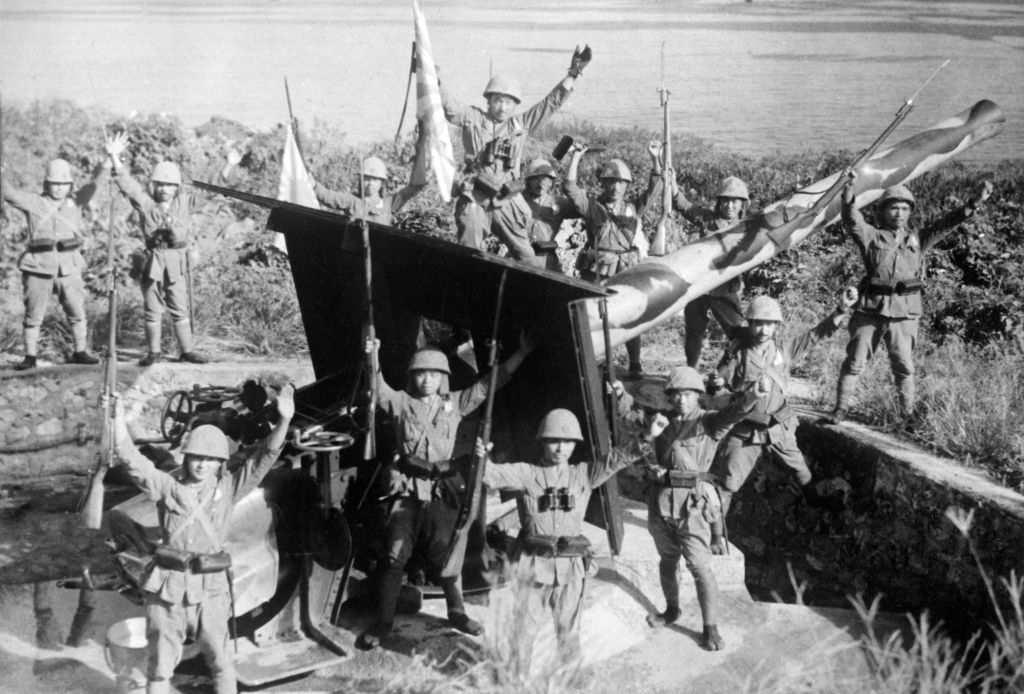
Some naively assumed that Hong Kong would be left untouched by Japan’s advance. They were wrong. As Emily Hahn watched the bombing of Hong Kong, General Takashi Sakai broke through Britain’s stretched defences (comically named the Gin Drinkers Line). In ten days Sakai swept through the New Territories, the mainland Chinese areas that attached to the British rule of Hong Kong Island. With Japan’s armies advancing from the North and facing Taiwan, then a Japanese colony, across the straits, Hong Kong was surrounded.
Neither could there be rescue from the sea. On 10 December, two days after the Japanese invasion, Britain suffered a humiliating naval catastrophe when its newest battleship, HMS Prince of Wales, and its companion, HMS Repulse, were sunk by Japanese torpedo planes off Malaya. They had left Singapore without air support; bizarrely the Royal Navy had failed to learn the lessons of its own aerial success at the Battle of Taranto just a month earlier, when 21 Fairey Swordfish torpedo planes launched from HMS Illustrious disabled three Italian battleships. It had been complacently assumed by Sir Thomas Philipps, the admiral of the HMS Prince of Wales, that his ships could not be sunk by Japanese airplanes in open waters. As Richard Smith, a 19-year-old rating on HMS Repulse remembered:
‘Everybody was told that the Japanese fleet was absolutely useless and that it was just a lot of rice paper and string. We would go up there and knock them about and cause havoc – it would be a walkover and we would enjoy ourselves.’
Yet even with naval support from Singapore, it was already recognised in London by Winston Churchill and the British chiefs of staff that Hong Kong was indefensible. As early as 1938 Hong Kong’s commanding officer gloomily noted that:
‘In the event of a wanton attack on Hong Kong, the garrison would have no option but to fight (but) the chances of effecting prolonged resistance even in the best of circumstances seem slight.’
A despatch sent to Hong Kong on 15 August made it clear that ‘Hong Kong is not a vital interest, and the garrison could not withstand a Japanese attack.’ The message, sent on the cargo-liner SS Automedon, was intercepted on 11 November en route from Liverpool to Hong Kong by a German attack cargo ship, Atlantis. The message’s contents were passed on to the Japanese government by the German ambassador in Tokyo.
Churchill had previously said of Hong Kong: ‘We must avoid frittering away our resources on untenable positions’, and had ordered its garrison to be reduced in January 1941. So why did he then do a volte face and decide to reinforce Hong Kong? It was as in chess, a Queen’s gambit – the sacrifice of a pawn to achieve a broader strategic objective. Britain and America needed to keep China in the war. Chiang Kai Shek’s continued resistance in China was keeping 1.5 million Japanese troops tied up. If Britain was seen to give up Hong Kong without a fight, Churchill feared that Chiang might come to an accommodation with Japan.
In the event, the British garrison in Hong Kong was not the only sacrificial pawn sent into battle. On 19 September the Dominion Office in London cabled Ottawa stating:
‘A small reinforcement of the garrison of Hong Kong…would be very fully justified… have a very great moral effect in the whole of the Far East and would reassure Chiang Kai Shek…’
With its arm twisted the Canadian government sent two battalions, consisting of 1,975 men, to reinforce the British garrison of 11,000 troops, about one third of whom were Indian. Curiously Britain made no attempt to set up a local Chinese militia to help them defend Hong Kong even though it was estimated that 75,000 or more would have volunteered.
The Japanese General Sakai’s campaign was short but violent. Having taken ten days to secure the New Territories, Sakai was shocked, indeed angry, that the British garrison on the island refused to surrender. The Daily Mirror summed up governor Mark Young’s reply to Sakai in its feisty headline ‘GO TO HELL’.
On 18 December, Sakai’s forces landed on Hong Kong Island. Churchill messaged, ‘We expect you to resist to the end. The honour of the Empire is in your hands’. Unlike in Singapore, the British and Canadian troops on Hong Kong fought and died heroically. This was epitomised by Sergeant Major John Osborn, of the Winnipeg Grenadiers, who won the Victoria Cross for saving ten comrades by diving on top of a Japanese grenade during an action on Mount Butler.
The unexpectedly fierce defence of Hong Kong may partially explain the horrific crimes committed during the battle. Murders and massacres were recorded at Jardine’s Lookout, Causeway Bay, Deepwater Bay, Repulse Bay, Maryknoll Mission, Quarry Bay, Eucliff, Wong Nai Chong, Salesian Mission, Happy Bay Racecourse, Brick Hill and Blue Pool Road.
The most horrific of these atrocities took place at St Stephen’s College, which had a Red Cross on the roof, on Christmas Day. When the elderly doctor, Captain Whitney, opened the door to the Japanese troops, telling them, ‘this is a hospital. You mustn’t come in. Leave us in peace,’ he was shot dead. Fifty-six wounded soldiers lying in the hallways were bayonetted. Three British and two Chinese nurses were gang raped, then murdered. In this massacre alone an estimated 150 were killed. Two ‘lucky’ men were spared but only after they had their ears and tongues cut off. They were told: ‘Go to Fort Stanley and tell your officers what you have seen’. At 3.30 p.m. on Christmas Day, later known as ‘Black Christmas’ governor Sir Mark Young appeared at the Peninsula Hotel, Japan’s headquarters and surrendered.
A reign of terror ensued. Hong Kong was looted. Summary executions by beheading became the norm for even minor infringements. It was estimated that over 10,000 Chinese women were raped over the next five years. The Hong Kong dollar was outlawed, and forcibly converted into Yen. By the end of the war rampant inflation destroyed all savings. Thousands of civilians did not survive food rationing, starving to death. By the end of the war, Hong Kong’s population had fallen from 1.6 million to 600,000. The reporter George Baxter concluded, ‘it was plain that humiliation was part of the Jap scheme to convince the natives that the white man had been conquered.’ The tragedy for the captured troops did not end in Hong Kong. Some 824 British and Canadian soldiers died when their transport ship bound for Japan, the Lisbon Maru, was torpedoed and sunk by the US submarine USS Grouper.
At the end of the war, Britain reoccupied Hong Kong and set about its restoration. But the relationship with the Chinese population had changed forever. As a British Foreign Office figure warned ‘we have lost a dreadful amount of face and prestige over the fall of Hong Kong.’ In the new post-war order, Hong Kong Chinese were given positions of authority and allowed to live on the Peak. Alexander Grantham, who became governor in 1947, noted a ‘decline in social snobbishness… I observed, too, a greater mixing of the races.’ The stage was set for Hong Kong’s remarkable resurgence as a model of capitalist endeavour. By contrast Britain, under the post-war socialist yoke, saw a relative economic decline that was only temporarily halted during the Thatcher era.
As for General Sakai, after the depredations of his military conquest of Hong Kong, he was rewarded with the governorship of the city until 1942 and was soon after retired from service. This did not save him. After the war he was arrested and sent to face trial at the war crimes tribunal in Nanjing. There he was found guilty and executed by firing squad.
The story of Hong Kong’s heroic defence may have been an irrelevant episode in the strategic determination of the war, but it was meaningful to the thousands of soldiers and civilians who lost their lives. Ultimately it was a battle whose only justification was the preservation of British face when it came to Chiang Kai Shek and his nationalist armies. Yet it was a sacrificial gambit that worked.




Comments