
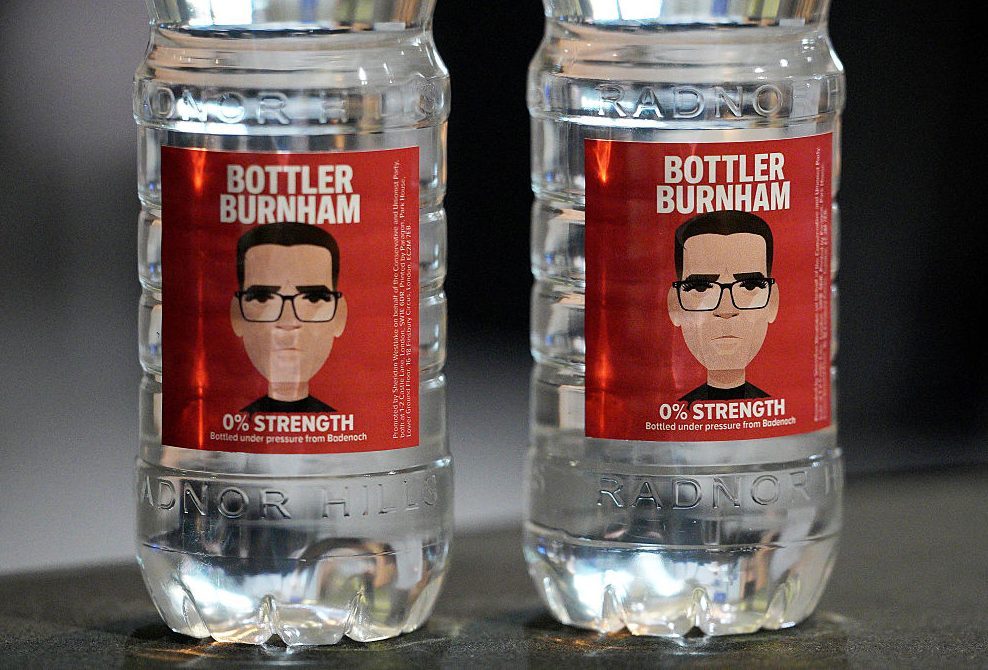
The point of politics is to crush your enemies, see them driven before you, and to hear the lamentations of their women. But most people in SW1 don’t listen to Conan the Barbarian, and think it is something awful like ‘making the world a better place’ or ‘giving something back’. This is why most people in politics are non-entities, a tragic mishmash of psychopaths, underachievers, drunks, ideologues, grifters, autists and Liberal Democrats. Quite often, alas, one of these non-entities ends up as prime minister. So it is with Andy Burnham.
Now his fate might be to be Bottler Burnham, the heir to Brown; just as unappealing, but far less substantial
Compared to that litany of defects, arrr Andeh gets off quite lightly. He’s a seemingly affable family man who likes pints, sport and the Smiths. He is easier to listen to than Keir Starmer, and enough of a professional politician to know that being liked by the people who you might vote for is quite useful. Beyond that, there’s not a lot, just the usual dross about Thatcher, PR, Europe, bus fares, inequality and ankle-flashing on Gaza.
So far, this has been enough for Burnham to win back voters lost to the Greens, attract a few Nige-curious voters over from the Reform dumpster fire and leave establishment liberals with even less of a reason to think that there is any point to Ed Davey. He now has quite a healthy poll lead. Plug recent ones into Electoral Calculus, and you get Labour winning a small – but far from insubstantial – majority. Hence talk about an early election to win Burnham his own mandate and liberate him from Starmer’s manifesto and some of his madder backbenchers.
The recent Budget seemed to be a pre-election exercise: a chance to punt everything difficult into the long grass. And its little giveaways seem to have landed well with the intended audience. So why hasn’t Burnham called an election? What is he waiting for? His ‘ten-year plan’ to spring from ChatGPT? The weather to change? Strictly to finish?
One assumes it is a combination of three things: an attempt to hold out until next year to see if his lead is sustainable, to have more time to work out what he actually wants to do, and to enjoy the trappings of office for a little longer before risking it all. Given this, an election next May seems sensible. But to return to the point of political action, you can’t help think that Burnham is missing his opportunity to capitalise on his current popularity, crush his enemies and get a couple more years in office.
The longer that Burnham is in office, the greater the likelihood there is of him becoming unpopular. All those difficult decisions on tax and spending that John Healey ducked at the Budget cannot be deferred forever. At some point, our premier will have to decide whether defending the realm actually matters to him, or he’d prefer to keep chucking money at PIP claimants, union shirkers and unwanted migration. As we plunge into our traditional NHS winter crisis, with the added bonus of rolling blackouts, the sheen might come off. If Burnham had called an election after his conference speech, he could have banked his momentum. Now his fate might be to be Bottler Burnham, the heir to Brown; just as unappealing, but far less substantial.
Not being Starmer can only get you so far. All that grand rhetoric about ‘good growth in every post code’ and using our ‘change moment’ to turn around ‘a path for 40 years that simply hasn’t worked’ will have to be matched with something more than capping bus fares. Since Brexit, voters have continually opted for the change option. Rather than reflect on what lies behind that, Burnham’s approach is to try and wish that last decade away, to crawl back into the comforting embrace of Brussels, to take Britain back to when, erm, David Cameron was in power.
Attention spans are short. By the time we get to next May, Burnham may well have become old hat, just as Starmer, Nigel Farage and Zack Polanski have managed in short order. What comes next isn’t entirely clear. Now the Tories have settled into being a party of well-off southerners and Reform have retreated to their core vote, neither has much pushing them to challenge Labour as a national force.
Perhaps the same thing will happen to Burnham as Starmer, just a little more slowly: Labour’s lead will erode as frustrated voters head back to their preferred party; football fans will start singing ‘Burnham is a wanker’; our national inadequacy will continue. Burnham will bed in for a 2029 election, his best opportunity missed. His backbenchers will become increasingly agitated, finding exciting new ways to fall out with each other. Labour might bite the bullet and get another new leader. It worked so well last time. ‘No hope, no harm/Just another false alarm…’
Our politicians are mostly clowns with no grasp of the vast challenges coming down the track: the unsustainability of social democracy, the breakdown in national solidarity downstream of our changing demography, the existential threat of AI. SW1 is a show that has long since become unwatchable. But the performance continues. Perhaps Burnham simply wants to sit and enjoy the show, before it is cancelled for good.



Comments