In 1921, a law student in Lviv asked his professor a question. An Armenian survivor, Soghomon Tehlirian, had just shot Talaat Pasha dead in a Berlin street. Why, the student asked, had Talaat never been tried for the killing of Armenians? The distinguished professor Juliusz Makarewicz gave the answer of his time: a state is sovereign, and what it does to its own people is its own business. The student was Raphael Lemkin. He escaped the Holocaust, which killed most of his family, and two decades after that question, in America, coined the word “genocide”. He spent the rest of his life proving his professor’s answer wrong.
The legal definition of genocide is deliberately dry and narrow. Yet genocide is the most emotionally charged word in international and domestic politics
Lemkin’s idea of genocide was too radical for the governments that had to turn it into law. His 1944 definition reached far beyond killing, to the destruction of a group’s political and social institutions, its culture, language, religion and economic life.
When states negotiated the Genocide Convention in 1947 and 1948, many of them read the draft against their own records and cut what they found dangerous. The Soviet Union was the main force behind removing political groups from protection, with help from Brazil, Iran, South Africa and others.
Other governments did their own editing. The draft article on cultural genocide, which covered the destruction of a group’s language, religion or culture, was deleted. The United States, Canada, Britain, France, Australia and others opposed the article, and historians connect those positions to how these states treated their indigenous peoples. In Washington, senators also worried that the treaty could be turned against segregation and lynching at home.
Leaving out political and social groups, and cultural genocide, significantly narrowed the definition of genocide. This showed one of the inborn traits of international law: it defines a crime by what states are willing to recognise as one, not by what the crime is. Justice is therefore incomplete, and impunity keeps room to survive.
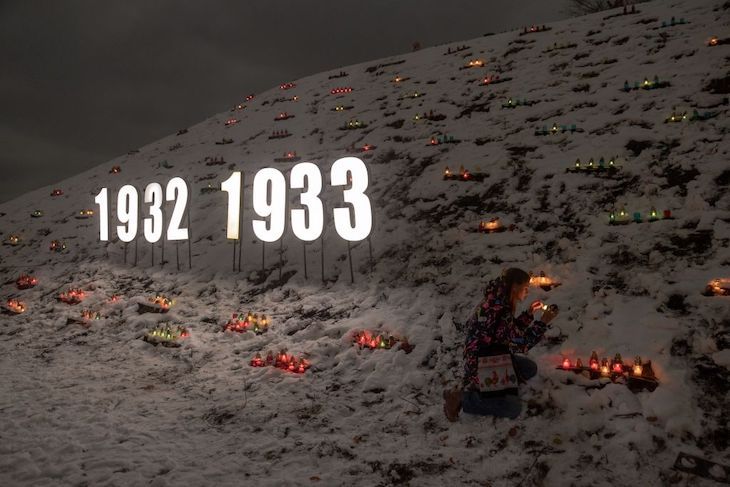
On 20 September 1953, five years after the Convention had been adopted and thousands of kilometres away from Ukrainian Lviv, Lemkin spoke at Manhattan Center in New York and called the destruction of the Ukrainian nation during Stalin’s Holodomor of 1932 and 1933 “the classic example of Soviet genocide.”
He estimated that five million Ukrainians starved to death. The standard argument against calling the Holodomor genocide leaned on the narrowed Convention rather than on the vision of the man who coined the term: Stalin, it was said, had targeted “kurkuls” (known internationally as ”kulaks” from the Russian term), the regime’s label for better-off peasants, because they opposed Soviet rule, not because they were Ukrainians. Lemkin’s own answer was that the target was the Ukrainian nation, a group the Convention does protect.
The Holodomor was taboo in Soviet times, and Moscow denied the famine itself for decades. It always understood exactly what the word meant, and it is no surprise that in 2015, Russia put Lemkin’s writings on Soviet genocide in Ukraine on its federal list of extremist materials.
For decades after its adoption, the Convention worked more as a monument to the Holocaust than as a tool for the future. The first international conviction for genocide came in September 1998, when the Rwanda tribunal convicted Jean-Paul Akayesu, half a century after the Convention was adopted.
Today the opposite danger has arrived. The word that states once fenced in so tightly is stretched to cover almost anything, and the authors of this new Policy Exchange paper are right that a word used for every atrocity ends up convicting no one. It is also abused to justify one’s actions.
This semantic tension between the word’s legal meaning and its moral weight pulls it constantly towards devaluation
Ukraine met this danger head on. In February 2022, Vladimir Putin justified a full-scale invasion by claiming that Ukraine was committing genocide in the parts of Donbas occupied by Russia.
This was lawfare in its purest form: a legal term turned into a vulgar pretext for war.
In those first days after the full-scale invasion my work as foreign minister was mostly about weapons for Ukraine and sanctions against Russia. They decided whether we would survive on the battlefield, and with that, how strong our hand would be at any negotiating table. Even so, the genocide question was never secondary for me, an international lawyer by training, and I found time to work with colleagues on our application to the International Court of Justice.
The hardest part was resisting temptation. The strain of the war and the mood in Ukrainian society pushed us to answer Russia’s accusation with one just as loose. We at the foreign ministry resisted it. We did not ask the Court to find Russia guilty of genocide. We asked it to declare that Ukraine had committed none, and that Russia had no right to use the Convention as apretext for war. A lower bar would have helped Moscow more than us, because it would have put our case on the same shelf as Russia’s invented one.
We filed the application on 26 February. The case mattered for a practical reason. Our whole experience with Russia has shown how much Moscow fears the long-term legal consequences of its actions. Three weeks later the Court ordered Russia to suspend its military operations. Moscow ignored the order, but it spent years contesting the case in The Hague.
Outside the courtroom, Ukrainians, myself included, did use the word about Russia’s war against us. Most of the time it was political rhetoric. Legally, though, I believe the evidence of intent, usually the hardest part to prove, is there: Putin’s 2021 claim that Ukrainians are not a separate people, and the forced transfer of Ukrainian children to Russia, an act the Convention names explicitly.
The legal definition of genocide is deliberately dry and narrow. Yet genocide is the most emotionally charged word in international and domestic politics. Perhaps this is because the word keeps trying to break out of the frame imposed on it and return to its original meaning.
This semantic tension between the word’s legal meaning and its moral weight pulls it constantly towards devaluation. The only defence is discipline: if we want the charge taken seriously, we have to meet the test this immensely significant paper from Policy Exchange defends, even though it is narrower than the one Lemkin wanted. Incomplete justice is still better than a word that blames everyone and convicts no one.
Dmytro Kuleba, Foreign Minister of Ukraine 2020-2024, is a Foreword author for Policy Exchange’s new paper ‘Genocide: The Use and Abuse of Term’




Comments