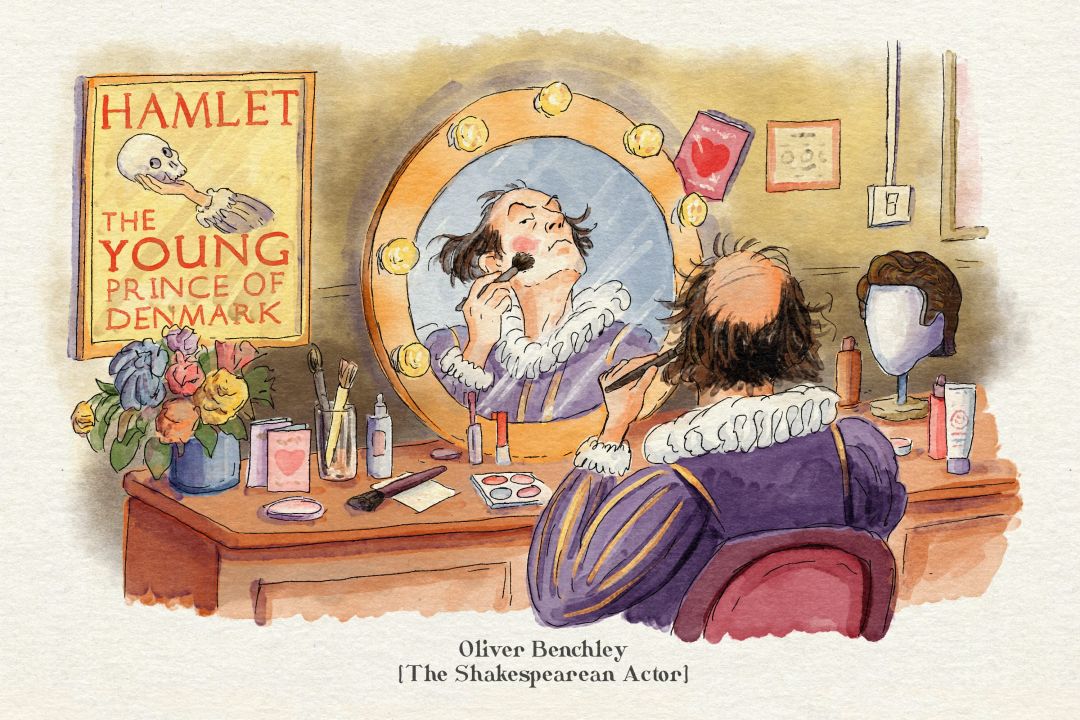
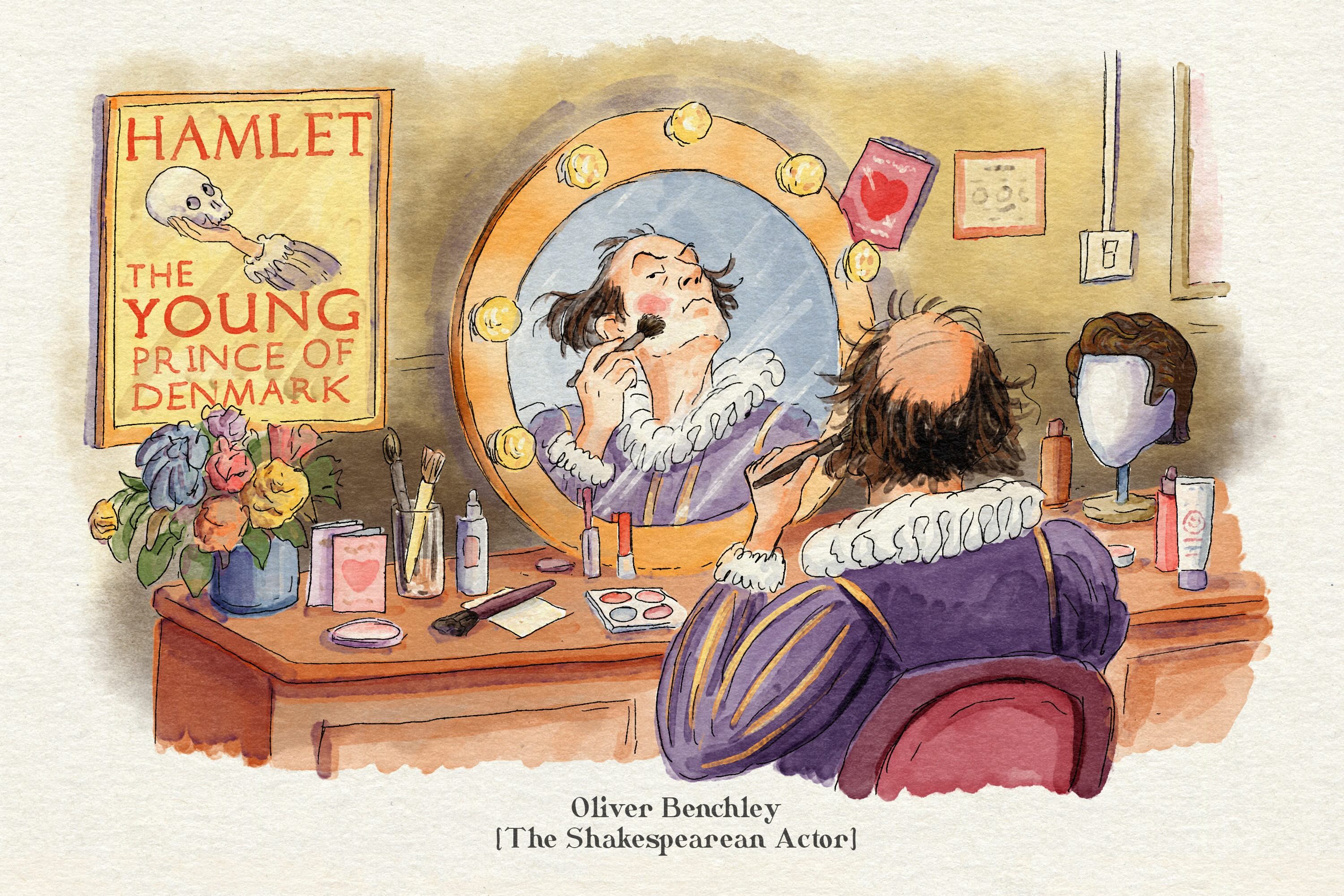

Oliver Benchley plays the Dane regularly at The Globe. He should be overjoyed — it’s been his dream to front Hamlet since he was but a stripling, after all. Alas, he plays mostly to group tours of baffled Japanese tourists, or class outings filled with glassy-eyed teens who’d rather be vaping and throwing stones at the swans in the Avon. ‘Pearls before swine dearie, pearls before swine’, he tells his chiropodist at his weekly fungal heel-scrub.
The fungus came after a recent run as Caesar, wearing Roman sandals he knows for a fact the prop master has never washed. He has lost sleep the last few nights, penning a stinging letter to the production team that somehow keeps morphing into a sonnet. It is his curse, Oliver knows, to turn even a message rife with more than one veiled death threat into haunting poetry.
He knew, as his unpublished memoir The Man for All Seasons notes, from a young age that ‘the Bard and I were meant to be lifelong kin’. One Halloween, aged seven, he shaved most of his hair and stole the dog’s vet cone to attend a party that, it turns out, wasn’t even dress-up themed. In the months it took his hair to grow back, adults spoke sombrely to him and called him ‘a ruddy trooper’, under the mistaken impression that he was a leukaemia survivor.
In response to this grown-up sympathy, he took his chance to quote Twelfth Night: ‘Fear not, Cesario, take thy fortunes up. Be that thou know’st thou art and then thou art as great as that thou fear’st.’ Far from being impressed by his delivery, most people would reply ‘Oh dear, and the poor lamb’s got a terrible lisp as well.’ One aunt followed his Cesario speech up by pressing a five pound note into his hand — his first performance fee. From that moment on, Oliver was hooked, and knew the stage lay in his future. (‘Not a bad rate overall either,’ he would later reminisce on the payment of five quid. ‘21 pence a word. Would that The Old Vic paid half as well…’)
After decades treading the boards, Oliver prides himself on his professionalism. No diva he, the old pro is happy to muck in and share dressing rooms, provided no-one looks him in the eye or uses any post-Elizabethan slang on performance night. Rumours that he once made a 17-year-old stage runner cry for handing him a Darjeeling tea instead of Genmaicha are ludicrous, he says (in actual fact, she was 19).
As he told an interviewer recently, his big break also came at 19 when, in a freak accident, both the actor playing Mercutio and the actor’s understudy fell gravely ill after drinking some Genmaicha laced with bleach. Oliver, who had managed to convince the director weeks before that he be made ‘an understudy to the understudy’, duly stepped up, abandoning his maintenance duties for the theatre. The young actor’s performance was praised by press as faultlessly authentic — as a review in The Inverness Courier noted, ‘young Oliver Benchley plays the part of a strutting blowhard with gusto.’)
Despite his stellar team spirit — he helpfully lets all female costars know when they’ve gained a few pounds (‘We have to be careful darling, there’s not that many load-bearing pillars beneath the stage you know’) — there are rumours he may be axed from The Globe come the end of this run. To branch out, he has started making good use of his stentorian delivery. Years of classical stage training at RADA (the Rotherham Association for Dramatic Antics) have gifted him with a diaphragm that could blow down an elephant. So far, however, the gigs are slightly less stellar than hoped. He’s MCed a village fete (for which the bonus fee was his pick of the prize-winning cabbages), cut the ribbon at the opening of a lovely new Asda in Kettering, and is in talks to be the voice of Rex Tex-Mex, A Fiesta for Every Dog™.
Retirement is a long way off. Oliver’s dream is to die onstage — literally, and not just once but twice. In a perfect world he’ll suffer chest pains during the climax of Hamlet, soldier valiantly on even as the crowd howls in despair, then be carried out to general mayhem and gnashing of teeth. After a six-month convalescence, during which he’s knighted by King Charles, he will return to the stage and suffer a brain haemorrhage from the sheer volume of the standing ovation. ‘It’s a tad baroque,’ he admits, and perhaps not quite a realistic end, ‘but after all I’ve given the world of theatre, not too much to ask.’


Comments